


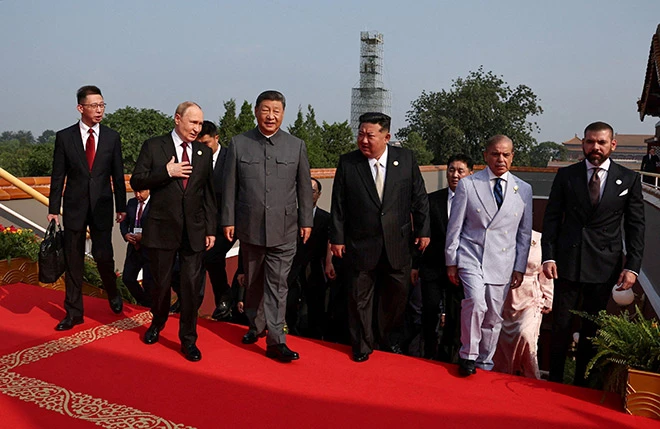
- Putin warned Ukraine the war can end either through negotiations “if common sense prevails” or by force of arms.
- Backed by China and North Korea, Russia is projecting growing strength despite Western sanctions.
- Kyiv rejected Moscow as a venue for talks, while Zelenskiy urged Washington to tighten sanctions on Russia.
- Trump has shown willingness to mediate but faces challenges balancing U.S. interests with NATO’s stance.
Russian President Vladimir Putin has issued his starkest warning yet to Kyiv, declaring that the war in Ukraine can be ended through negotiations “if common sense prevails” but insisting that Russia is fully prepared to achieve its objectives by force if necessary. Speaking in Beijing at the conclusion of a state visit, Putin suggested there was still a narrow window for diplomacy but underlined that Moscow’s patience has limits.
“It seems to me that if common sense prevails, it will be possible to agree on an acceptable solution to end this conflict. That is my assumption,” Putin told reporters. “Especially since we can see the mood of the current U.S. administration under President Donald Trump, and we see not just their statements, but their sincere desire to find this solution… And I think there is a certain light at the end of the tunnel. Let’s see how the situation develops. If not, then we will have to resolve all the tasks before us by force of arms.”
Stronger With Allies
The Russian leader’s remarks came on the heels of an agreement to expand gas supplies to China, strengthening Moscow’s economic resilience as Western sanctions continue to bite. The deal underscored Russia’s growing strategic alignment with Beijing and Pyongyang, both of which have signaled open political support for Moscow in its confrontation with NATO.
Putin’s diplomatic choreography in Beijing was deliberate. By standing alongside Chinese officials and boasting of new economic lifelines, he sent a message not just to Kyiv but to Washington and Brussels: Russia is not isolated and will not be pressured into concessions. North Korea, meanwhile, has increasingly offered Russia both rhetorical and material support, further emboldening Putin’s war posture.
Sources close to the Kremlin told reporters that Putin’s confidence has only grown in recent months, as Western unity shows signs of strain and European economies struggle under energy pressures. “The president is determined to end this war either way — through dialogue if Ukraine shows flexibility, or by decisive military means if not,” one Moscow insider said.
Kyiv and Moscow Still Far Apart
Despite Putin’s remarks about diplomacy, fundamental disagreements remain. The Kremlin insists that Ukraine must abandon its NATO ambitions, recognize Russia’s annexation of four Ukrainian regions, and end what Moscow calls discrimination against Russian speakers. Kyiv and its Western allies reject these demands outright, calling them illegitimate and tantamount to surrender.
Ukrainian President Volodymyr Zelenskiy has repeatedly called for direct talks with Putin, but under very different terms. He has suggested Washington and European powers act as guarantors for any potential settlement, and he continues to push for additional sanctions against Moscow. “Any talks that start in Moscow are unacceptable,” Ukraine’s foreign minister said on Wednesday, dismissing Putin’s offer for Zelenskiy to come to the Russian capital for negotiations.
Trump, who has attempted to play mediator, has said he favors a direct meeting between Putin and Zelenskiy but has yet to achieve progress. He has also warned of additional “secondary sanctions” against Russia if Moscow fails to take steps toward peace.
Putin’s Balancing Act
Although Putin emphasized that he prefers a peaceful resolution, his rhetoric carried unmistakable menace. “We will have to resolve all the tasks before us by force of arms,” he warned, making clear that Russia’s military campaign would escalate if Kyiv refuses concessions.
Analysts say Putin’s message is designed to pressure Ukraine into talks while projecting strength to his domestic audience. After nearly three years of war, Russia’s economy has adapted to sanctions more effectively than many expected, though strains are evident. By securing new trade deals with China and military cooperation with North Korea, Putin is attempting to show that Russia has alternatives to the West.
“Putin is trying to convince both Ukrainians and his own people that time is on Russia’s side,” said a European diplomat. “He is signaling that either Kyiv negotiates on his terms or Moscow will grind it down militarily.”
Western Dilemmas
For Europe and NATO, Putin’s remarks are both a challenge and a warning. European leaders have pledged to stand by Ukraine but face mounting political and economic pressures at home. Energy costs remain volatile, public support for the war effort is uneven, and divisions within the European Union are becoming harder to paper over.
The United States under Trump has adopted a more transactional approach, pushing for a settlement that would reduce Washington’s financial commitments while avoiding escalation. While some see this as an opportunity for diplomacy, others worry it could lead to pressure on Kyiv to make painful compromises.
The Road Ahead
As the war grinds on, both sides appear locked in a dangerous stalemate. Ukraine, heavily reliant on Western support, continues to resist Russian advances but lacks the capacity to force Moscow into retreat. Russia, despite battlefield setbacks and economic sanctions, remains determined to hold onto occupied territories and project the image of a resurgent power aligned with Asia rather than Europe.
Putin’s latest comments make clear that he sees the coming months as decisive. By dangling the possibility of peace while threatening overwhelming force, he is betting that pressure on Kyiv and its Western backers will produce concessions. Whether Ukraine and NATO will bend under that pressure remains uncertain.
For now, the message from Moscow is unambiguous: the war will end on Russia’s terms — through negotiations if possible, through escalation if necessary.