


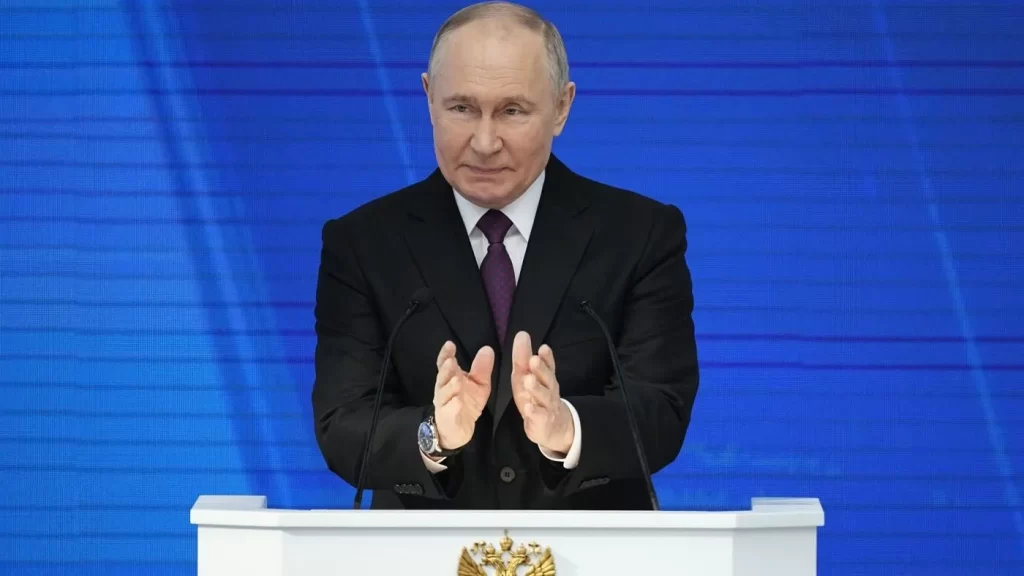
- Putin’s landslide victory in the recent Russian election, with over 87% of the vote, underscores his enduring influence and the complex dynamics shaping Russian politics.
- While Putin’s promises of sovereignty and security resonate with many Russians, concerns persist about the erosion of democratic norms and the consolidation of power in the hands of a single individual.
- Tensions with Ukraine and NATO, coupled with Putin’s emphasis on diplomacy and negotiation, highlight the challenges and risks inherent in the current geopolitical landscape.
- Russian President Vladimir Putin celebrated a landslide victory, securing a new six-year term after an election with record turnout.
Russian President Vladimir Putin’s victory in the recent election marked not just a political triumph but also underscored a deeply ingrained sentiment of patriotism and unity among the Russian populace. With a resounding mandate, Putin secured over 87% of the vote, a testament to his enduring popularity and the confidence the people have in his leadership.
“I dreamed of a strong, independent, sovereign Russia,” Putin told the audience, hoping that the election results would pave the way for achieving these goals together with the Russian people.
Russian President Vladimir Putin’s recent landslide victory in the Russian election has captured the attention of the world. With an overwhelming 87% of the vote, Putin’s win is not just a political victory but a statement of his enduring influence and the complex dynamics shaping Russian politics. However, behind the facade of a resounding mandate lies a deeper narrative of power, control, and the future trajectory of Russia under Putin’s rule.
Absence of Putin and Xi Sets New Diplomatic Stage at G20: Modi and Biden Seize the Moment
Putin’s victory speech following the election was characteristic of his leadership style – confident, assertive, and steeped in nationalist rhetoric. He spoke of a vision for a strong and independent Russia, resonating with sentiments deeply ingrained within the Russian psyche. His promises of sovereignty and security struck a chord with many Russians who yearn for stability and prosperity in an increasingly uncertain world.
Yet, amidst the celebrations, there are concerns both within Russia and on the global stage. Putin’s grip on power has led to accusations of authoritarianism and a lack of political pluralism. Critics argue that the electoral process in Russia is heavily manipulated, with opposition voices stifled and dissent suppressed. While Putin’s popularity remains high, questions linger about the legitimacy of his rule and the extent to which the Russian people are truly free to choose their leaders.
The recent incursions by Ukrainian sabotage groups into Russian territory have further heightened tensions in the region. Putin’s response to repel these intrusions underscores Russia’s determination to safeguard its sovereignty and protect its citizens. However, it also raises concerns about the potential for escalation and conflict, particularly given the strained relations between Russia and the West.
Putin’s warnings against a direct confrontation with NATO are a sobering reminder of the risks inherent in the current geopolitical landscape. The specter of a full-scale conflict looms large, casting a shadow of uncertainty over the region. Putin’s emphasis on diplomacy and negotiation reflects a recognition of the need for dialogue in resolving conflicts and fostering mutual understanding. However, it also underscores the challenges of finding common ground in an increasingly polarized world.
As Russia embarks on a new chapter under Putin’s leadership, the road ahead is fraught with obstacles. Economic reforms, geopolitical tensions, and domestic concerns will require careful navigation and strategic foresight. Yet, amidst these challenges, Putin’s overwhelming victory sends a clear message of confidence and unity, both within Russia and on the global stage.
However, it is essential to recognize that Putin’s victory is not without its critics. Many within Russia and abroad have raised concerns about the erosion of democratic norms and the consolidation of power in the hands of a single individual. The lack of political opposition and the suppression of dissent undermine the legitimacy of Putin’s rule and raise questions about the future trajectory of Russian democracy.
Moreover, Putin’s assertive foreign policy and confrontational stance towards the West have exacerbated tensions and raised fears of a new Cold War. The annexation of Crimea, the intervention in Syria, and allegations of election interference have strained Russia’s relations with the United States and its allies. Putin’s efforts to assert Russian influence on the world stage have met with mixed success, with some applauding his efforts to restore Russia’s status as a global power and others condemning his disregard for international norms and institutions.
In conclusion, Putin’s landslide victory in the Russian election is a reflection of his enduring influence and the complex dynamics shaping Russian politics. While his promises of sovereignty and security resonate with many Russians, concerns linger about the erosion of democratic norms and the consolidation of power in the hands of a single individual. As Russia navigates the challenges of the 21st century, the world watches with a mix of fascination and apprehension, uncertain of what the future holds under Putin’s rule.