


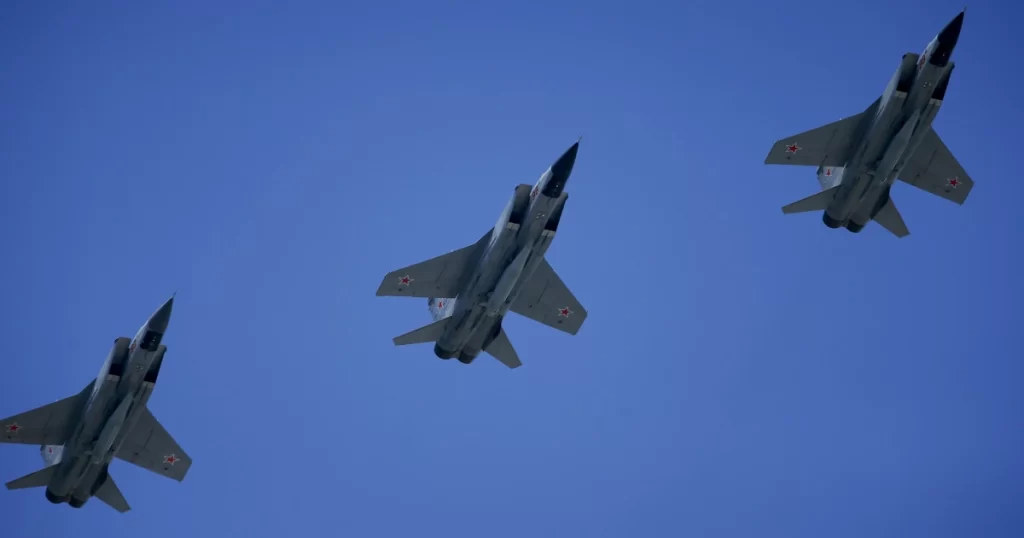
- Estonia says three Russian MiG-31 jets violated its airspace for 12 minutes.
- NATO scrambled Italian F-35s to intercept the Russian aircraft.
- Tallinn may seek Article 4 consultations, signaling growing alarm.
- Incident follows Russian drone incursions into Polish airspace last week.
- Analysts warn Moscow is deliberately testing NATO’s resolve and cohesion.
When three Russian MiG-31 fighter jets pierced Estonia’s skies on Friday, they did more than simply trespass into NATO territory for twelve long minutes. They sent a message—a deliberate one—that Moscow remains willing to test the patience, resolve, and readiness of the Western alliance on its eastern flank.
For Tallinn, a NATO frontline state barely 100 kilometers from St. Petersburg, the violation was not just another incident. Estonia’s Foreign Minister Margus Tsahkna called it “unprecedentedly brazen,” noting that Russia had already violated Estonian airspace four times this year. But never before had three military jets flown five nautical miles deep into Estonian skies with their transponders off, flight plans missing, and radio silence maintained.
The timing is as telling as the act itself. Just days earlier, Russia and Belarus wrapped up their Zapad 2025 military exercises—war games long viewed with suspicion in NATO capitals. Only a week before that, more than 20 Russian drones breached Polish airspace, forcing NATO jets to scramble. The pattern is clear: Russia is probing NATO’s defenses, calculating the alliance’s tolerance, and reminding its adversaries that the Kremlin still commands the initiative in Europe’s tense security chessboard.
A Dangerous Game of Signals
For Moscow, these intrusions are not random accidents. A senior U.S. official, speaking anonymously, dismissed the notion of a navigational mishap. “It’s tough to see how this wasn’t intentional,” the official said. Indeed, keeping three high-speed jets loitering in NATO airspace for 12 minutes strains the limits of any plausible excuse.
Estonia responded with diplomacy, summoning Russia’s top envoy and issuing a formal note of protest. Yet Tallinn also hinted at something more consequential: triggering NATO’s Article 4 consultations. This rarely used mechanism obliges the alliance to discuss collective security whenever a member feels threatened. If Estonia formally invokes it, the stage could be set for an escalatory cycle of military deployments and counter-deployments in the Baltics.
NATO, meanwhile, was quick to show teeth. Italian F-35s intercepted the Russian jets and escorted them out, while the alliance’s spokesperson blasted Moscow’s “reckless behavior.” The message was clear: NATO will not leave its small eastern members exposed. But whether such interceptions are deterrent enough remains an open question.
Testing the West’s Resolve
Analysts see the incursion as part of a broader Russian strategy to destabilize NATO unity. Jakub M. Godzimirski of the Norwegian Institute of International Affairs noted that while the incident could be coincidental, the context of repeated drone and jet violations makes coincidence unlikely. Each act forces NATO into a dilemma: respond too aggressively, and risk confrontation; respond too passively, and embolden Russia further.
It is no secret that Moscow thrives on ambiguity. By pushing boundaries without triggering outright war, it tests how far it can go without provoking Article 5—the alliance’s sacred clause on collective defense. In doing so, Russia aims to exploit divisions within NATO, particularly as the United States faces election-year distractions and Europe grapples with economic strain.
Echoes of the Cold War
The incident has drawn inevitable comparisons with Cold War-era cat-and-mouse games between Soviet and NATO jets over the Baltic and North Seas. Yet today’s stakes are arguably higher. Unlike then, Europe is already engulfed in the fallout of Russia’s war in Ukraine. Every provocation carries the risk of spillover, whether by design or by accident.
Estonia, one of Ukraine’s staunchest supporters, knows this well. In May, it accused Moscow of using a fighter jet to shield a Russian oil tanker suspected of defying sanctions. Friday’s violation, seen through this lens, underscores not just military brinkmanship but also the broader contest over sanctions, supply chains, and geopolitical narratives.
Conclusion: A Precarious Moment
Russia’s foray into Estonian skies will not be the last. For Moscow, such provocations are low-cost, high-impact tools to rattle NATO’s nerves. For NATO, they are sobering reminders that vigilance on the eastern flank cannot falter.
What remains uncertain is how long this dangerous dance can continue before a miscalculation turns a “brazen” violation into a flashpoint with consequences far graver than a 12-minute intrusion.