


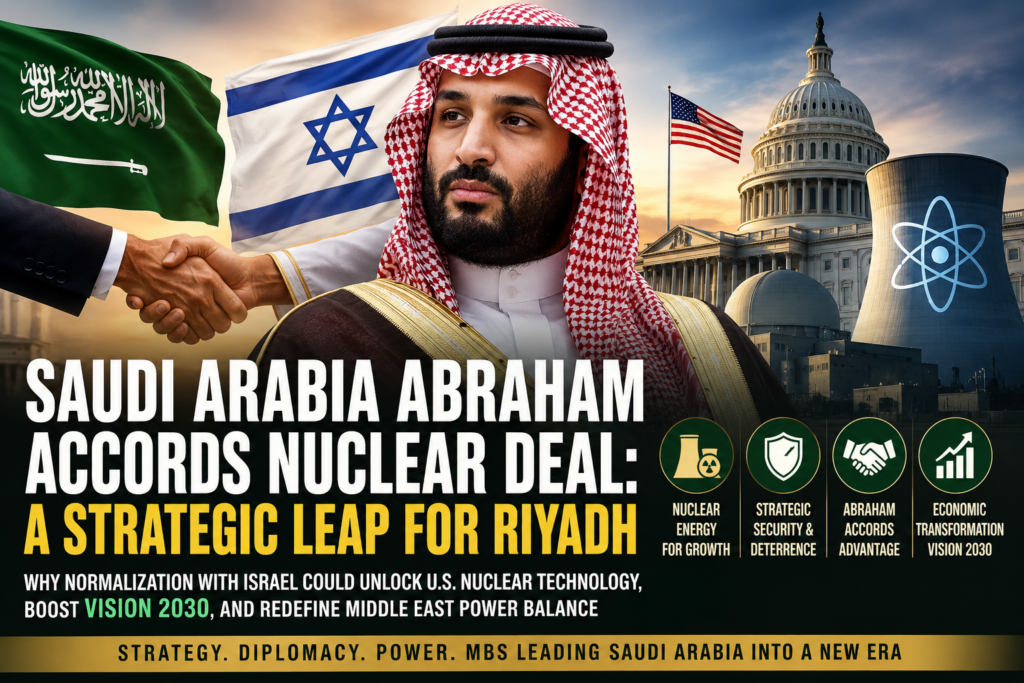
- Saudi Arabia Abraham Accord nuclear deal could unlock U.S. nuclear technology and reshape regional power
- Crown Prince Mohammed bin Salman is leveraging normalization for maximum strategic gain
- The deal strengthens Saudi deterrence against Iran’s nuclear ambitions
- Economic transformation under Vision 2030 stands to accelerate significantly
RIYADH — President Donald Trump’s latest condition tying a U.S.-Saudi civil nuclear agreement to normalization with Israel has injected uncertainty into an already complex geopolitical equation. Yet beneath the controversy lies a deeper strategic reality: for Saudi Arabia, aligning with the Abraham Accords may not be a concession—but a calculated, high-reward move that advances its long-term national interests.
At the heart of the debate is Crown Prince Mohammed bin Salman’s ambitious vision to transform the Kingdom into a technologically advanced, economically diversified global power. Access to U.S. nuclear technology is not merely about energy—it is about sovereignty, prestige, deterrence, and the future architecture of Saudi Arabia’s power.
Nuclear Power: The Cornerstone of Vision 2030
Saudi Arabia’s pursuit of a civilian nuclear program is deeply embedded in Vision 2030. As global energy markets shift and oil demand faces long-term uncertainty, Riyadh recognizes the necessity of diversifying its energy mix. Nuclear energy offers:
- A stable, long-term power source to sustain industrial growth
- Reduced domestic oil consumption, freeing more crude for export
- Technological advancement and high-skilled job creation
A U.S.-backed nuclear deal would provide Saudi Arabia with world-class technology, safety standards, and global legitimacy—far surpassing alternative partnerships with China or Russia.
READ NEXT: Saudi Arabia Abraham Accords: Why Riyadh Won’t Normalize Ties with Israel Anytime Soon
Crucially, it would anchor the Kingdom firmly within the Western technological ecosystem.
Strategic Deterrence in a Volatile Region
The Middle East remains one of the most militarized and unstable regions in the world. Iran’s nuclear ambitions—despite fluctuating diplomatic constraints—continue to shape Saudi threat perceptions.
Crown Prince Mohammed bin Salman has been unequivocal: if Iran develops nuclear weapons, Saudi Arabia will follow suit.
In this context, a U.S.-Saudi nuclear agreement serves multiple purposes:
- Establishes a latent nuclear capability without immediate weaponization
- Sends a strong deterrent signal to Tehran
- Reinforces Saudi Arabia’s position as the Arab world’s leading power
By accepting U.S. oversight mechanisms, Riyadh can pursue nuclear advancement while maintaining international confidence—something Iran has struggled to achieve.
The Abraham Accords: From Symbolism to Strategic Leverage
Critics argue that normalization with Israel risks domestic backlash and undermines Saudi Arabia’s longstanding position on Palestine. However, this perspective underestimates Riyadh’s diplomatic leverage.
Saudi Arabia is not the UAE or Bahrain. It is the custodian of Islam’s holiest sites and the political heavyweight of the Arab and Muslim world. Any Saudi entry into the Abraham Accords would fundamentally reshape the regional order.
Rather than a concession, normalization could be leveraged to extract significant gains:
- Concrete progress toward a Palestinian state
- Security guarantees from Washington
- Advanced defense and technological cooperation
- Enhanced influence over regional diplomacy
In effect, Riyadh holds the strongest negotiating hand.
READ MORE: Trump Says Saudi Arabia Must Normalize Relations With Israel to Seal Nuclear Deal
By delaying normalization until its conditions are met, Saudi Arabia can transform the Abraham Accords into a tool of strategic bargaining.
Economic Transformation and Global Investment
Normalization with Israel would unlock vast economic opportunities. Israel’s strengths in technology, cybersecurity, artificial intelligence, and water management align directly with Saudi Arabia’s development goals.
Potential benefits include:
- Joint ventures in high-tech industries
- Increased foreign direct investment
- Integration into global innovation networks
- Acceleration of giga-projects such as NEOM
For Crown Prince Mohammed bin Salman, this is not merely diplomacy—it is economic statecraft. The fusion of Israeli innovation with Saudi capital could create one of the most dynamic economic corridors in the world.
Managing Domestic and Regional Sensitivities
Saudi leadership is acutely aware of public sentiment, particularly regarding Gaza and Palestinian rights. However, the Kingdom has historically demonstrated an ability to shape public opinion through gradual policy shifts and strategic communication.
A phased approach to normalization—linked explicitly to Palestinian concessions—would allow Riyadh to maintain its moral leadership while advancing national interests.
Moreover, regional dynamics are already shifting. Quiet security cooperation between Gulf states and Israel has existed for years. Formal normalization would simply acknowledge an evolving reality.
The U.S. Factor: Securing a Strategic Alliance
The United States remains Saudi Arabia’s most important security partner. Despite occasional tensions, the relationship is foundational to regional stability.
By agreeing to Trump’s condition, Riyadh would:
- Reinforce its strategic alliance with Washington
- Secure long-term defense commitments
- Gain preferential access to advanced military and civilian technologies
At a time when global power competition is intensifying, anchoring itself firmly within the U.S. orbit provides Saudi Arabia with unmatched strategic advantages.
A Calculated Decision, Not a Compromise
The narrative that Saudi Arabia would be “forced” into normalization is misleading. In reality, the Kingdom is weighing a complex matrix of costs and benefits.
Crown Prince Mohammed bin Salman’s leadership has consistently demonstrated pragmatism and bold decision-making. From economic reforms to social transformation, he has shown a willingness to break with tradition when it serves the Kingdom’s future.
Joining the Abraham Accords in exchange for a robust nuclear deal is not capitulation—it is strategic alignment.
Redefining the Middle East Order
Trump’s condition has undoubtedly complicated the immediate prospects of a U.S.-Saudi nuclear agreement. Yet it has also crystallized a pivotal moment in Middle Eastern geopolitics.
For Saudi Arabia, the choice is not binary. It is a question of timing, leverage, and vision.
If negotiated on its own terms, Saudi participation in the Abraham Accords could deliver:
- A transformative nuclear capability
- Enhanced regional leadership
- Economic modernization at unprecedented scale
- A redefined balance of power in the Middle East
In this light, normalization is not a risk—it is an opportunity. And for a Kingdom determined to shape the future rather than react to it, the path forward may well lie in embracing both diplomacy and power in equal measure.