


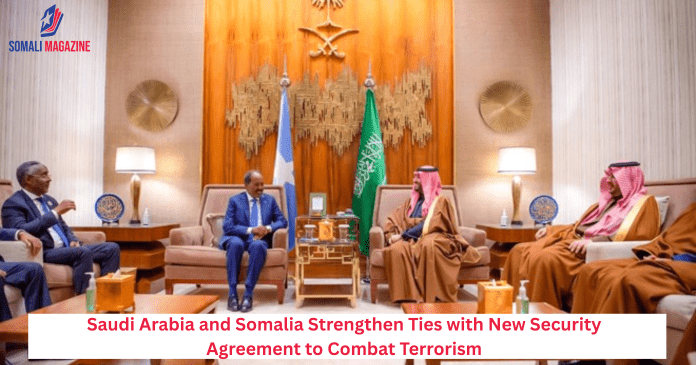
- Saudi Arabia Expands Influence in Africa : Saudi Arabia has signed a defence and military cooperation agreement with Somalia, marking a major expansion of its influence in Africa.
- Somalia’s strategic location near the Bab el-Mandeb Strait and the Suez Canal gives the deal global significance for maritime trade and energy security.
- The agreement positions Saudi Arabia as an emerging security actor in the Horn of Africa, a region increasingly shaped by external rivalries.
- Gulf competition is intensifying, with Saudi Arabia now countering the United Arab Emirates’ deep involvement in Somaliland.
- The UAE’s control of the Berbera port and airport, developed by DP World without Mogadishu’s consent, has raised sovereignty concerns for Somalia.
Saudi Arabia is steadily expanding its geopolitical footprint in Africa. Its latest defence agreement with Somalia highlights a clear shift in Riyadh’s foreign policy priorities. The Kingdom is no longer focused only on the Middle East. Instead, it is projecting power into regions that shape global trade and security.
Somalia occupies a uniquely strategic position. It sits near the Bab el-Mandeb Strait and the Suez Canal. These waterways handle a major share of global maritime traffic. Any country with influence over this corridor gains leverage over international commerce and energy flows. Saudi Arabia understands this reality well.
On Monday, Somalia and Saudi Arabia signed a military cooperation agreement in Riyadh. Somali Defence Minister Ahmed Moallim Fiqi and Saudi Defence Minister Prince Khalid bin Salman formalized the deal. The Somali defence ministry confirmed that the agreement strengthens military and defence cooperation across several areas of mutual interest.
Although officials have not released full details, the agreement likely includes training, intelligence sharing, and defence coordination. More importantly, it signals Saudi Arabia’s intent to become a security actor in the Horn of Africa. This move places Riyadh directly into a region increasingly shaped by Gulf rivalries.
The Horn of Africa has become a competitive arena for external powers. Gulf monarchies now view it as an extension of their strategic depth. Control over ports, airfields, and security partnerships has become central to this contest. Saudi Arabia’s agreement with Somalia must be seen in this broader context.
The deal also reflects growing tensions between Riyadh and Abu Dhabi. The United Arab Emirates has invested heavily in Somaliland, a self-declared republic that Somalia still considers part of its sovereign territory. Emirati firm DP World has poured hundreds of millions of dollars into the Berbera port. The UAE also controls a nearby airport with minimal coordination with Mogadishu.
Saudi Arabia increasingly views these unilateral actions with concern. Once close allies, Riyadh and Abu Dhabi now diverge on key regional issues. Their disagreements over Sudan and Yemen have already surfaced. Somalia now appears to be another front where Saudi Arabia seeks to counter Emirati influence.
Timing also matters. The agreement comes weeks after Israel recognized Somaliland. That move challenged Somalia’s territorial claims and raised regional alarm. By strengthening ties with Mogadishu, Saudi Arabia implicitly supports Somalia’s sovereignty. At the same time, it pushes back against efforts to reshape the region’s political map without African consensus.
For Somalia, the agreement offers clear benefits. It provides access to a powerful military partner with financial resources and international clout. Saudi support can help strengthen Somalia’s armed forces and improve maritime security. This is critical for a country facing persistent security threats and weak state institutions.
For Saudi Arabia, the gains are strategic. Somalia offers proximity to vital sea lanes linking Asia, Europe, and the Middle East. A presence there enhances Riyadh’s ability to monitor and influence maritime traffic. It also reinforces Saudi Arabia’s ambition to act as a global security provider.
The agreement also sends a message beyond Africa. It signals to the United States, Europe, and China that Saudi Arabia intends to shape security outcomes along key trade corridors. As global competition intensifies, control over chokepoints matters more than ever.
In conclusion, the Saudi–Somalia defence agreement is not symbolic. It is a calculated geopolitical move. It reflects Saudi Arabia’s expanding foreign policy vision and its willingness to compete for influence in Africa. As Gulf rivalries spill beyond the Middle East, Somalia emerges as a pivotal state. Riyadh has now made clear that it intends to be part of that strategic equation.