


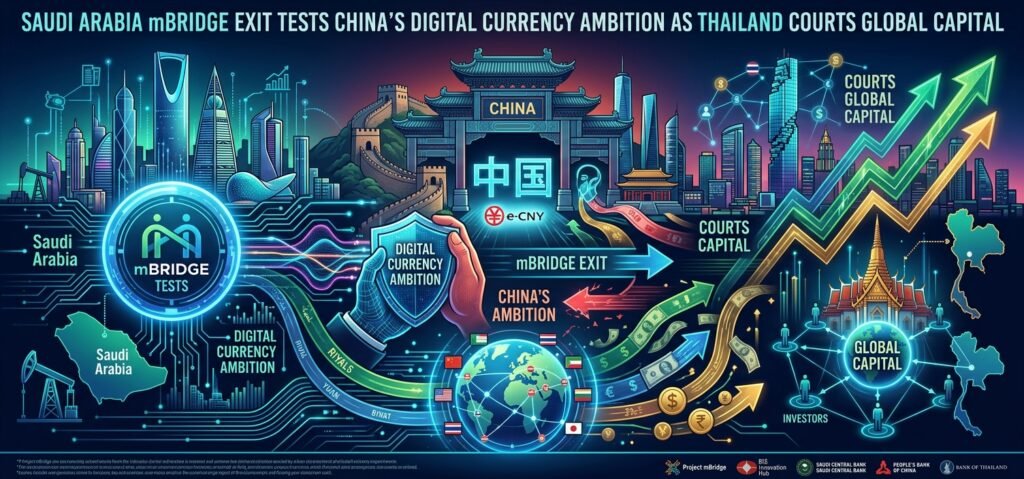
- Saudi Arabia mBridge exit weakens the political symbolism of China’s alternative digital payments architecture.
- mBridge remains operational with China, Hong Kong, Thailand, UAE and Macau, but broader international adoption remains the key challenge.
- Thailand is simultaneously courting US financial institutions and technology companies as Bangkok promotes its recovering market and digital economy.
Saudi Arabia’s exit from the China-linked mBridge digital currency project is unlikely to cripple the platform technically, but it represents a significant geopolitical setback for Beijing’s ambition to build a broader international payments architecture outside the traditional dollar system.
At almost the same time, Thailand is sending a very different message to global investors. Prime Minister Anutin Charnvirakul is in New York this week using the United Nations General Assembly to promote Thailand as a destination for American capital, technology investment and institutional money. Together, the two developments illustrate the competing forces shaping Asia’s financial future: diversification from the dollar on one side and continued dependence on Western capital and financial networks on the other.
Saudi Arabia’s departure from mBridge became public this month, although it actually occurred in May 2025. The Saudi Central Bank said it completed its proof-of-concept exercise on May 13 last year and was no longer a participating member afterward, describing the exit as part of its original plan.
READ NEXT: Why the Red Sea Matters as Iran and Houthis Tighten Global Energy Vise
That qualification is important. mBridge has not collapsed. The project had already reached its minimum viable product stage, and the Bank for International Settlements ended its formal involvement in 2024, saying participating central banks could take the project forward independently. The platform was designed to allow central banks to conduct cross-border transactions using their own digital currencies on shared distributed-ledger infrastructure.
But Saudi Arabia was an important addition because of its position in the global energy system. Its participation gave a China-associated digital payments experiment access to one of the world’s largest oil exporters and a major holder of international financial assets.
Its departure therefore affects the political narrative surrounding mBridge more than its immediate technology.
The platform is frequently discussed as part of China’s wider effort to reduce dependence on dollar-based settlement infrastructure. The loss of Saudi Arabia weakens the argument that a major US security partner and energy power is prepared to become a permanent participant in such an alternative system.
READ MORE: What Saudi Arabia’s exit means for China-led mBridge amid global de-dollarisation
Analysts cited by the Financial Times and South China Morning Post have nevertheless cautioned against interpreting the move as the end of mBridge. The remaining participants include China, Hong Kong, Thailand, the United Arab Emirates and Macau, while Saudi Arabia can still observe developments outside formal membership.
The larger problem for Beijing is adoption. Building a functioning digital settlement platform is one challenge; persuading major trading nations, banks and corporations to conduct significant volumes of international commerce through it is another. Global payments depend not only on technology but also on liquidity, regulatory confidence, convertibility, financial markets and geopolitical relationships.
Saudi Arabia’s decision highlights precisely that problem.
Riyadh has deep economic ties with China but remains closely integrated with the US-led financial and security system. Its mBridge experience demonstrates that countries can explore alternatives to dollar infrastructure without necessarily committing themselves to a parallel financial bloc.
Thailand’s current strategy in New York offers a contrasting example.
The Thai government says Anutin’s September 20–27 mission is designed to connect Thailand with global investors, financial institutions and technology companies while presenting the country’s capital market and digital economy. His New York agenda includes an investor roundtable involving Bank of America and Jefferies, talks with PIMCO and meetings with major technology companies. The delegation is also engaging US technology firms on artificial intelligence, digital infrastructure and workforce skills.
Thailand has numbers to put behind its pitch. The Stock Exchange of Thailand reported that its benchmark index had risen 28.9 percent from the end of 2025 by the end of July, while foreign investors had recorded net purchases of 75.86 billion baht year-to-date.
The government is attempting to turn that market momentum into longer-term investment in artificial intelligence, data centres, digital infrastructure and other technology-intensive industries.
The strategy extends beyond New York. In London, Anutin and Thai capital-market officials are scheduled to meet institutional investors with UBS, while Thailand is also pursuing cooperation with major international companies.
The contrast is revealing. China is attempting to expand the technological infrastructure through which international transactions could eventually become less dependent on established dollar networks. Thailand, meanwhile, is actively seeking deeper access to those established pools of Western capital and technology.
Neither development means Asia has chosen one financial system over another.
Instead, they demonstrate how middle and emerging powers are pursuing flexibility. Saudi Arabia can cooperate economically with China while remaining cautious about formal participation in an alternative payments architecture. Thailand can deepen Asian economic integration while simultaneously courting American investors and technology companies.
For China, Saudi Arabia’s exit means mBridge now has a narrower political footprint than its advocates might have hoped. For Thailand, the New York roadshow is an attempt to turn improving market performance and technological ambitions into durable foreign investment.
The emerging Asian financial order may therefore be less about replacing the dollar outright and more about countries maintaining multiple channels of economic access. That makes mBridge’s future dependent not simply on whether the technology works, but on whether governments believe joining it strengthens—or complicates—their wider economic and strategic relationships.