


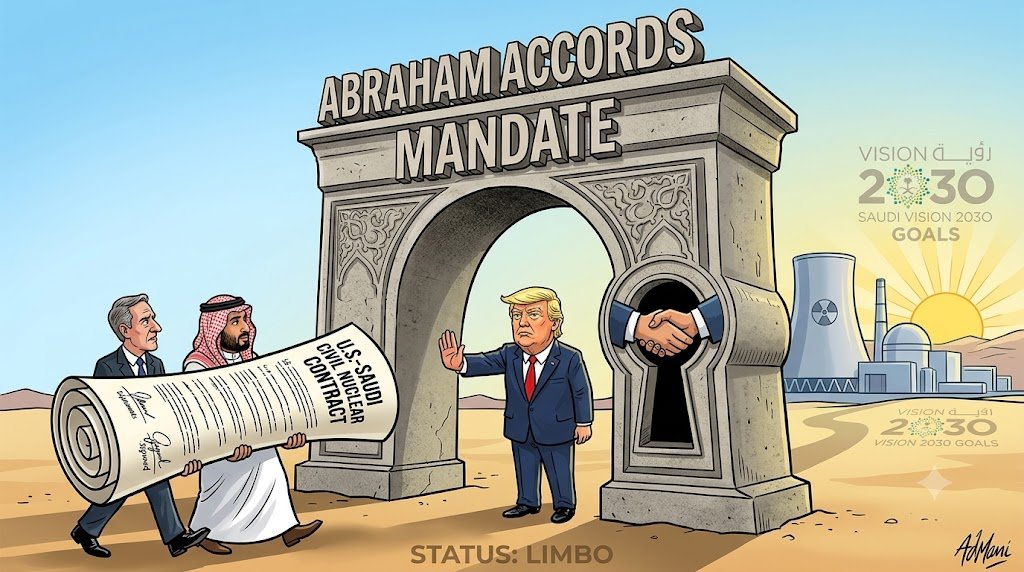
- Saudi Nuclear Deal thrown into limbo after President Donald Trump added a last-minute requirement for Riyadh to normalize ties with Israel under the Abraham Accords.
- Severe Proliferation Concerns raised by non-proliferation experts and lawmakers over transferring advanced technology to the Middle East without standard IAEA oversight.
- Diplomatic Deadlock emerges as Saudi leaders reaffirm that official recognition of Israel remains strictly tied to a clear pathway toward an independent Palestinian state.
WASHINGTON — Just twenty-four hours after U.S. and Saudi officials formally signed a landmark bilateral civilian nuclear agreement, President Donald Trump injected deep uncertainty into the pact by declaring that final approval would hinge on Saudi Arabia normalizing diplomatic relations with Israel.
The abrupt policy pivot—announced via social media on Thursday—attaches a monumental diplomatic condition to a nuclear cooperation framework that contained no such prerequisite when signed a day earlier by U.S. Energy Secretary Chris Wright and Saudi Energy Minister Prince Abdulaziz bin Salman.
“The Civil Nuclear Deal… will be approved, but is totally subject to Saudi Arabia joining the very respected and successful Abraham Accords,” Trump wrote on Truth Social, adding that the arrangement would be strictly for non-military purposes with “no enrichment of material.”
White House Press Secretary Karoline Leavitt reinforced the president’s position during a news briefing later Thursday, telling reporters: “If they don’t join the Abraham Accords, the deal is off.” Asked why the requirement was omitted from the initial agreement, Leavitt responded that Trump is “always the final dealmaker.”
The sudden demand caught foreign diplomats and non-proliferation experts by surprise. The 30-year bilateral agreement, structured as a “123 Agreement” under the U.S. Atomic Energy Act, was designed to allow American firms to build nuclear reactors in Saudi Arabia.
READ NEXT: Trump Warning to Iran: Pakistan and MBS Align After Red Sea Attacks on Saudi Tankers
Unlike previous civilian nuclear treaties—such as the 2009 U.S.–United Arab Emirates agreement—the draft framework negotiated with Riyadh exempted the kingdom from signing the International Atomic Energy Agency’s (IAEA) Additional Protocol, which permits unannounced inspections of non-declared facilities.
Instead, sensitive inspections were to be carried out under specialized U.S.-led monitoring protocols.
According to U.S media reports, initial announcements on Wednesday made no mention of diplomatic recognition of Israel. However, the omission sparked immediate backlash in Jerusalem and on Capitol Hill, where lawmakers from both parties questioned why Washington was granting nuclear technology without securing significant foreign policy concessions in return.
By Thursday afternoon, Israeli Prime Minister Benjamin Netanyahu welcomed Trump’s new mandate, calling potential Saudi entry into the Abraham Accords a “historic leap forward for peace in the Middle East.”
READ MORE: Trump Says Iran Will Be Held Responsible for Future Houthi Attacks
However, Saudi officials signaled that post-hoc social media declarations do not rewrite legally signed bilateral documents.
“It was signed. So nothing to renegotiate,” a Saudi source was quoted by Wall Street Journal as saying following the announcement.
“Tweets don’t overturn signed agreements,” he said.
Connecting the civil nuclear pact to the Abraham Accords places the agreement behind a complex diplomatic wall.
While Saudi Arabia and Israel were nearing a historic normalization deal in late 2023, talks stalled following the October 7 attacks and the subsequent war in Gaza.
Saudi leaders have repeatedly affirmed that formal diplomatic recognition of Israel remains contingent on a clear, time-bound, and irrevocable pathway toward an independent Palestinian state—a condition that current Israeli leadership firmly rejects.
-
Legal and Contractual Uncertainty: Commenters expressed bewilderment at the administration’s strategy of introducing major new demands after an international pact has been formally executed, with many questioning whether such tactics damage American credibility in future treaty negotiations.
- Nuclear Proliferation Risks: Proliferation experts and citizens alike warned that introducing nuclear capabilities into an already volatile region risks triggering a regional arms race, particularly if safeguards fail to prevent eventual domestic fuel enrichment.
- Geopolitical Bargaining Power: Critics argue that tying energy partnerships to complex regional alliances may backfire by encouraging Gulf partners to look toward alternative nuclear suppliers, such as China, South Korea, or Russia, who impose fewer geopolitical conditions.
What Comes Next in Congress
Under U.S. law, the civil nuclear agreement must be submitted to the U.S. Congress for a mandatory 90-session-day review period. While Congress can pass a joint resolution of disapproval to block the agreement, the president retains veto power, requiring a two-thirds majority in both chambers to override.
However, with Trump himself conditioning the deal’s approval on a condition Saudi Arabia has yet to accept, the debate on Capitol Hill may be moot before legislative review even concludes. For now, the administration’s new mandate leaves the landmark energy deal hanging in the balance, exposing the tensions between nuclear commerce, regional diplomacy, and presidential dealmaking.