


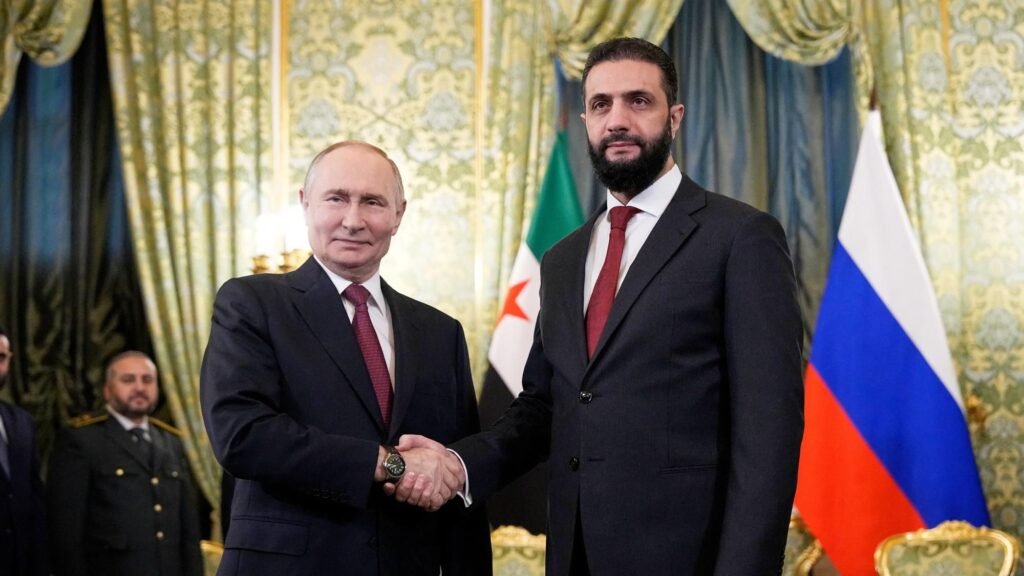
Russian President Vladimir Putin welcomed Syrian President Ahmed al-Sharaa to the Kremlin on Wednesday in a meeting that marked a significant recalibration of Moscow’s approach to Syria following the dramatic overthrow of Bashar al-Assad in December 2024.
The visit, Sharaa’s second to Russia since assuming power, highlighted both the strategic pragmatism of Moscow and the shifting dynamics in the Middle East as Sharaa consolidates authority over Syria’s fractured territories.
Sources on both sides confirmed that the agenda covered Russia’s military presence in Syria, economic cooperation, regional security, and broader Middle East stability. While Qamishli airport in northeast Syria is reportedly being handed back to Damascus, Russia is expected to maintain its core military installations at Hmeimim air base and Tartous naval facility.
Analysts see these moves as an effort to accommodate Sharaa’s Islamist-led coalition while preserving Moscow’s longstanding strategic foothold in the Levant.
In televised remarks at the Kremlin, Putin congratulated Sharaa on “restoring the territorial integrity of Syria,” underscoring Russia’s desire to appear aligned with the new Syrian leadership. Sharaa reciprocated, thanking Moscow for its assistance in stabilizing Syria and the region more broadly.
The exchange reflects a pragmatic approach by both capitals: Russia, reeling from Assad’s unexpected fall, seeks to protect its military investments and influence; Sharaa, meanwhile, aims to legitimize his rule internationally while securing Moscow’s cooperation in consolidating power.
A central focus of the talks was the future of Russia’s bases in Syria. Qamishli had long been a contentious site, allowing Moscow leverage over Damascus and supporting Kurdish autonomy. By withdrawing from Qamishli while retaining Hmeimim and Tartous, Russia signals flexibility without relinquishing its strategic assets. Sharaa’s administration, according to Syrian sources, intends to negotiate a new framework for Russian presence in these key locations, balancing sovereignty with security guarantees.
Security issues beyond Syria were also high on the agenda. Sharaa reportedly raised the risk of potential strikes on Iran, underscoring Damascus’ interest in preventing regional spillover from U.S. or Israeli operations. The Syrian president also sought Russian support for a strengthened military police presence in southern Syria, particularly Quneitra near the Golan Heights, to deter Israeli incursions. For Moscow, engagement in these matters allows it to maintain a role as a regional power broker, even as the Assad era recedes.
Sharaa’s visit carries profound implications for Syria-Russia relations and the broader Middle East. With Assad now living in Moscow under Russian protection, Sharaa must navigate the delicate challenge of consolidating authority without provoking retaliation from former regime loyalists sheltered in Russia.
One key discussion point reportedly concerned ensuring that senior Assad allies and former army officers do not use their sanctuary in Moscow to fund or organize insurgent activities against the Sharaa government, particularly along Syria’s coast.
The optics of Sharaa meeting Putin in the Kremlin also signal Moscow’s willingness to recognize and cooperate with the post-Assad leadership. This is critical for Russia, which has invested heavily in Syria over more than a decade of civil war.
Sharaa’s Islamist coalition, while ideologically distinct from Assad’s secular Ba’athist regime, appears intent on maintaining a constructive relationship with Moscow, recognizing that Russian military, economic, and diplomatic support remains essential to stabilizing the country.
Regionally, Sharaa’s diplomacy may reshape alliances. By consolidating relations with Russia, he strengthens his hand in negotiations with Iran, Israel, and neighboring states. Russian endorsement also helps Sharaa present his authority as legitimate and internationally recognized, potentially deterring challenges from regional actors or former regime loyalists.
Yet the visit underscores a paradox: Assad, once Moscow’s key partner, now lives as a political exile in the very capital that Sharaa is courting for support. This shift demonstrates Russia’s adaptability but also reflects the volatility of Middle Eastern geopolitics, where alliances are often transactional and contingent on power on the ground.
For the region, Sharaa’s Moscow engagement signals a potential stabilization of Syria under a new leadership paradigm, but it also underscores lingering risks from exiled factions, foreign interference, and competing regional interests.
In sum, Ahmed al-Sharaa’s visit to Moscow is both symbolic and strategic. It affirms Russia’s continued presence in Syria, redefines post-Assad relations, and positions Sharaa as a pragmatic leader capable of navigating complex regional dynamics.
The outcome of these talks will likely reverberate beyond Syria, affecting Middle Eastern security calculations, Russian influence in the Levant, and the delicate balance of power among the region’s key actors.