


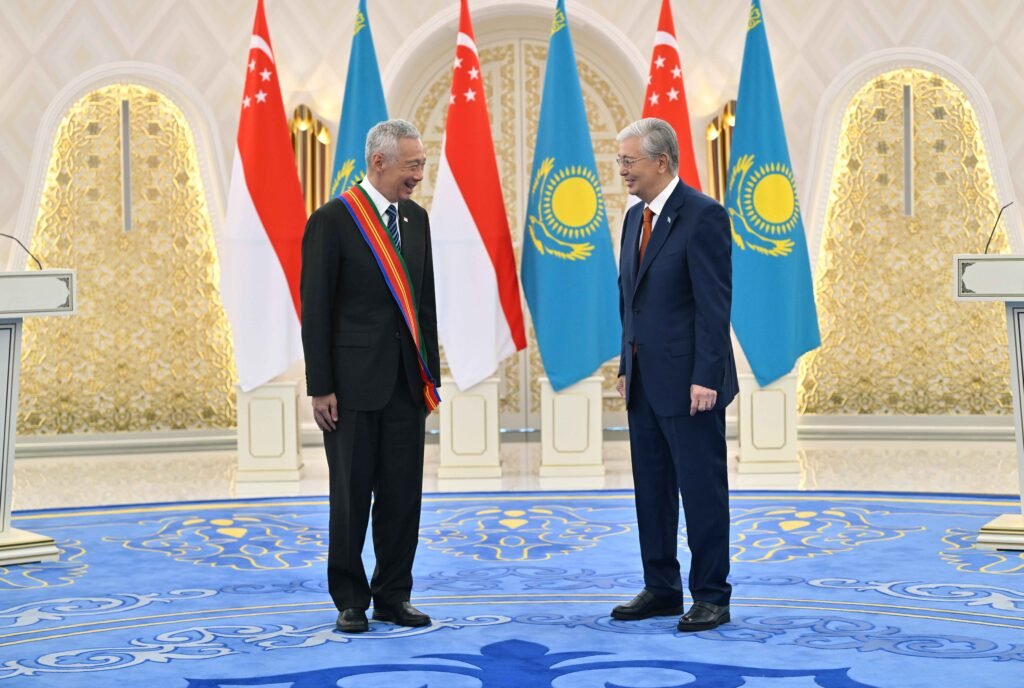
- Singapore ASEAN 2027 Central Asia strategy could use ASEAN as a platform to connect Southeast Asia with the Eurasian heartland through trade, transport, energy and technology.
- Singapore’s Central Asia strategy is built around connectivity, with the Middle Corridor offering a potential new trade bridge between China, Central Asia, Europe and Southeast Asia.
- ASEAN Central Asia cooperation could create a win-win economic framework, giving Southeast Asian businesses access to Eurasian markets while opening Central Asia to ASEAN capital, technology and expertise.
ASTANA — Singapore is preparing to use its 2027 chairmanship of ASEAN to pursue an ambitious idea: bringing Southeast Asia and Central Asia closer together through trade, transport, digital connectivity, energy, water management and sustainable development.
The proposal, outlined by Senior Minister Lee Hsien Loong during his visit to Kazakhstan, goes beyond conventional bilateral diplomacy. Singapore appears to be looking at Central Asia not merely as a collection of emerging markets, but as a strategic gateway between Southeast Asia, China, Europe and the wider Eurasian heartland.
The strategy comes at a time when maritime and overland trade routes are being reshaped by geopolitical crises. The Islamabad Telegraph has previously examined how maritime disruption is becoming a structural reality for Asian economies, making alternative corridors and diversified supply chains increasingly important.
“As ASEAN Chair next year, Singapore looks forward to creating more opportunities for ASEAN to engage partners beyond our traditional networks,” Lee said in Astana on Aug. 26. “We will explore how South-east Asia and Central Asia can work more closely together.”
READ NEXT: Singapore Maritime Disruption: Singapore Navigates Global Supply Chain Friction Amid Prolonged Middle East Conflict
The significance of the statement lies in the fact that Singapore is not proposing another narrowly focused bilateral initiative. It appears to be considering whether ASEAN itself can become a platform through which Southeast Asia engages Central Asia as a region.
Singapore’s bigger strategic calculation
Singapore has little territory, no large domestic market and virtually no natural resources. Its extraordinary economic success has instead been built around connectivity, efficient institutions, international trade, finance, logistics and its ability to position itself between larger economies.
That history may explain the thinking behind Lee’s Central Asian initiative.
Singapore is effectively proposing to replicate one of its greatest strategic strengths at a regional level: connect markets rather than compete with them.
ASEAN already represents an economic heavyweight, with around 680 million people and a combined economy approaching $4 trillion. The bloc’s trade and investment relationships give Singapore a ready-made institutional platform through which it can pursue a much wider regional connectivity agenda.
Central Asia provides an attractive counterpart.
Kazakhstan, Uzbekistan, Kyrgyzstan, Tajikistan and Turkmenistan sit at the intersection of China, Russia, the Caspian region, South Asia and Europe. Their geographical position gives them enormous potential as logistics and energy hubs, while their governments are increasingly looking for diversified economic relationships.
READ MORE: SM Lee conferred Order of Dostyk for strengthening Singapore-Kazakhstan cooperation
Kazakhstan is already Singapore’s largest economic partner in Central Asia. Bilateral trade in goods amounted to $326.6 million, services trade reached $159 million and Singapore’s stock of direct investment in Kazakhstan stood at $2.1 billion, with 158 Singapore overseas affiliates operating there.
But Singapore’s real objective may be larger than these numbers suggest.
It is looking at Central Asia as a gateway to Eurasia.
The Middle Corridor could become the physical backbone
One of the most important pieces of the emerging strategy is transport connectivity.
On Aug. 26, the Singapore Cooperation Enterprise signed an agreement with Kazakhstan-based Middle Corridor Multimodal to explore digital integration of the Middle Corridor, the trade route linking China with Europe through Central Asia and the Caspian Sea.
The corridor has become increasingly important as geopolitical tensions have disrupted traditional Eurasian routes. Singapore’s interest is therefore partly commercial and partly strategic.
The Astana Times has reported that Singapore-Kazakhstan discussions are expanding into transport, logistics, aviation, smart-city development, critical minerals, tourism, water management, artificial intelligence and digitalisation.
For Singapore, however, the objective is not simply to move more containers.
It wants to apply its expertise in customs interoperability, digital documentation, logistics and supply-chain management to a corridor crossing multiple jurisdictions.
That could help reduce border bottlenecks while opening opportunities for Singaporean logistics, technology, financial and infrastructure companies.
The strategic logic is straightforward: ASEAN companies could gain better access to Central Asian and European markets, while Central Asian companies could gain a more efficient gateway into Southeast Asia.
Water, energy and technology
Singapore’s strategy also extends beyond trade.
A separate agreement with Kazakhstan’s Ministry of Water Resources and Irrigation will allow Singapore to share expertise in water sustainability, flood management, water reclamation and digitalisation.
That may become increasingly valuable as Central Asian states confront climate change, water scarcity and pressure on traditional water systems.
Singapore has spent decades developing sophisticated systems for water recycling, conservation and urban water management despite having limited natural freshwater resources.
This creates an unusual form of diplomatic leverage: Singapore can export knowledge and institutional capacity rather than merely capital.
The two countries have also agreed to cooperate on artificial intelligence, digital development and science, technology, engineering and mathematics, with training planned for Central Asian government officials.
The objective is therefore gradually becoming clearer.
Singapore wants to connect capital, technology, logistics, expertise and markets.
Why ASEAN could see a win-win
The greatest challenge will be convincing other ASEAN members that the initiative is not simply Singapore’s commercial strategy.
That is where the ASEAN platform becomes crucial.
If Singapore presents the initiative as an ASEAN-Central Asia connectivity and economic partnership, rather than a Singapore-Kazakhstan project, the potential benefits become much larger.
Indonesia could find new markets for commodities and manufactured goods. Malaysia, Thailand and Vietnam could benefit from logistics, industrial and infrastructure opportunities. The Philippines could find openings in services and infrastructure. Brunei could explore energy cooperation.
For Central Asia, ASEAN offers access to one of the world’s most dynamic economic regions.
For ASEAN, Central Asia offers something different: a bridge into the heart of Eurasia.
Singapore’s strategy also has a strong geopolitical dimension.
The world economy is increasingly being reorganised around resilient supply chains, alternative transport corridors and diversified strategic partnerships. Singapore itself has experienced the vulnerabilities created when major maritime routes are disrupted. The Islamabad Telegraph’s reporting on the impact of tensions around the Strait of Hormuz on Singapore highlights why alternative trade corridors have become strategically important for the city-state and the wider Asian economy — read the analysis here.
Singapore’s success story is the selling point
Singapore’s greatest diplomatic asset may ultimately be its own success story.
Since independence, the city-state has transformed itself from a relatively poor trading port into one of the world’s leading financial, logistics and business centres.
Its model has been remarkably consistent: remain open, connect different economic systems, build world-class infrastructure and turn geographical limitations into strategic advantages.
Lee’s message in Kazakhstan reflects that philosophy.
Singapore and Kazakhstan are geographically distant, but both seek to integrate with their respective regions while remaining connected to the wider world. Kazakhstan is also pursuing closer institutional links with ASEAN, including accession to the Treaty of Amity and Cooperation, which could strengthen the foundation for broader engagement.
The Straits Times has described Singapore’s 2027 approach as an effort to look beyond ASEAN’s traditional partners and explore closer cooperation with Central Asia in transport, connectivity, energy and sustainable development.
That is potentially the most important part of Singapore’s emerging strategy.
It is not trying to create another geopolitical bloc.
It is trying to build another bridge.
And ASEAN is perhaps the most effective platform Singapore possesses to build it.
A new economic geography
If Singapore succeeds in turning its 2027 chairmanship into practical ASEAN-Central Asia programmes covering digital customs, transport corridors, energy, water, investment, tourism, education and technology, the consequences could extend well beyond Singapore and Kazakhstan.
Southeast Asia could gain a new gateway into Eurasia.
Central Asia could gain a stronger economic gateway to the Indo-Pacific.
Singaporean companies could gain access to infrastructure and technology markets stretching across the Eurasian heartland.
And ASEAN could demonstrate that its relevance extends beyond Southeast Asia itself.
Channel NewsAsia has reported that Singapore sees closer integration between Southeast Asia and Central Asia as part of its plans for the 2027 ASEAN chairmanship, with cooperation envisaged in transport, connectivity, energy and sustainable development.
That is the larger strategic calculation behind Lee’s initiative.
Singapore has spent decades proving that a small state can become disproportionately influential by making itself indispensable to global connectivity.
Now it appears ready to test whether the same formula can work at the regional level.
If it succeeds, Singapore’s 2027 ASEAN chairmanship could become more than another year of diplomatic leadership.
It could mark the beginning of a new economic bridge between Southeast Asia and Central Asia — linking the Indo-Pacific with the Eurasian heartland through trade, technology and connectivity.