


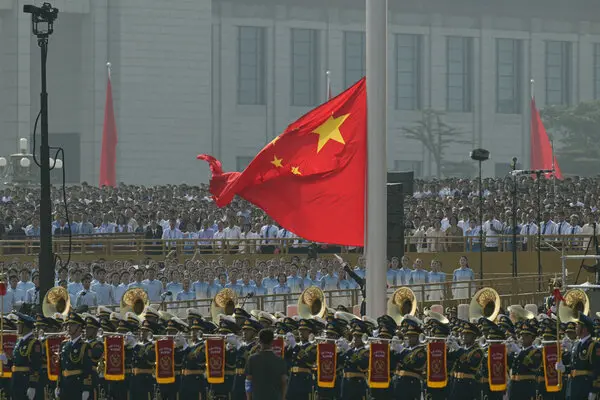
- South China Sea Geopolitical Analysis 2025: U.S.-China Military Escalation intensifies as Taiwan begins test flights for new F-16 Block 70 “Viper” jets.
- Leaked Pentagon “Overmatch” reports suggest the U.S. could be outpaced by China’s mass-production of drones and hypersonic missiles.
- China’s Ministry of Foreign Affairs reaffirms the “One China” principle, warning against Japanese and U.S. “interference” in cross-strait affairs.
- Economic summits in Nanjing continue despite record-breaking naval transits by eight nations through the Taiwan Strait.
In the high-stakes arena of the Indo-Pacific, December 2025 has emerged as a month of profound military and diplomatic maneuvers. From the rumble of new engines over Greenville to the defiant rhetoric in Beijing, the “Taiwan question” has once again become the focal point of the broader U.S.-China power struggle. This struggle, according to analysts, is surely going to escalate in future.
The Military Pivot: Deterrence in the Skies
The geopolitical temperature spiked this month as the first of Taiwan’s long-awaited F-16 Block 70 fighter jets entered test flights. Part of an $8 billion deal, these advanced “Viper” variants represent a critical shift in Taipei’s air defense strategy. Equipped with the AN/APG-83 AESA radar and sophisticated electronic warfare suites, the jets are designed to counter the People’s Liberation Army’s (PLA) qualitative edge.
East Asia on Alert: Japan–China Taiwan Tensions Deepens Geopolitical Fault Lines
However, a leaked Pentagon “Overmatch Brief” has cast a shadow over this delivery. The report warns that by 2027—a date frequently cited as President Xi Jinping’s target for military readiness—China’s industrial capacity to produce hypersonic missiles and swarming drones could overwhelm traditional U.S. and Taiwanese defense platforms. The brief stresses that while the F-16s are vital, the sheer “volume and speed” of China’s military buildup threatens to erode the long-standing U.S. advantage in the region.
Chinese Official Stance: The Red Line Reaffirmed
Beijing’s response has been swift and unyielding. Foreign Ministry spokesperson Guo Jiakun characterized the arms sales as a “dangerous act” that turns Taiwan into a “powder keg.” In multiple December briefings, the Ministry of Foreign Affairs (MFA) reiterated the “One China” principle, asserting that national reunification is a historical inevitability.
READ MORE: US approves $11bn in arms sales to Taiwan in deal likely to anger China
Beyond the U.S., Beijing has ramped up its opposition to “foreign interference” from other regional players. The MFA recently issued stern warnings against Japanese political visits and “security cooperation” with Taipei, reminding Tokyo of its historical “colonial crimes” in Taiwan. This diplomatic hardening suggests that Beijing views the current U.S. administration’s “collective defense” strategy—involving Japan and the Philippines—as a direct threat to its sovereignty.
The Paradox of Nanjing: Economic Ties vs. Military Tensions
While military transits in the Taiwan Strait reached record numbers this month—with eight countries conducting freedom of navigation operations—the 2025 Cross-Strait CEO Summit in Nanjing provided a stark contrast. Nearly 800 participants gathered to discuss industrial innovation and the role of Taiwan’s youth in the mainland’s 15th Five-Year Plan.
ALSO READ: Breaking News: Pentagon Shifts Strategic Gaze Toward China, Sparking Fears of Future U.S.-China Clash
This “dual-track” reality defines the current crisis: a deep-seated economic interdependency existing alongside an escalating military standoff. Beijing continues to use summits like Nanjing to promote “peaceful development,” while simultaneously conducting exercises that simulate blockades and encirclement.
South China Sea Geopolitical Analysis 2025 And
Future Prospectus: A 2027 Horizon?
As we look toward 2026, the potential for escalation remains a “gray zone” gamble. Analysts suggest that while a full-scale invasion may still be deterred by the catastrophic global economic fallout—estimated at a $10 trillion hit to global GDP—the risk of “accidental escalation” is at an all-time high.
The geopolitical landscape of the South China Sea is no longer just about territorial reefs; it is a laboratory for 21st-century warfare. Whether the arrival of F-16s and the threat of “military overmatch” will be enough to maintain the status quo remains the most urgent question of the decade.