


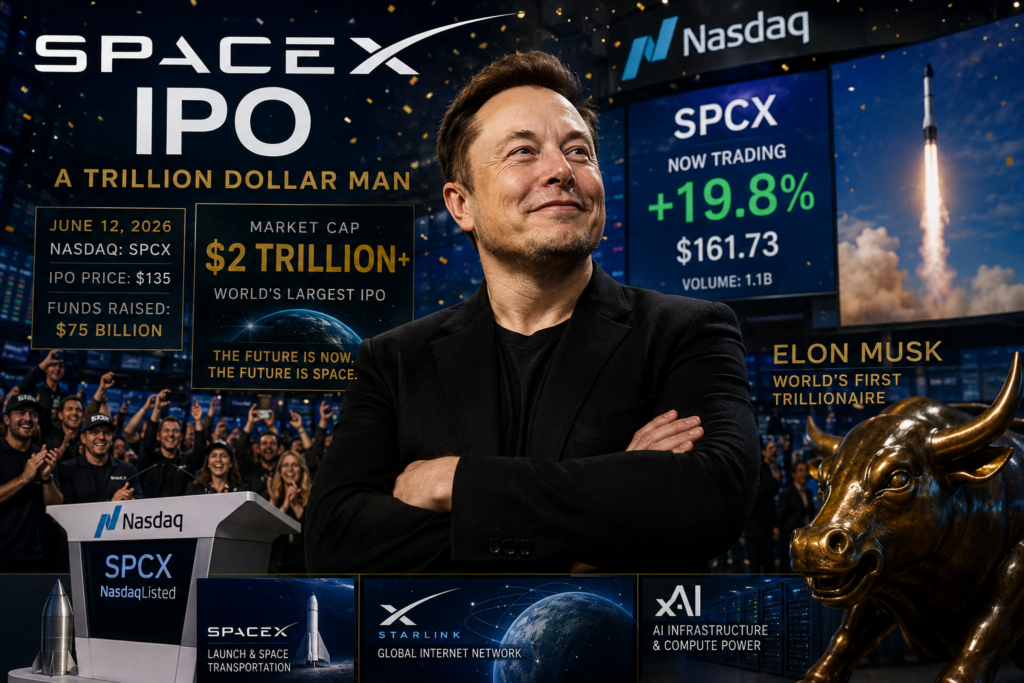
- SpaceX IPO raises record $75 billion, becoming the largest public offering in history
- Elon Musk becomes the world’s first trillionaire with over 82% voting control
- Starlink, Starship, and xAI drive SpaceX’s $2 trillion valuation surge
- Global markets recalibrate as SpaceX emerges as a new infrastructure asset class
When trading opened on June 12, 2026, SpaceX did not merely go public—it detonated onto the global financial stage. Listed on the Nasdaq under the ticker SPCX, the company priced its shares at $135, raising an unprecedented $75 billion in what is now the largest initial public offering in history.
By the closing bell, the stock had surged nearly 20%, catapulting SpaceX’s valuation past $2 trillion. In a single trading session, the company vaulted into the top tier of global corporate power—and in the process, minted the world’s first trillionaire: Elon Musk, who retains more than 82% voting control.
In the company’s S-1 filing, Musk framed the IPO not as a financial milestone, but as something far more ambitious. “This isn’t a finance event—it’s a civilization event,” he wrote, arguing that public ownership of SpaceX “aligns humanity behind a multiplanetary future.”
Tesla Solar Investment China: Musk’s $2.9 Billion Strategic Pivot Amid Iran War Energy Crisis
Whether investors interpret that as visionary or volatile, the market’s response was unequivocal.
A Valuation That Rewrites the Record Books
At roughly $1.75–$1.77 trillion, SpaceX now sits alongside the most valuable corporations on Earth—surpassing Tesla at certain intraday points and trailing only the largest U.S. tech giants.
The scale is staggering:
- More than nine times larger than India’s Reliance Industries
- Nearly triple the size of the Saudi Aramco IPO
- Instantly among the top 10 most valuable companies globally
Yet this valuation is not built on rockets alone. SpaceX is, in effect, three industrial revolutions bundled into a single ticker:
- Launch Systems: Falcon rockets and the next-generation Starship platform
- Orbital Internet: Starlink, generating an estimated $16 billion in 2025 revenue
- Artificial Intelligence: The integration of xAI, forming a rapidly expanding compute infrastructure
See how Elon Musk became the world’s first trillionaire thanks to the SpaceX IPO
As Aswath Damodaran, the NYU valuation expert known for challenging market exuberance, put it: “This is not just an IPO—it is a recalibration of how the public markets value infrastructure companies.”
Why Markets Are Treating SpaceX as a New Asset Class
1. Starlink as a Sovereign-Level Network
Starlink’s global reach, combined with defense contracts and enterprise adoption, has turned it into something resembling a borderless telecom utility. Investors are pricing it less like a tech product and more like a planetary-scale communications grid.
2. Orbital Logistics as the Next Shipping Revolution
Reusable rockets have fundamentally altered the economics of space access. With fresh public capital, SpaceX is poised to industrialize Starship production—much as Boeing scaled jetliners in the 20th century—transforming orbital transport into a commodity.
3. AI Infrastructure Moves Off-Planet
The integration of xAI adds a powerful new dimension. Regulatory filings reveal that xAI alone purchased $269 million in Tesla Megapacks earlier this year, underscoring the enormous energy demands of its compute ambitions. SpaceX is no longer just launching satellites—it is building one of the world’s largest AI ecosystems.
4. Musk’s Control: Strength or Systemic Risk?
Musk’s 82% voting control is virtually unprecedented at this scale. Supporters argue it ensures strategic continuity. Critics warn it concentrates decision-making power over a trillion-dollar infrastructure platform in a single individual.
What This Means for Global Markets
A New Benchmark for Mega-IPOs
The previous IPO record—Alibaba’s $21.8 billion—now appears modest. SpaceX’s $75 billion raise resets expectations for what frontier infrastructure companies can command in public markets.
Pressure on Nation-States
Space agencies in China, India, and Russia now face competition not just from a private firm—but from one with direct access to global capital markets. The implication is clear: commercial space may outpace state-led programs in both speed and scale.
The Rise of Retail Capital in Frontier Tech
In a notable departure from Wall Street norms, up to 30% of shares were allocated to retail investors. Musk’s strategy is unmistakable—transform users into shareholders, and shareholders into long-term advocates.
Pioneering the Future
SpaceX’s public debut is more than a financial milestone—it is a signal that global capital has shifted its gaze upward. The company now operates as a gravitational force in markets, pulling investment, policy, and innovation into its orbit.
With Starlink, Starship, and AI infrastructure fused into a single corporate architecture, SpaceX is positioning itself not merely as a company, but as a foundational layer of the 21st-century economy.
The market has already rendered its verdict.
It is betting that the future will be orbital, interconnected, and computational—and that SpaceX will be the engine carrying humanity into that new frontier.