


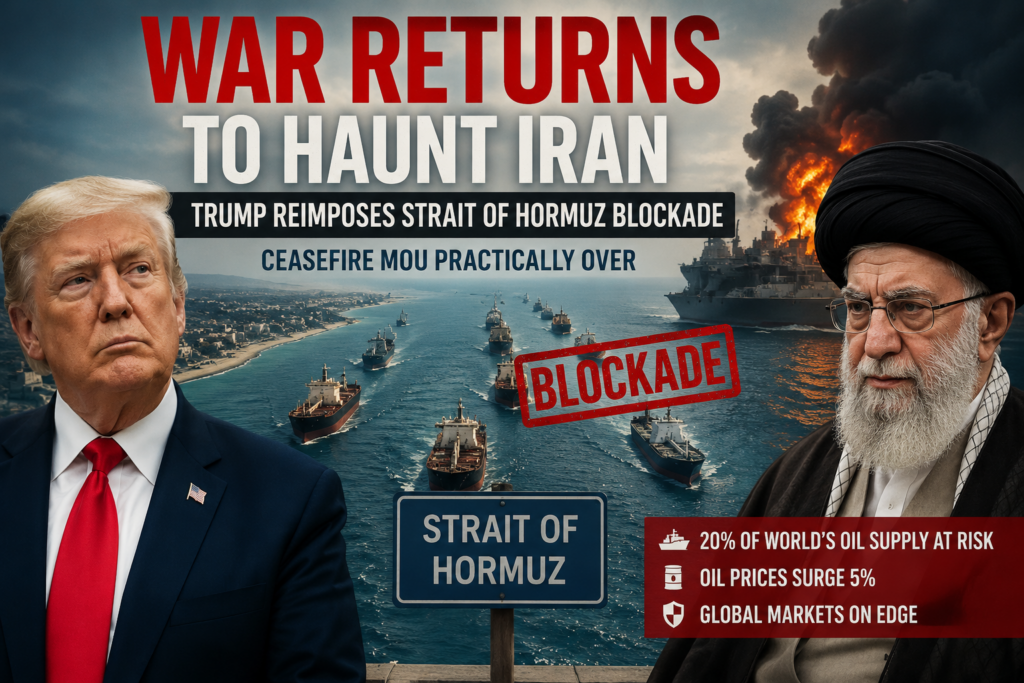
- Strait of Hormuz blockade reimposed by Trump signals collapse of ceasefire MoU
- Iran rejects US control, escalating tensions across Gulf region
- Global oil prices surge amid disruption fears in key shipping lane
- Sources say Trump may take longer than expected to end the war
War has once again returned to haunt Iran, shattering fragile diplomatic gains and pushing the Middle East back toward a dangerous escalation. In a dramatic move that signals the effective collapse of the Islamabad-brokered ceasefire framework, U.S. President Donald Trump on Monday announced the reimposition of a naval blockade on Iranian shipping in the Strait of Hormuz—one of the world’s most critical energy chokepoints.
The announcement marks a decisive turning point in the conflict, underscoring that the Memorandum of Understanding (MoU) signed in June has, in practical terms, come to an end. While the agreement had briefly raised hopes of de-escalation, renewed hostilities, mounting distrust, and competing interpretations of key provisions have now rendered it largely obsolete.
Speaking via social media, President Trump declared that the United States would assume direct control over maritime security in the strait. “The U.S.A. will be, from this point forward, known as ‘THE GUARDIAN OF THE HORMUZ STRAIT,’” he stated, adding that Washington would impose a 20 percent charge on cargo transiting the waterway as compensation for security operations. Details of the mechanism remain unclear, but officials indicated that procedures would be finalized imminently.
The move comes in the wake of intensified U.S. military strikes against Iranian targets, launched after Tehran refused American demands to publicly guarantee that the Strait of Hormuz would remain open. Instead, Iran moved to restrict passage, effectively closing the waterway and triggering immediate global market reactions. Brent crude prices surged by approximately 5 percent following the announcement, reflecting renewed fears over supply disruptions.
Iran’s response was swift and defiant. The country’s armed forces issued a stark warning, declaring that under no circumstances would Tehran allow the United States to interfere in the management of the strait. The statement highlights the deepening standoff, with both sides asserting competing claims over control of a corridor through which nearly 20 percent of the world’s oil supply traditionally flows.
Collapse of the Ceasefire Framework
The current escalation represents the most serious breakdown in relations since the ceasefire MoU was signed on June 17. That agreement, widely seen as a diplomatic breakthrough facilitated by Pakistan and regional stakeholders, aimed to stabilize global energy markets by ensuring the uninterrupted flow of oil through Hormuz.
READ MORE: U.S.–Iran Tensions Reignite as Washington Revokes Oil Waiver After Strait of Hormuz Attacks
However, the deal contained inherent ambiguities—particularly in Paragraph 5, which tasked Iran with restoring shipping while also committing to safe passage and the removal of military threats such as naval mines. While U.S. officials interpreted this as a binding obligation on Tehran to reopen the strait unconditionally, Iranian hardliners viewed it as an opportunity to assert sovereign control and extract strategic leverage.
This divergence has now proven fatal to the agreement.
Sources familiar with ongoing diplomatic backchannels told The Islamabad Telegraph that Washington has grown increasingly pessimistic about negotiations with Tehran. Frustration within the Trump administration has mounted over continued Iranian attacks on commercial vessels, leading to a recalibration of strategy toward coercive enforcement rather than negotiated compliance.
Strait of Hormuz Blockade: Escalation at Sea and in the Skies
The past week has witnessed a sharp escalation in military activity. Iranian forces initiated hostilities by targeting ships attempting to use a U.S.-backed maritime corridor through the strait. In response, American forces launched a series of retaliatory strikes on Iranian military infrastructure.
RELATED NEWS: Trump Says He Is Reimposing the U.S. Blockade of Iran
The conflict has since expanded beyond maritime engagements. Iran has fired missiles at multiple regional targets, including sites in Kuwait, Bahrain, and Qatar, while also striking Omani positions in Duqm and Musandam—an unprecedented move that risks drawing additional Gulf states into the conflict.
Oman, which controls the southern side of the strait, had attempted to mediate a compromise by offering a dual-channel arrangement: toll-free passage through Omani waters and Iranian discretion over its own corridor. Tehran rejected the proposal, viewing it as undermining its strategic position.
The Islamic Revolutionary Guard Corps (IRGC) further signaled its rejection by firing on vessels navigating the waterway, while Iranian state media accused Oman of yielding to U.S. pressure.
Shipping Collapse and Market Shockwaves
The impact on global shipping has been immediate and severe. Data from maritime analytics firm Kpler indicates that confirmed vessel traffic through the Strait of Hormuz fell by more than 50 percent over the weekend, dropping to just 19 ships—levels comparable to those seen before the ceasefire was implemented.
Most vessels have either rerouted through Iranian-approved channels or resorted to clandestine navigation paths, while traffic through the U.S.-backed corridor near Oman has virtually ceased.
Although U.S. officials claim that more than 800 commercial vessels and 380 million barrels of crude have been safely escorted since early May, the current security environment has sharply eroded confidence among shipowners and insurers. The risks associated with transit through Hormuz are once again rising, threatening to disrupt global energy flows at a time of already fragile economic recovery.
Strategic Calculations and Risks Ahead
Despite the aggressive posture, analysts caution that a full-scale U.S. military takeover of the Strait of Hormuz remains unlikely. Such an operation would require either a large-scale ground invasion or a high-risk naval campaign, both of which carry the potential for significant American casualties and broader regional escalation.
For now, the Trump administration appears to be pursuing a strategy of controlled pressure—leveraging military strikes, economic coercion, and maritime enforcement to compel Iranian compliance without committing to an all-out war.
However, the risks of miscalculation remain high.
The Strait of Hormuz is not merely a regional flashpoint but a global economic lifeline. Any prolonged disruption could send oil prices soaring, destabilize financial markets, and trigger cascading effects across supply chains worldwide.
Uncertain Endgame
Perhaps most concerning is the growing realization that a quick resolution may no longer be feasible. Sources indicate that President Trump may take longer than expected to bring the conflict to an end, reflecting both the complexity of the dispute and the entrenched positions on both sides.
The collapse of the MoU has eliminated a key diplomatic pathway, leaving military confrontation as the dominant mode of engagement. While backchannel communications may continue, the prospects for a renewed agreement appear increasingly remote.
As war clouds gather once again over the Gulf, the international community faces a stark reality: the brief window of de-escalation has closed, and the world’s most vital energy corridor is once again at the center of a high-stakes geopolitical confrontation.
Unless urgent diplomatic intervention materializes, the Strait of Hormuz risks becoming not just a chokepoint for oil—but a flashpoint for a broader and more dangerous conflict.