


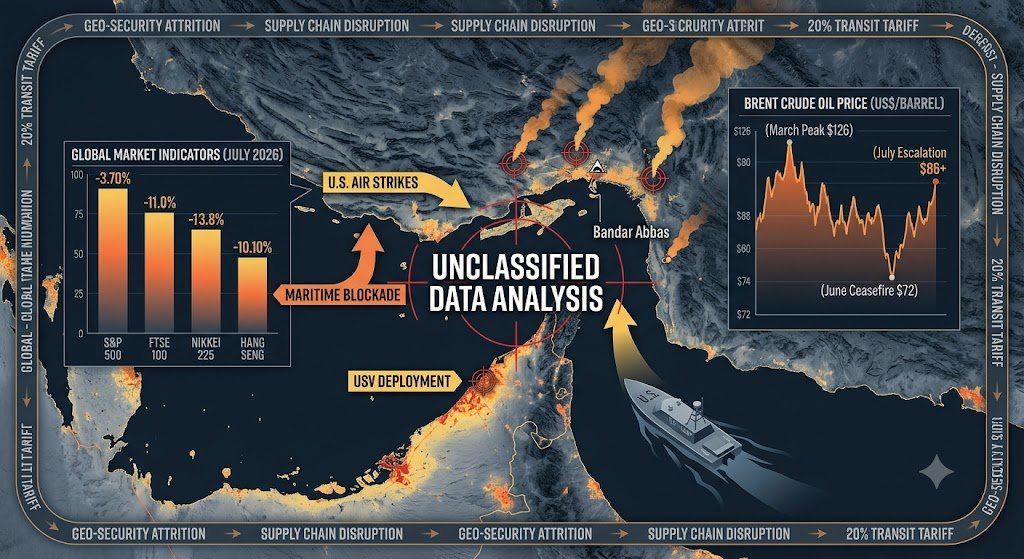
- Strait of Hormuz conflict triggers sharp declines in major stock indices across Wall Street, London, Tokyo, and Shanghai as supply chain fears intensify.
- Brent crude oil prices surge past $86 per barrel following the United States’ decision to reimpose a strict maritime blockade on Iranian ports.
- Negotiations brokered in Islamabad stall, leading to a dangerous military escalation and the first-ever deployment of unmanned surface vessels in the Persian Gulf.
- Global energy security hangs in the balance as analysts warn of an open-ended war of attrition threatening 20% of the world’s liquid petroleum supply.
ISLAMABAD — The fragile peace in the Middle East has shattered. Following a high-stakes, multi-month military standoff, the Strait of Hormuz has plunged back into active conflict. On Monday, U.S. President Donald Trump announced a dramatic return to open-ended airstrikes and the reimposition of a strict naval blockade on all Iranian ports.
This third major shift in Washington’s strategic approach comes just weeks after a June 17 interim ceasefire—brokered during tense negotiations in Islamabad between Vice President JD Vance and senior Iranian officials—failed to hold. The fallout has been immediate, sending shockwaves through global energy sectors and triggering a severe, coordinated retreat across international financial capitals.
Global Markets in Retreat: Panic from Wall Street to Tokyo
Financial capitals are reacting with stark negativity to the sudden return of hostilities in the world’s most vital maritime choke point. With 20% of the world’s petroleum supply transiting the narrow waterway, institutional investors have moved rapidly to price in a prolonged supply disruption.
The market response on Tuesday highlighted deep systemic fears:
- Wall Street: The S&P 500 and Dow Jones Industrial Average slid sharply, reflecting investor anxiety over renewed domestic inflation and declining corporate margins.
- London & Europe: The FTSE 100 closed down as energy-sensitive equities struggled under the weight of escalating shipping insurance premiums.
- Asian Hubs (Tokyo, Hong Kong, Shanghai, Singapore): Major indices, including the Nikkei 225 and the Hang Seng, fell between 1.5% and 3%. Export-dependent East Asian economies are uniquely vulnerable to prolonged maritime instability in the Persian Gulf.
Crude Oil Surges: The US$85 Threshold Broken
The direct consequence of the escalating Strait of Hormuz conflict is a violent correction in energy pricing.
  Brent Crude Price Trajectory (2026)

  $126 |      * (March Peak)
       |     / \
       |    /   \
  $86  |   /     \         * (July 14 Escalation)
       |  /       \       /
  $72  | /         \*____/ (June 17 Ceasefire)
       |________________________
         Mar       Jun    Jul
Following the initial outbreak of conflict earlier this year, Brent crude peaked at a historic $126 per barrel in March. While the June 17 Islamabad Memorandum of Understanding (MOU) temporarily cooled the market down to $72–$73 per barrel, the resumption of hostilities has erased those gains.
READ MORE: Redrawing the Map: Trump’s High-Stakes Gamble to Force a New Middle East Order
On July 13, Brent crude registered a massive 9.6% single-day surge—its largest daily gain since May 2020. By July 14, Brent futures climbed another 3.99% to trade at $86.62 per barrel, while West Texas Intermediate (WTI) advanced past $79.79. Commodity analysts warn that if the blockade remains strictly enforced, Brent is technically positioned to test the $93.05 resistance level.
A “Guardian” with a Price Tag: The New US Blockade
The renewed U.S. military strategy has taken an unprecedented, controversial turn. Beyond deploying B-52 bombers, tactical drones, and launching the first-ever American offensive use of unmanned surface vessels to target the port of Bandar Abbas, Trump has declared the U.S. as the self-appointed “Guardian of the Strait of Hormuz.”
Under this new declaration, the White House is demanding an extraordinary 20% transit fee (tariff) on all commercial cargo passing through the international waterway. While the U.S. Navy’s Joint Maritime Information Center confirmed the blockade on Iranian ports commenced at 20:00 GMT on July 14, neutral transit to non-Iranian ports is theoretically permitted.
However, shipping conglomerates warn that enforcing such a tariff—and navigating around active drone and missile crossfire—makes commercial transit practically unviable.
RELATED NEWS: The Battle for Hormuz: Trump Shifts Into Dangerous New Phase in Iran War
Forecasting: Where the Conflict Leads the World
As the U.S. and Iran lock into a coercive war of attrition, geopolitical analysts and military strategists are modeling three potential pathways for the coming months:
1. The Extended Attrition Scenario (Highest Probability)
Both Washington and Tehran remain convinced they can outlast the other’s pain threshold. Iran will continue deploying asymmetric warfare—utilizing its proximity to launch localized drone strikes and disrupt tanker traffic—while avoiding direct confrontation with U.S. carrier groups. In this scenario, Brent crude is projected to hover between $85 and $100 per barrel through Q3 2026, keeping global inflation sticky and preventing a sustained recovery in global equities.
2. Full Escalation and Strait Closure
Should U.S. forces attempt to forcibly collect the proposed 20% transit tariff or intercept Iranian state vessels, Tehran may attempt a complete, physical closure of the Strait using naval mines and anti-ship missile batteries. Analysts at Fitch Ratings and Chatham House warn that a sustained, full closure would remove upwards of 10 million barrels per day from the market, sending oil prices skyrocketing into the $100 to $130+ range, triggering a severe global recession.
3. The Return to the Islamabad Table
With U.S. midterm elections scheduled for November 2026, prolonged high fuel prices represent a critical political vulnerability for the Trump administration. As domestic dissatisfaction grows, the U.S. may be forced to seek an diplomatic off-ramp. A return to the negotiating table in Islamabad remains the most viable diplomatic avenue, which could quickly normalize supply lines and pull Brent crude back down toward its baseline of $70 per barrel by early 2027.