


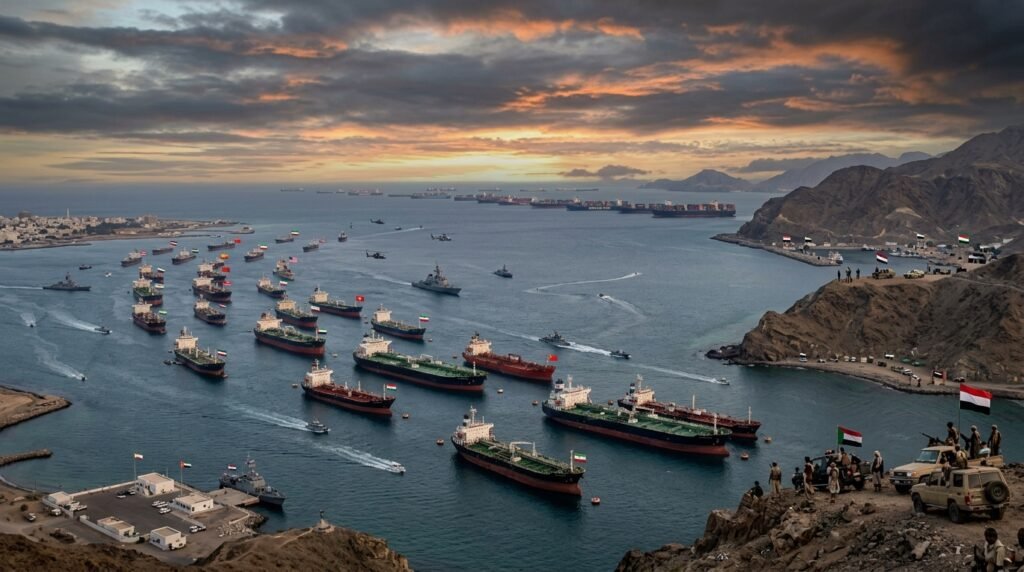
- Strait of Hormuz and Bab Al Mandeb chokepoints have effectively cut nearly 40% of global seaborne oil supplies, plunging international energy markets into an unprecedented price shock.
- Saudi Arabia’s container traffic has come to a total standstill following the Houthi takeover of Bab Al Mandeb and the emergency shutdown of the crucial East-West oil pipeline.
- Pakistan has initiated an emergency fuel subsidy scheme for small vehicles to cushion consumers, even as analysts warn of even more lethal economic challenges ahead.
Strait of Hormuz Crisis: Dual Maritime Chokepoints Paralyze Global Energy Routes and Propel Oil Prices to Historic Highs
Bab Al Mandeb Falls as Saudi Trade Stalls
Houthis taking control of Bab-Al Mandeb—culminating in the swift capture of the strategic port city of Mokha and the surrounding Perim Island—has delivered a catastrophic blow to the international shipping architecture. Maritime traffic through the Red Sea corridor has ground to a near-total halt as commercial insurers withdraw coverage and vessels alter course to avoid targeted missile strikes. For Saudi Arabia, the regional energy titan, the fallout has been immediate and severe: container shipping traffic across its western ports has been completely paralyzed.
Compounding the maritime blockade, a sequence of precise aerial strikes targeted Saudi Arabia’s crucial East-West pipeline, forcing an emergency shutdown of the entire conduit. The East-West pipeline served as the Kingdom’s main strategic alternative, designed to bypass vulnerable gulf waters by pumping crude directly from eastern fields to Red Sea export terminals.
READ MORE: Mecca Defence Alliance ‘Defensive’ in Nature, Expansion Currently Not on Cards, Says FO
With both its land-based bypass destroyed and its western shipping lanes compromised, Saudi Arabia’s oil exports have suffered a crippling hit. Industry analysts estimate this single disruption has stripped roughly 4% off the total global oil supply, leaving refiners worldwide scrambling for alternate crude allocations.
The Hormuz Bottleneck and the Dual-Chokepoint Trap
In the Strait of Hormuz, the situation was already at a breaking point. Months of escalating conflict involving U.S. naval forces, Iranian commandos, and regional proxy networks had restricted vessel transit to a fraction of normal capacity. The narrow waterway—historically responsible for carrying over 20% of the world’s petroleum consumption—has effectively turned into a militarized exclusion zone following repeated vessel seizures and missile exchanges.
The simultaneous closure of both the Strait of Hormuz and Bab Al Mandeb represents a worst-case scenario long feared by geopolitical strategists. Together, these two critical bottlenecks control the flow of nearly 40% of global seaborne crude and liquefied natural gas (LNG).
READ NEXT: Widening Mideast Instability Squeezes Global Oil Supplies
With Tehran and its aligned forces holding sway over both ends of the Arabian Peninsula, global energy supply routes have been severed simultaneously. Energy markets have reacted with absolute panic: Brent crude and West Texas Intermediate (WTI) benchmark prices have surged past historic highs, soaring into uncharted territory and threatening to drag the global economy into a severe stagflationary spiral.
Diplomatic Strains and the Looming Regional Fallout
Efforts to engineer a diplomatic off-ramp are failing under the weight of expanding combat zones. Regional summits intended to broker maritime truces have been repeatedly postponed, while Washington finds its military capabilities stretched to capacity across multiple fronts.
Saudi Arabia and other Gulf Cooperation Council (GCC) states now face the stark reality that major trade diversification projects cannot bypass an active, multi-front war zone. Iranian officials have made their terms explicit: seaborne traffic will not resume normal operations until all broader political and military disputes in the region are resolved.
As energy prices hit unprecedented levels, import-dependent developing economies are taking the brunt of the immediate impact. Pakistan—acting as a chief diplomatic negotiator between Iran and the United States—has been forced to institute emergency stabilization measures to shield its domestic populace from hyperinflation.
Prime Minister Shehbaz Sharif announced a targeted national relief package providing a discount of Rs100 per litre for motorbikes, rickshaws, and small passenger vehicles.
However, policy experts acknowledge that domestic subsidies are merely temporary band-aids. The coming days are projected to be even more lethal for the global economy as long-term supply deficits lock in, storage reserves drain, and key international trade routes remain severed without a viable resolution in sight.