


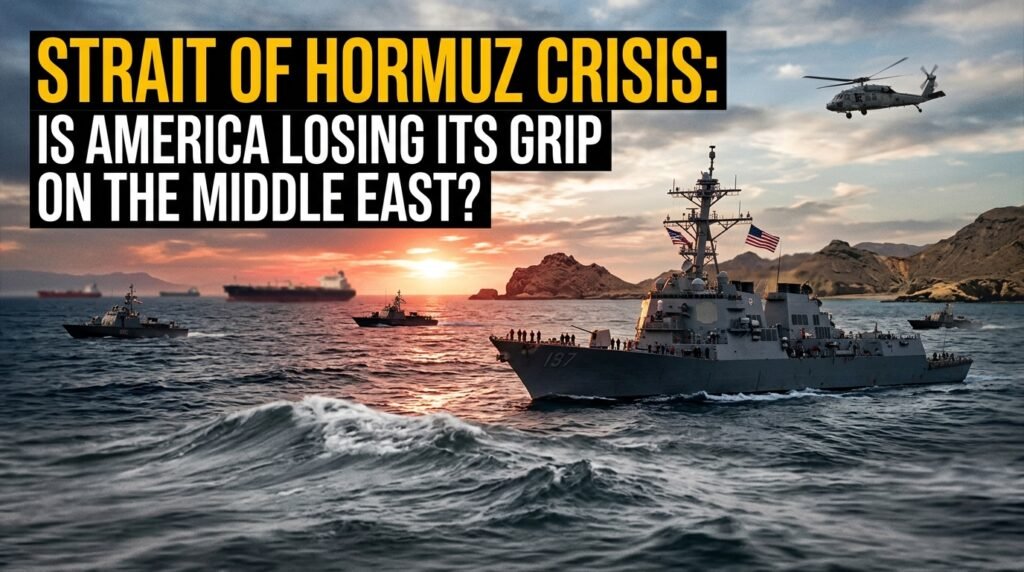
- Strait of Hormuz crisis: Shipping traffic through the strategic waterway has fallen sharply, exposing the vulnerability of global energy flows and the limits of military deterrence.
- Pakistan Saudi Arabia Türkiye defence pact: The three countries are developing a collective security framework that could reduce regional dependence on Washington.
- US influence in Middle East: The Hormuz crisis may not force an immediate American withdrawal, but it could accelerate the decline of US political indispensability across the region.
The Strait of Hormuz crisis is exposing the limits of American power in the Gulf while accelerating a new regional security architecture led by Saudi Arabia, Türkiye and Pakistan. Like the Suez Crisis weakened British and French dominance in 1956, Hormuz could become the turning point in the decline of unquestioned U.S. primacy in the Middle East.
The Strait of Hormuz has become more than a military flashpoint between the United States and Iran. It is now a test of whether Washington can continue to guarantee the security of the Gulf—and whether Middle Eastern powers are prepared to build an alternative security architecture of their own.
On Tuesday, only four commodity vessels transited the Strait of Hormuz, compared with a 10-day average of roughly 13, according to preliminary shipping data. Before the conflict, almost 20 percent of global oil shipments moved through the strategic waterway. The dramatic decline in traffic illustrates how quickly a regional conflict can threaten the foundations of the global energy system.
The crisis escalated further on September 1, when two supertankers carrying Saudi crude were attacked while passing through the Strait. Both vessels had loaded about two million barrels of Saudi oil at the Juaymah terminal. No casualties were reported, but the attacks immediately heightened fears over the safety of Gulf energy exports.
For Washington, the implications extend far beyond Iran.
Read Next: U.S. Firepower Shortage After Iran War Raises Fears Over China and Russia
The United States has spent decades constructing a security system around the Gulf based on military superiority, forward deployments, intelligence cooperation and security partnerships with Arab monarchies. Yet the current crisis is raising an uncomfortable question: What happens when overwhelming American military power cannot guarantee the uninterrupted operation of the world’s most important energy chokepoint?
The answer may increasingly be found not in Washington, but in Riyadh, Ankara and Islamabad.
Strait of Hormuz Crisis Exposes the Limits of American Power
The United States remains the most powerful external military actor in the Middle East. It possesses superior airpower, naval capabilities, intelligence assets and extensive military infrastructure across the region.
But military superiority does not automatically translate into political control.
Iran has demonstrated the distinction.
Tehran does not need to defeat the U.S. Navy in a conventional confrontation to impose strategic costs. It only needs to make commercial shipping sufficiently dangerous, uncertain or expensive to disrupt global energy markets and force Washington to devote enormous resources to protecting a narrow maritime corridor.
That is precisely why Hormuz matters.
A waterway only a few dozen miles long has become a strategic pressure point for the entire international economy. If tankers hesitate to enter it, insurers raise premiums, shipping companies alter routes and energy traders price in additional risk.
The result is a form of asymmetric power.
READ MORE: The End of the American Middle East
Iran can threaten the economic system without possessing anything close to America’s conventional military capabilities.
This is also why the crisis is increasingly uncomfortable for America’s Gulf partners.
Saudi Arabia can invest hundreds of billions of dollars in oil production and infrastructure, but those investments ultimately depend on secure access to international markets. The attacks on Saudi tankers demonstrate the vulnerability of that assumption.
The broader lesson is that Gulf states cannot afford to treat security as a problem that can be outsourced indefinitely to Washington.
Saudi Arabia has not abandoned the United States. There is no evidence that Riyadh intends to sever its longstanding military and economic relationship with Washington.
But Saudi strategy is changing.
The kingdom is increasingly pursuing a diversified foreign and security policy involving the United States, China, Russia, Türkiye, Pakistan and other regional actors.
That diversification has become much more significant during the Hormuz crisis.
Pakistan, Saudi Arabia and Türkiye: The Rise of a New Security Axis
The most important development in this emerging regional order may be the Saudi Arabia–Türkiye–Pakistan defense relationship.
On August 7, the three countries signed the Mecca Joint Defence Agreement, under which an armed attack against one signatory is to be treated as an attack against all three. The agreement came after months of negotiations and amid escalating regional tensions linked to the war with Iran.
The agreement has since moved beyond symbolism.
On August 31, Saudi Arabia, Türkiye and Pakistan agreed to establish a permanent secretariat in Saudi Arabia to coordinate the mechanism created by the defense pact. The secretariat will initially be headed by a Pakistani secretary-general for three years.
That institutional development matters.
Military alliances become meaningful when political declarations are converted into permanent mechanisms, command coordination, defense planning and regular consultations.
The emerging Saudi–Türkiye–Pakistan framework is beginning to acquire precisely those characteristics.
Each country also brings a different strategic asset.
Saudi Arabia possesses enormous financial resources, energy reserves and political influence across the Arab and Muslim worlds.
Türkiye has one of the region’s largest conventional militaries, an increasingly sophisticated defense industry and a strategic position connecting Europe, the Middle East and Asia.
Pakistan brings a large military, nuclear deterrence, missile capabilities, extensive operational experience and decades of defense cooperation with Saudi Arabia.
But Pakistan’s most important asset may be its geography.
Pakistan borders Iran while maintaining close defense relations with Saudi Arabia and increasingly strong strategic ties with Türkiye. Islamabad also retains working relationships with China and the United States.
Few countries can occupy such a position.
That gives Pakistan potential importance beyond its military capabilities.
During the Iran-U.S. conflict, Islamabad has repeatedly advocated dialogue and diplomacy and has been involved in efforts to facilitate communication between the parties. Pakistan’s Foreign Office has previously said that Islamabad’s diplomatic engagement contributed to the Iran-U.S. ceasefire and negotiations.
Pakistan’s role therefore has two dimensions.
It can be a security partner for Saudi Arabia and Türkiye while simultaneously serving as a diplomatic bridge between Iran and the Arab Gulf.
This combination could become increasingly valuable if the Hormuz crisis continues.
For Saudi Arabia, Pakistan provides military depth.
For Türkiye, Pakistan offers an established defense partner and access to the Gulf.
For Pakistan, the partnership provides greater strategic relevance at a time when the Middle East is undergoing a fundamental transformation.
The emerging triangle does not necessarily represent an anti-American alliance.
That would be an oversimplification.
Its significance lies elsewhere: regional powers are increasingly preparing for a Middle East in which their security cannot depend exclusively on Washington.
That is a profound change.
From Suez to Hormuz: Is the Era of American Primacy Ending?
The historical parallel with the 1956 Suez Crisis deserves attention.
In July 1956, Egyptian President Gamal Abdel Nasser nationalized the Suez Canal Company, which had been controlled by British and French interests. Britain and France, together with Israel, subsequently launched military action against Egypt.
But the intervention ended in political failure.
American opposition, Soviet pressure and international diplomatic resistance forced Britain and France to withdraw. The crisis exposed the declining ability of the two European powers to impose their will on the Middle East.
Suez did not make Britain and France disappear from the region overnight.
Their diplomats remained. Their commercial interests remained. Their military relationships did not simply vanish.
What changed was more important: their ability to determine the region’s political future was dramatically reduced.
That is why the Suez analogy matters today.
The Hormuz crisis is unlikely to force the United States out of the Middle East tomorrow. Washington will retain military bases, naval forces, intelligence capabilities and strategic partnerships.
But Hormuz could produce a similar shift in the nature of American influence.
The United States could remain militarily present while becoming less politically indispensable.
That distinction may ultimately define the next Middle Eastern order.
If Saudi Arabia continues strengthening defense cooperation with Türkiye and Pakistan, if Gulf states diversify their strategic partnerships, if China expands its economic role, if Türkiye becomes a more important security actor and if regional states increasingly negotiate directly with Iran rather than relying on Washington to manage every crisis, then America’s traditional position as the ultimate guarantor of Gulf security will become increasingly difficult to sustain.
The emergence of the Saudi–Türkiye–Pakistan framework is particularly important because it demonstrates that regional powers are not simply waiting for an American solution.
They are building their own.
For Pakistan, this represents an opportunity—but also a major responsibility.
Islamabad must strengthen its defense relationship with Riyadh and Ankara without allowing its ties with Tehran to deteriorate. It must preserve channels with Washington while deepening economic and strategic cooperation with China. Most importantly, Pakistan must avoid becoming merely another participant in a regional confrontation.
Its greatest strategic value may lie in being a bridge rather than a battlefield.
If the Hormuz crisis eventually produces negotiations, Pakistan could become an important diplomatic channel between Iran and the Gulf states. If regional security institutions expand, Islamabad could become one of their principal military contributors. And if Saudi Arabia and Türkiye seek to build a broader Muslim security framework, Pakistan’s participation would be difficult to ignore.
The strategic transformation is therefore already underway.
The Middle East is not necessarily becoming anti-American.
It is becoming less dependent on America.
That is a far more consequential development.
Suez marked the beginning of the end of British and French primacy in the Middle East. Hormuz may become the beginning of the end of unquestioned American primacy.
The United States is unlikely to leave the region simply because of the current crisis.
But history rarely changes in a single moment.
Sometimes it changes when allies begin searching for alternatives.
Sometimes it changes when a narrow waterway exposes the limits of a superpower’s ability to guarantee security.
And sometimes it changes when regional powers decide that they must take responsibility for their own future.
The Strait of Hormuz may prove to be such a moment.
If the Saudi–Türkiye–Pakistan partnership develops into a credible regional security structure, the Middle East could enter a new era in which Washington remains powerful but is no longer indispensable.
The United States may still have the strongest military in the region.
But the decisive question will be whether it remains the power that others need most.
That is the real geopolitical battle unfolding around Hormuz.