


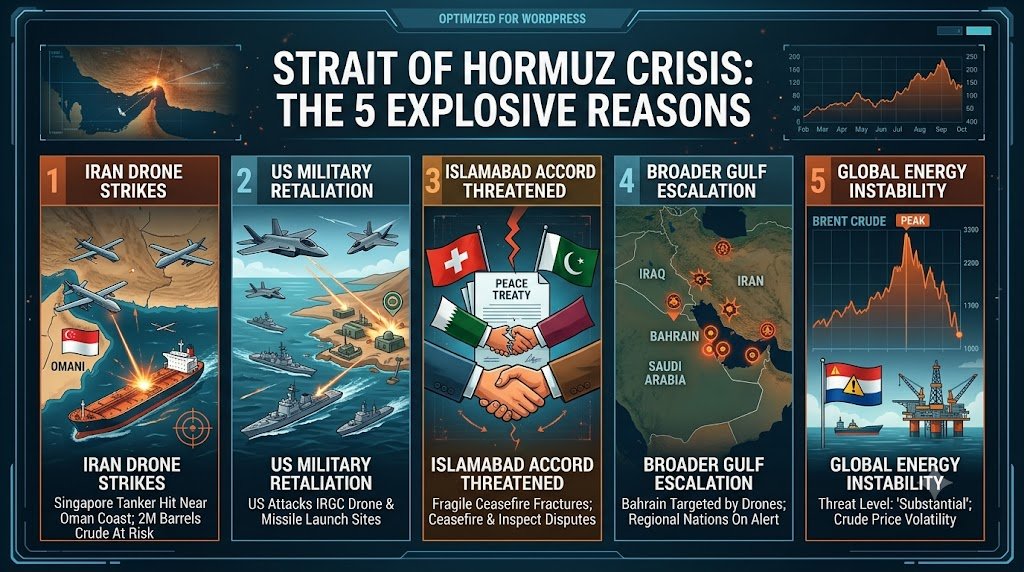
- Strait of Hormuz security threat level officially upgraded to “Substantial” by U.S.-U.K. maritime bodies following targeted drone strikes on merchant shipping.
- A Singapore-based tanker carrying 2 million barrels of crude oil was struck in the bridge near the coast of Oman.
- U.S. forces retaliated instantly with targeted strikes on Iranian military installations and IRGC coastal positions along the strategic waterway.
- The fragile diplomatic framework established under the Swiss-brokered Islamabad Accord faces potential collapse just days after implementation.
The strategic Strait of Hormuz has plunged back into chaos as regional escalation threatens the freshly inked U.S.-Iran peace framework.
Only days after the historic Islamabad Accord was brokered in Switzerland to halt the devastating U.S.-Iran war, the Middle East has erupted into a volatile new wave of attacks. Despite an electronic signature intended to seal a fragile ceasefire, heavy fighting near the critical Strait of Hormuz entered its third consecutive day on Saturday. Regional defense systems are flashing red as Tehran reasserts its aggressive chokehold on global energy lanes, pushing the newly minted diplomatic framework to the absolute brink of collapse.
                  CRITICAL CHOKEPOINT AT RISK

   [Persian Gulf] ----> (Strait of Hormuz) ----> [Sea of Oman]
                               |
                        [Oman Coastline]
                 *Target zone for drone strikes*
The Catalyst: Singpore-Based Tanker and Oman Coast Targets
The immediate breakdown of the ceasefire began on Thursday when a Singapore-based merchant tanker transited the Strait of Hormuz. Flying near the strategic coastline of Oman, the vessel crossed into waters that Tehran had unilaterally warned commercial shippers strictly to avoid.
According to naval monitoring data, an Iranian drone successfully breached the vessel’s perimeter, striking the bridge of the commercial tanker with an unidentified projectile. The vessel—which was reportedly carrying an immense payload of 2 million barrels of crude oil—sustained visible top-side damage. While no catastrophic oil spill has been detected, the strike sent shockwaves through international energy markets.
       MARITIME SECURITY THREAT LEVEL: STRAIT OF HORMUZ

       [ LOW ] --------> [ MODERATE ] --------> [[ SUBSTANTIAL ]]
                                                      ^
                                                (Updated Saturday)
In direct response to this blatant disruption of merchant shipping, the Joint Maritime Information Center (a combined U.S. and U.K. naval body) officially raised its maritime security threat level for the Strait of Hormuz to “Substantial” on Saturday.
Escalation in the Gulf: Drones Target Bahrain
The violence quickly rippled outward from the immediate strait into the broader Gulf. The Kingdom of Bahrain announced that its sovereign territory had come under a coordinated attack from incoming Iranian drones.
+------------------+----------------------------------------------------+
| TARGET PROFILE   | ACTION / ENGAGEMENT STATUS                         |
+------------------+----------------------------------------------------+
| Singapore Tanker | Hit in the bridge by an unidentified projectile     |
| Bahrain Airfield | 1 Iranian drone bypassed; crashed in remote zone   |
| Bahrain Ground   | 1 Iranian drone intercepted by defense systems     |
| Gulf Shipping    | 2 Iranian drones shot down by U.S. Navy warships   |
+------------------+----------------------------------------------------+
A senior U.S. defense official confirmed that regional tracking systems detected two Iranian-manufactured unmanned aerial vehicles (UAVs) heading directly toward Bahraini territory:
- Drone 1: Successfully intercepted and shot down by a ground-based air defense system before reaching its target.
- Drone 2: Evaded initial interceptors and impacted a remote airfield area, causing no immediate casualties or infrastructure damage.
Simultaneously, U.S. naval forces operating in the area intercepted and shot down two additional drones that were actively targeting other commercial vessels in nearby shipping lanes.
U.S. Retaliation: Striking Back at the IRGC
The response from Washington was instantaneous. President Donald Trump forcefully condemned the renewed offensive, labeling the maritime strikes a direct, egregious violation of the newly established ceasefire agreement.
               U.S. RETALIATORY STRIKE CODES

 [Command Authority] ---> [Naval Air Strike] ---> [IRGC Coastal Positions]
Under direct presidential orders, U.S. military assets launched a series of precise retaliatory strikes against Iranian military installations. The targets were heavily concentrated along the northern coast of the waterway, aiming specifically at Islamic Revolutionary Guard Corps (IRGC) drone launch sites, radar arrays, and fast-attack missile bays.
While Iranian state media stopped short of explicitly claiming official responsibility for the initial tanker and Bahrain strikes, they proudly broadcasted the IRGC’s retaliatory maneuvers. State networks confirmed that Iranian units had engaged “American targets” in the region, boldly reasserting Tehran’s total sovereign right to monitor, regulate, and restrict any naval traffic passing through the narrow Strait of Hormuz.
The Fate of the Islamabad Accord
This sudden explosion of kinetic warfare throws a dark shadow over the Islamabad Accord, a 14-point memorandum of understanding (MoU) facilitated by Pakistan and Qatar, and finalized through Swiss diplomatic channels.
READ MORE: Trump Iran Senate Reversal: How Donald Trump Forced Republicans to Fall in Line on Iran War Strategy
The preliminary peace deal was designed to provide an off-ramp to the grueling U.S.-Iran war. Under its initial terms, the U.S. agreed to lift its strict naval blockade of Iranian ports and issue temporary Treasury waivers for crude oil exports. In return, Iran committed to ensuring the completely free, toll-free, and safe passage of commercial vessels through the Persian Gulf and the Sea of Oman for a mandatory 60-day window.
The Diplomatic Friction Point: Iran loudly insists that any finalized permanent peace deal must explicitly recognize its legal authority to collect operational revenues and fees from commercial ships transiting the strait. Furthermore, Tehran maintains a rigid, non-negotiable stance that it will not surrender or dismantle its domestic nuclear program under western pressure.
+-----------------------------------+-----------------------------------+
| ISLAMABAD ACCORD: U.S. CONCESSIONS| ISLAMABAD ACCORD: IRAN PLEDGES    |
+-----------------------------------+-----------------------------------+
| Lift naval blockade within 30 days| 60 days of safe, toll-free passage|
| Issue oil export Treasury waivers | Complete mine clearance in strait |
| $300B regional reconstruction plan| Maintain nuclear status quo (MoU) |
+-----------------------------------+-----------------------------------+
Compounding the diplomatic stress, regional peace remains deeply fragmented. While Israel and Lebanon signed a parallel, U.S.-brokered peace framework on Friday, Hezbollah—the heavily armed, Iran-backed faction in Lebanon—issued a fiery public statement on Saturday utterly rejecting the accord, vowing to keep trading fire across the border.
MUST READ: Mideast Fighting Widens With Attacks on Bahrain, Hormuz Tanker
Despite the smoke rising over the Gulf, both Washington and Tehran have subtly signaled a desire to prevent these tit-for-tat skirmishes from degenerating into a total collapse of the Swiss-mediated framework. For now, technical teams continue to meet behind closed doors, trying desperately to salvage a peace deal that is unraveling faster than it can be implemented.