


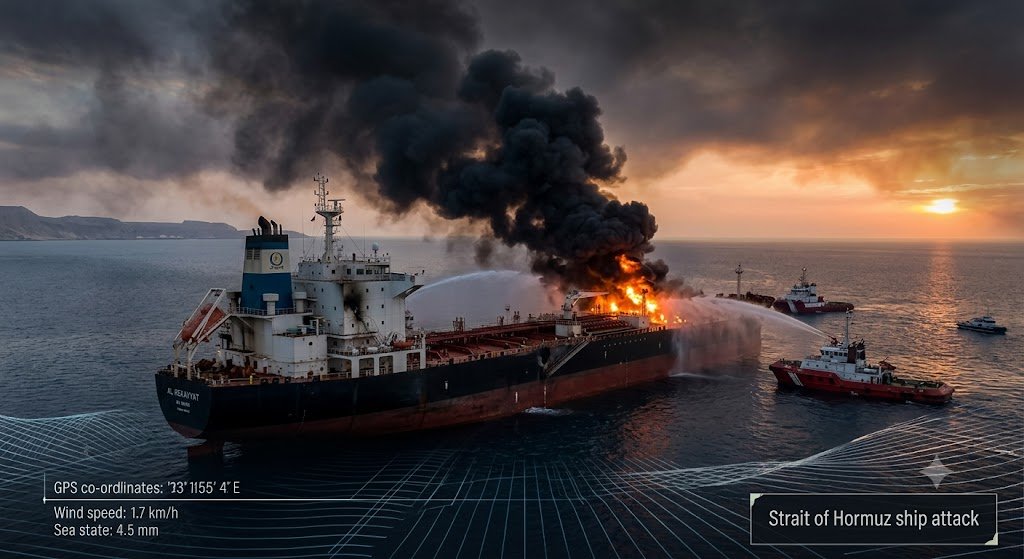
- Strait of Hormuz ship attack: Iran’s Islamic Revolutionary Guard Corps (IRGC) fired missiles at two commercial ships, intentionally using tactical escalation to undermine moderate Iranian diplomats and sabotage impending peace talks.
- The Primary Target: The Al Rekayyat, a Qatari-owned LNG tanker, was struck on its port side near Limah, Oman, sustaining an engine room fire while operating with its GPS transmission turned off.
- Shipping Lane Impact: Despite recent recurring threats, maritime data shows the chokepoint remains resilient, with daily traffic stabilizing between 30 and 60 crossings even as war-risk insurance premiums face imminent spikes.
- Diplomatic Forecasting: The attack severely compromises the U.S.-Iran 60-day negotiation memorandum, forcing a high-stakes shift toward brinkmanship and increasing the probability of a U.S. kinetic response ahead of the Islamabad summit.
TEHRAN / WASHINGTON — In a move that directly threatens to derail upcoming peace negotiations, Iran’s Islamic Revolutionary Guard Corps (IRGC) fired missiles at two commercial ships near the strategic Strait of Hormuz early Tuesday. The escalation comes at a highly sensitive moment, occurring just days before the U.S. and Iran are scheduled to convene in Islamabad for a critical third round of talks aimed at ending their ongoing war.
The attacks underscore a bitter internal rift within Tehran, pitting the powerful paramilitary IRGC against more moderate Iranian leaders who had recently agreed to a 60-day memorandum of understanding (MoU) to negotiate a permanent ceasefire.
Strait Of Hormuz Ship Attack: Anatomy of the Escalation
According to senior U.S. officials and maritime security reports, the strikes targeted vessels navigating the mouth of the strait in the Gulf of Oman. State broadcaster IRIB confirmed the targeting, claiming the vessels ignored repeated warnings and attempted to utilize a U.S.-backed transit route near the Omani coast.
The data surrounding the primary strike includes:
- The Target: The Al Rekayyat, a liquefied natural gas (LNG) tanker owned by Nakilat (Qatar’s state shipping arm).
- Location: Approximately 8 nautical miles east of Limah, Oman.
- Damage Assessment: The projectile struck the port side, directly hitting the top of the engine room and causing a significant fire and heavy smoke.
- Casualties: Zero. According to distress recordings, all crew members safely mustered on the starboard side, and the onboard fire was later brought under control by maritime security firm Vanguard Tech.
READ MORE: US strikes on Iran escalate as Strait of Hormuz tensions threaten global oil prices
This strike follows an explicit radio warning broadcasted by the IRGC over the weekend, stating: “Our missiles and drones are ready to fire at you.”
Impact on Maritime Traffic and Global Energy
Despite the attack, maritime data suggests global shipping has developed a resilient, albeit cautious, tolerance to the conflict.
| Metric | Current Status |
| Daily Strait Crossings | Stabilized at 30 to 60 crossings per day. |
| Recent Precedents | Follows two separate attacks on a cargo ship and an oil tanker last month. |
| AIS Tracking | The Al Rekayyat had been operating dark, failing to transmit GPS signals since June 18. |
While traffic has recovered to these levels, insurance premiums for vessels transiting the chokepoint are expected to spike significantly following this direct missile deployment against an LNG carrier.
Forecasting: What This Means for the Islamabad Talks
The timing of the attack is deliberately disruptive. It coincides with national mourning in Iran for the former Supreme Leader, Ayatollah Ali Khamenei—who was killed at the onset of the war—and lands precisely on the eve of the third round of diplomatic talks in Islamabad later this week.
Relate News: Iran’s Revolutionary Guard Fires Missiles at Ships Near Hormuz
Observers point to three primary forecasts for how these strikes will reshape the upcoming negotiations:
1. Diplomatic Brinkmanship and Leverage Seeking
Rather than scuttling the talks entirely, the IRGC’s actions are likely designed to force a hardline posture on Iran’s diplomatic delegation in Islamabad. By proving it can shut down or severely disrupt LNG and oil transit at will, Tehran may attempt to leverage maritime stability to demand steeper concessions from Washington, such as immediate sanctions relief or specific military withdrawals.
2. Deepening Iranian Internal Fractures
The Islamabad talks will test who truly dictates Iranian foreign policy. The IRGC has consistently positioned itself as the largest obstacle to a final agreement. If the moderate faction in Tehran cannot guarantee the security of the shipping lanes during the 60-day MoU period, the U.S. delegation may view any diplomatic breakthrough in Islamabad as functionally unenforceable.
3. Heightened Risk of a U.S. Kinetic Response
The U.S. military cleared the specific Omani route chosen by the Al Rekayyat. By directly attacking a ship on a U.S.-secured path, Iran has challenged Washington’s red lines. While the U.S. remains committed to the Islamabad framework, a third round of talks will almost certainly begin with a rigid American ultimatum regarding freedom of navigation, backed by the implicit threat of localized U.S. retaliatory strikes if the IRGC fires again.
The Bottom Line: The Islamabad talks are no longer just about text on a page; they are now bound to the volatile reality of the Strait of Hormuz. Success later this week will depend entirely on whether negotiators can insulate the diplomatic table from the smoke still rising in the Gulf of Oman.