


-
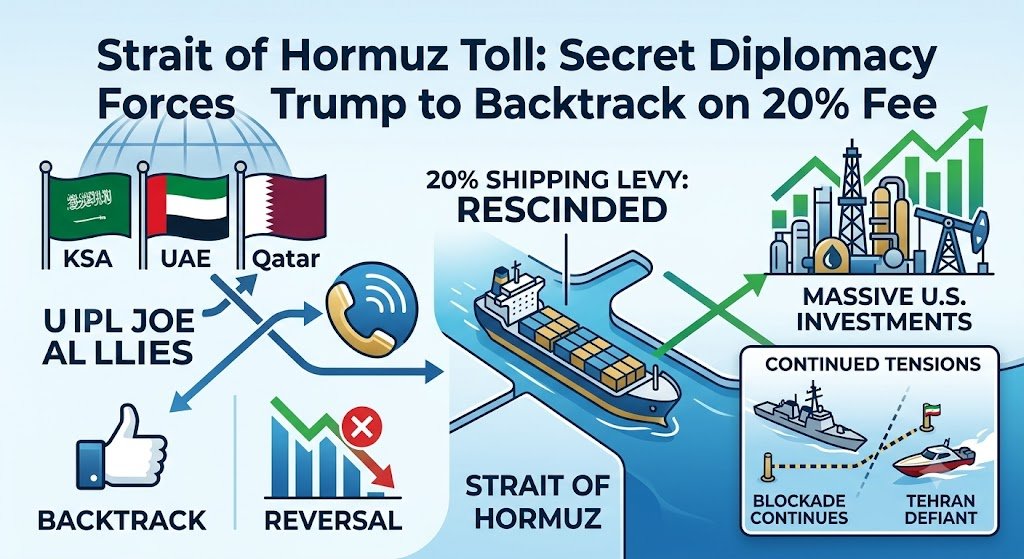
Strait Of Hormuz Toll And Unprecedented Diplomatic Coalition: In a rare display of complete regional alignment, authorities from Saudi Arabia (KSA), the UAE, and Qatar jointly bypassed traditional diplomatic channels to lobby President Trump directly.
-
The Strategic Reversal: Within 24 hours of declaring the U.S. “The Guardian of the Hormuz Strait,” Trump rescinded the proposed 20% toll, replacing it with massive, long-term Gulf investment deals in U.S. infrastructure and manufacturing.
-
The Legal & Economic Threat: Gulf allies warned that imposing a U.S. transit fee would violate international maritime law, trigger a global energy crisis, and legally validate Iran’s own plans to levy illegal tolls.
-
Horns Locked in the Gulf: Despite dropping the safeguarding fee, the geopolitical deadlock persists as the U.S. maintains a strict naval blockade, while a defiant Tehran continues to aggressively challenge American authority in the strait.
In an extraordinary display of diplomatic unity, America’s closest Middle Eastern allies successfully lobbied U.S. President Donald Trump to backtrack on his sudden, highly controversial proposal to impose a 20% safeguarding fee on all commercial cargo transiting the region.
Insiders close to the developments told The Islamabad Telegraph that authorities from the Kingdom of Saudi Arabia (KSA), the United Arab Emirates (UAE), Qatar, and other regional partners immediately coordinated a diplomatic blitz to convince Trump that the proposed Strait of Hormuz toll would destabilize global energy markets, violate international maritime law, and hand a massive geopolitical victory to Iran.
While the high-stakes push succeeded in reversing the toll within 24 hours, the fundamental crisis in the Gulf remains unresolved. Trump has vowed that the U.S. military will continue its aggressive blockade of Iranian ports to “teach Iran a lesson,” while a defiant Tehran continues to openly challenge American authority in the vital waterway.
The 24-Hour Diplomatic Sprint to Kill the Strait of Hormuz Toll
The crisis began on Monday morning when President Trump took to Truth Social, declaring the United States as the official “GUARDIAN OF THE HORMUZ STRAIT” and proposing a 20% U.S. reimbursement fee on all transit cargo as compensation for U.S. naval protection.
Strait of Hormuz Conflict Escalates as Trump Orders Strikes and Global Markets Plunge
The announcement caught regional capitals and even Trump’s own White House aides completely off guard. Officials in Riyadh, Abu Dhabi, and Doha instantly recognized the severe economic and legal ramifications of the decision. High-ranking diplomatic sources revealed to The Islamabad Telegraph that the announcement triggered an immediate, coordinated response. Leaders and senior emirs from KSA, the UAE, Bahrain, and Qatar bypassed traditional bureaucratic channels, directly contacting the White House.
Historically divided on various regional foreign policy issues, Gulf allies found themselves on the exact same page. Their core arguments to Trump were twofold:
- The Legal Precedent: Imposing a U.S. Strait of Hormuz toll would legally validate Iran’s long-held assertion that it has the right to charge transit fees in the strait.
- The Economic Fallout: A 20% toll would send shipping insurance rates and global oil prices spiraling, triggering a severe global energy crisis that could harm the global economy.
- Trump Backs Down—At a Price
By Tuesday morning, the intense lobbying effort paid off. Trump officially rescinded the toll proposal, pivotally shifting the narrative from direct transit fees to sovereign regional investments.
“I was called by different people, different countries, kings and emirs, and all of the people that we all know and we all love,” Trump told reporters on Tuesday. “And they said we’d love to do it a different way.”
Instead of a maritime Strait of Hormuz toll, Gulf allies reportedly placated the transaction-oriented president by pledging substantial, though currently undefined, new capital injections into U.S. domestic investments.
The U.S. and Iran Reckon With Shrinking Options to End the War
While the immediate threat of a commercial shipping toll has been neutralized, the geopolitical standoff in the Strait of Hormuz is rapidly intensifying.
Horns Locked On Strait Of Hormuz Toll: The Blockade and Iranian Defiance
Despite dropping the safeguarding fee, President Trump made it clear that the U.S. military footprint in the region is not backing down. According to administration sources, Trump remains committed to maintaining a strict naval blockade of the Strait of Hormuz to choke off Iranian exports and “teach Iran a lesson.”
Tehran, however, shows no signs of capitulating. Iran has continued to actively challenge U.S. naval authority in the region, asserting its own sovereignty over the narrow choke point. Following Trump’s initial toll announcement, Iranian Foreign Minister Abbas Araghchi sarcastically welcomed the premise, arguing that if the U.S. believes securing passage warrants a financial fee, Iran—as the primary coastal state—is equally entitled to compensation
Military analysts warn that the situation has evolved into a classic “chicken” scenario, where neither Washington nor Tehran is willing to step back. With shipping traffic already down and oil prices climbing, the temporary diplomatic victory achieved by Gulf allies has only delayed a broader, more volatile reckoning in the world’s most critical energy transit corridor.