


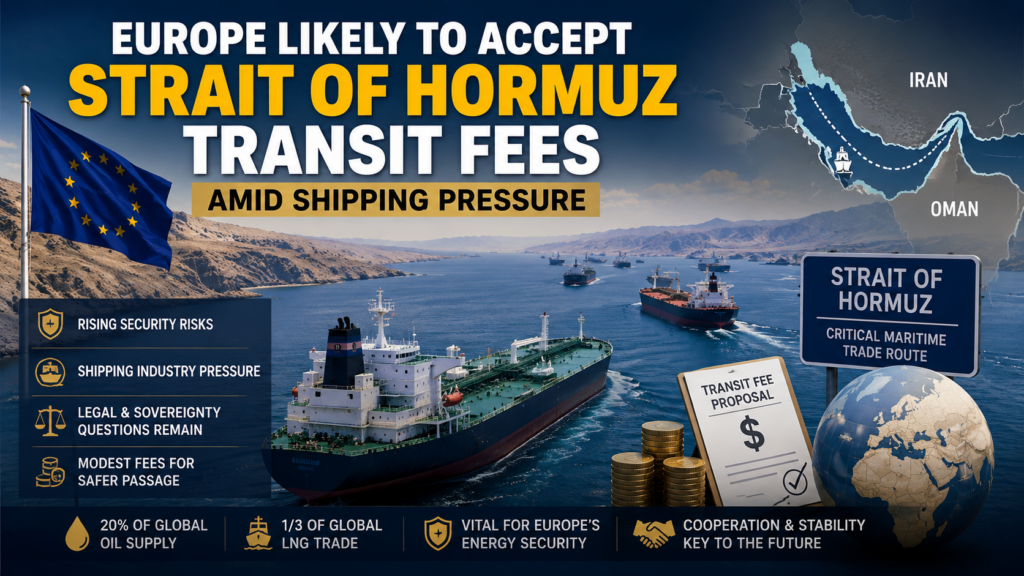
European governments, many of them key members of NATO, are increasingly inclined to accept the introduction of modest transit fees for commercial vessels passing through the Strait of Hormuz, according to senior diplomatic insiders who spoke to The Islamabad Telegraph. The emerging consensus reflects mounting pressure from global shipping giants and insurers seeking predictability in one of the world’s most volatile maritime chokepoints.
Officials across major European capitals have quietly begun studying proposals that would allow voluntary navigational service fees—provided they are endorsed by the United Nations’ maritime regulatory framework and remain non-compulsory. The shift marks a notable recalibration in Europe’s long-standing position on freedom of navigation in international waterways.
Shipping Pressure Reshapes European Calculus
The Strait of Hormuz handles nearly 20 percent of global oil supply and around one-third of seaborne liquefied natural gas (LNG), making it indispensable for energy-dependent economies across Europe. Disruptions in recent months—triggered by escalating US-Iran tensions and intermittent military strikes—have sent insurance premiums soaring by as much as 60 percent and forced rerouting costs into billions of dollars.
Industry leaders, including major tanker operators and maritime insurers, have lobbied European governments to consider structured payment mechanisms that could enhance safety, coordination, and predictability. Insiders indicate that policymakers now view modest fees—particularly those tied to navigational services such as pilotage, surveillance, and emergency response—as a pragmatic compromise.
A senior European diplomat noted: “There is growing recognition that if fees are transparent, voluntary, and linked to safety services, most European states would accept them as part of a broader stability framework.”
Legal Ambiguity: Who Owns the Strait, Who Gets Paid?
However, critical legal and sovereignty questions remain unresolved. The Strait of Hormuz is geographically shared between Iran and Oman, with Oman controlling a larger portion of the navigable southern channel commonly used by international shipping.
This raises fundamental questions: Who has the legal authority to levy fees? Would revenues be shared between Tehran and Muscat? And what happens if vessels exclusively transit through Omani-controlled waters?
Under the United Nations Convention on the Law of the Sea (UNCLOS), straits used for international navigation guarantee the right of transit passage without impediment. Any attempt to impose mandatory tolls risks violating international law. However, voluntary contributions for services—similar to arrangements in the Strait of Malacca—are considered permissible.
READ MORE: Trump Unleashes ‘Massive Strike’ on Iran as Ceasefire Collapses, War Enters Decisive Phase
Oman has already developed a proposal, reportedly in collaboration with British legal experts, based on the Malacca model. This framework emphasizes cooperative funding mechanisms rather than compulsory tolling, with contributions directed toward maritime safety, environmental protection, and emergency preparedness.
Europe Aligns with Oman’s Voluntary Model
European governments appear more comfortable aligning with Oman’s approach rather than Iran’s more assertive posture. Muscat has explicitly opposed compulsory tolls but has endorsed voluntary financial arrangements tied to service provision.
At a recent International Maritime Organization (IMO) council meeting in London, Omani officials reiterated that transit passage must remain free under international law. However, they signaled openness to “voluntary arrangements relating to navigational support services.”
US and Iran trade escalating strikes as supreme leader is buried after days-long funeral
This position has gained traction among European policymakers, particularly as they seek to avoid legitimizing unilateral control over the strait by any single actor.
Iran’s Position Remains Unclear Amid Internal Divisions
Iran, meanwhile, has sent mixed signals. While some factions within Tehran support cooperative frameworks, others—particularly elements within the Islamic Revolutionary Guard Corps (IRGC)—have questioned the relevance of international maritime law following recent US military strikes.
Iranian Foreign Minister Abbas Araghchi is expected to hold talks in Oman focusing on shipping safety and the future governance of the strait. Iranian state media has framed these discussions as part of ongoing consultations, but no clear policy direction has emerged.
Diplomatic sources suggest that Iran may seek a role in administering or approving transit routes, raising concerns among European and Gulf states about potential politicization of maritime access.
US Pressure and Security Dynamics
The United States has intensified pressure on Tehran to publicly guarantee safe passage through the strait. Washington has also facilitated the transit of more than 800 commercial vessels and approximately 380 million barrels of crude oil since early May, according to US Central Command.
Despite these efforts, tensions remain high. Recent US strikes on over 150 Iranian targets and retaliatory attacks on US bases in the Gulf have underscored the fragility of the current ceasefire framework.
Former President Donald Trump further escalated rhetoric, declaring the ceasefire “over” and issuing renewed threats against Iran, adding to uncertainty surrounding long-term maritime security.
Malacca Model Gains Policy Momentum
The Strait of Malacca, which sees over 120,000 vessel transits annually, has emerged as a key reference point in policy discussions. Its cooperative mechanism—funded through voluntary contributions from user states such as Japan—has demonstrated that shared responsibility can enhance safety without undermining legal principles.
European officials increasingly view this model as adaptable to the Strait of Hormuz, particularly if it ensures transparency, multilateral oversight, and equitable burden-sharing.
Unanswered Questions Persist
Despite growing momentum, several critical issues remain unresolved:
- Whether fees would be collected jointly by Iran and Oman or administered through an international mechanism
- How compliance would be ensured without making payments effectively compulsory
- Whether ships could opt out by exclusively using Omani-controlled waters
- And how revenues would be allocated to avoid political leverage by regional actors
For now, European governments appear willing to accept modest costs in exchange for stability. But without clear legal frameworks and political consensus, the future governance of the Strait of Hormuz remains uncertain.
As one senior official put it: “Europe is prepared to pay for security—but not at the cost of international law.”