


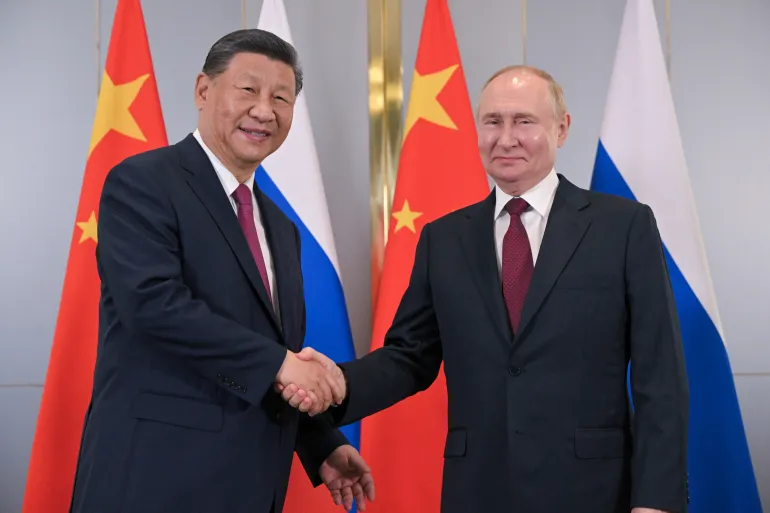
China’s Defense Minister Dong Jun told his Russian counterpart on Tuesday that Beijing was willing to enhance strategic coordination with Moscow and jointly improve their capacity to respond to risks and challenges, state media reported.
The recent pledge by Chinese Defense Minister Dong Jun to his Russian counterpart, Andrei Belousov, marks a critical pivot in global power dynamics. By vowing to “strengthen strategic coordination” and “enrich the substance of cooperation,” the two nations are moving beyond mere diplomatic pleasantries into a robust, integrated security framework.
China Russia South Africa Naval Exercise: A Strategic Signal Amid Trump’s Hawkish Foreign Policy
This development is particularly alarming for the United States, Japan, and Europe, as it solidifies a secondary power axis that directly challenges the post-WWII security architecture.
Trade Dynamics: The $240 Billion Lifeline
Economic synergy remains the bedrock of this alliance. Despite Western sanctions designed to isolate Moscow, the trade volume between China and Russia has reached historic heights.
| Year | Trade Volume (USD) | Growth/Trend |
| 2021 | $147 Billion | Pre-conflict baseline |
| 2023 | $240.1 Billion | Record high surge |
| 2024 | $244.8 Billion | Plateau/Consolidation |
| 2025 (est) | ~$234 Billion | Impact of secondary sanctions & market saturation |
Main Areas of Cooperation:
- Energy: Russia provides over 20% of China’s oil and significant portions of its LNG and coal. The “Power of Siberia” pipelines are the physical arteries of this dependency.
- Automotive & Tech: Following the exit of European and Japanese brands, Chinese automakers now command the Russian market, with exports of passenger cars growing by nearly 970% since 2021.
- Dual-Use Goods: China has become Russia’s primary source for microelectronics, machine tools, and telecommunications gear—essential components for modernizing military hardware.
- Defense Industry Analysis: Volume and Ferocity
The “ferocity” of the Sino-Russian defense relationship is defined by a shift from buyer-seller to co-developers. Russia, once the senior partner in military tech, is now increasingly reliant on China’s industrial scale.
China calls for closer defense ties with Russia in ministers’ talks
Intelligence & Space: Recent reports indicate China is sharing satellite intelligence and reconnaissance data to aid Russian operations, filling gaps left by Russia’s aging orbital constellations.
The Drone Factor: While Beijing denies sending lethal weapons, the flow of fiber-optic cables, lithium batteries, and engines has allowed Russia to scale its domestic drone production to unprecedented levels.
Global Watch Daily Briefing
Naval Integration: Joint exercises in the South China Sea and the Tsushima Strait (near Japan) utilize shared sonar data, signaling to the U.S. that the Indo-Pacific is no longer an uncontested American lake.
“The Sino-Russian nexus is no longer a marriage of convenience; it is a structural necessity for both regimes to survive Western containment.”
Global Context: A Middle Eastern Powder Keg
The timing of this coordination is no coincidence. As the U.S. USS Abraham Lincoln carrier strike group docks in the Middle East to threaten Iran—a mutual partner of both Moscow and Beijing—the Eurasian duo is signaling a unified front.
While the U.S. and Europe grapple with internal political shifts and differing priorities regarding NATO and trade tariffs, China and Russia are presenting a “stable” alternative. The 2026 U.S. National Defense Strategy has notably downplayed China as the “primary threat” to focus on the Western Hemisphere, a move that may inadvertently give Beijing and Moscow the breathing room they need to finalize their “no-limits” integration.
For Europe and Japan, this alignment represents a pincer movement: Russia remains the primary land-based security threat in the West, while China’s naval and economic expansion creates a maritime blockade in the East.
Perspective: The Limits of a “Eurasian NATO”
The prospect of a formal China-Russia military bloc—a “Eurasian NATO”—remains a strategic aspiration rather than a current reality. While both nations have pledged “no-limits” cooperation, several structural barriers prevent them from forming a traditional collective defense alliance like NATO.
Key Obstacles to Integration
- Strategic Autonomy: Beijing, in particular, values non-alignment. A NATO-like “Article 5” (collective defense) would obligate China to intervene in Russia’s conflicts (like Ukraine) or Russia to join a conflict over Taiwan, risks neither side is currently willing to institutionalize.
- Interoperability: Unlike NATO, which has decades of standardized equipment and command structures, the Chinese and Russian militaries lack deep operational integration.
- Diverse Interests: The Shanghai Cooperation Organization (SCO) and BRICS+ attract countries from Africa and Asia primarily for economic and diplomatic reasons. Most “Global South” nations seek a multipolar world to avoid choosing sides, rather than joining a rigid military bloc that could trigger Western sanctions.
Current Trajectory
Instead of a formal alliance, analysts are seeing a “Functional Alignment”:
- Joint Exercises: Increasing in frequency and “ferocity” in the Pacific and Mediterranean.
- Military-Technical Exchange: China provides the industrial scale (chips, drones), while Russia offers combat-tested missile and undersea tech.
Analysts and defence experts believe while China and Russia can effectively coordinate to challenge U.S. hegemony, a formal, multi-nation military bloc remains unlikely. Their strength lies in flexible, bilateral partnerships rather than a centralised, rigid alliance.