


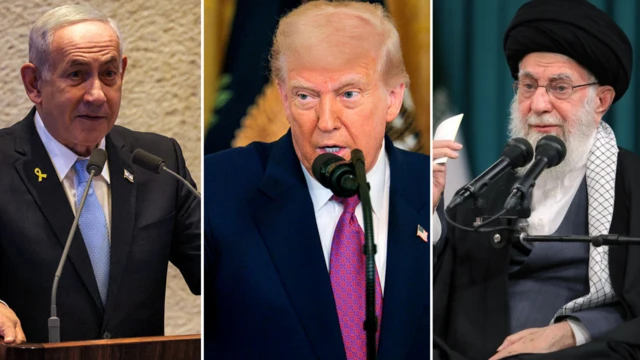
- Strike on Iran is being weighed against a regime that has already reconstituted a 2,000-missile stockpile.
- Inflation in Iran has hit 52.6%, fueling mass protests across 155 cities.
- Military preparedness remains high with the deployment of the autonomous Bavar-373 II system.
- Insiders warn that the regime’s security pillars remain unified despite Western assumptions of weakness.
The geopolitical theater of the Middle East is currently dominated by a singular, looming shadow: the potential for a massive, secondary military strike on Iran. Following their recent summit at Mar-a-Lago, U.S. President Donald Trump and Israeli Prime Minister Benjamin Netanyahu have signaled that the “June War” was merely a prelude.
However, an analytical dive into the figures—economic, social, and military—reveals a paradox. While Iran is currently weathering a perfect storm of internal crises, the assumption that the clerical regime is a “house of cards” ready to collapse is a dangerous miscalculation by Western strategists.
Middle East Strategic Tensions: Assessing the 2026 Fragile Equilibrium
The Economic Crucible: Inflation and Unemployment by the Numbers
The pressure on the Iranian street is undeniable and mathematically staggering. As of late December 2025, the Statistical Center of Iran has reported a point-to-point inflation rate of 52.6%. This is not merely a number on a ledger; it represents a reality where the price of essential food items—milk, cheese, and eggs—has surged by over 10% in a single month.
- Hyperinflationary Threshold: With monthly inflation touching 4.2%, experts warn that Iran is teetering on the edge of the standard definition of hyperinflation (50% monthly growth).
- The Unemployment Crisis: While official figures are often opaque, independent analysts suggest that youth unemployment in urban centers like Tehran, Mashhad, and Isfahan has bypassed 25%.
- The Bread Crisis: In a country where bread is a sacred staple, costs have risen by 7.7% in December alone, pushing lower-income deciles toward absolute hunger.
Saudi Arabia Foreign Policy: How MBS and Trump Are Re-Engineering Middle East Stability
These economic indicators have birthed a wave of protests. From the oil workers of Ahvaz to the nurses in Sanandaj and retirees in Kermanshah, “tens of hundreds” have blocked roads to decry corruption and the “incompetence” of government officials. Yet, despite a 92% dissatisfaction rate reported in some internal polls, this public anger has not yet translated into a unified movement capable of toppling the state.
Turkey’s Balancing Act: Navigating Complex Relations with Russia and Ukraine Amid Ongoing Conflict
Military Preparedness: Rebuilding the “Wall of Fire”
The Western narrative often focuses on the “obliteration” of Iranian sites during the June 2025 strikes. However, reports from The Islamabad Telegraph and defense intelligence circles suggest a rapid, almost phoenix-like rearmament.
Trump threatens Hamas, warns Iran of more strikes after Netanyahu talks
The Iranian military is far from paralyzed; it is actively adapting. Following the June conflict, Tehran replaced its air defense commander and accelerated the deployment of domestically produced “game-changers.”
- Bavar-373 II: Iran has unveiled an upgraded version of its flagship air defense system. It now features independent launcher stations, meaning each unit can track and engage targets autonomously, even if the central radar is jammed or destroyed.
- Strategic Reconstitution: Despite the destruction of planetary mixers in June, Iranian missile production has already rebounded. Intelligence estimates suggest a stockpile of approximately 2,000 “heavy” ballistic missiles capable of reaching any target in Israel or U.S. bases in the Gulf.
- The Monir System: A new low-altitude detection system has been integrated into the network, specifically designed to identify stealth drones with low-radar cross-sections.
The U.S. and Israel view the protests as the beginning of the end. However, the Iranian regime’s strength lies in its institutional cohesion. The IRGC (Revolutionary Guard) and the regular army remain unified, viewing an external strike not as a reason to defect, but as a catalyst for national defence.
Furthermore, while urban elites may demand secular reform, a significant core of the population—particularly in rural areas and among the religious working class—still views the current leadership as the only bulwark against “foreign intervention and separatism.”
India and Pakistan Fuel South Caucasus Arms Race: Fighter Jet Deals with Armenia and Azerbaijan Escalate Tensions
The Geopolitical Gamble
A renewed strike on Iran might satisfy the tactical goals of the Trump-Netanyahu duo, but the strategic fallout would be permanent. Toppling the regime remains a “distant dream” because the state’s security apparatus is built for survival under extreme pressure. Rather than inducing a collapse, a strike is more likely to:
- Galvanize the “Axis of Resistance.”
- Fuel anti-U.S. sentiments that could destabilize the newly formed Syrian administration and the fragile Gaza ceasefire.
- Push Tehran to finally cross the nuclear threshold as a desperate act of “deterrence-at-all-costs.”
In modern history, few duos have wielded as much power as Trump and Netanyahu. But in the high-stakes game of Middle Eastern chess, a direct strike may not result in checkmate, but in a board that is flipped entirely, leaving the region in a state of irreversible chaos.