


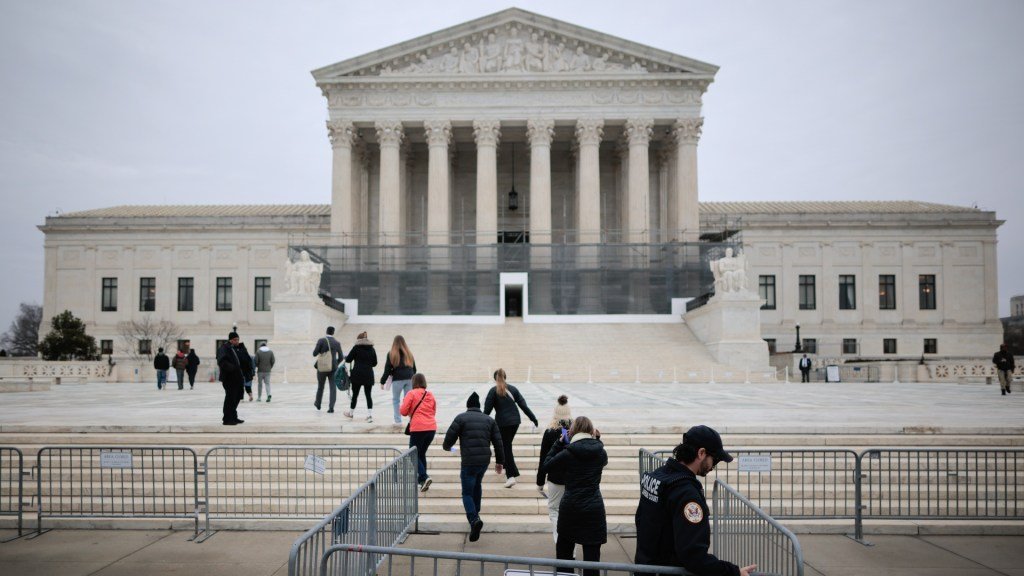
- Supreme Court tariff ruling Trump trade agenda enters a new legal phase after limits on emergency economic powers.
- The Court’s decision curbs unilateral presidential authority under IEEPA while preserving other tariff tools.
- Washington’s economic statecraft shifts toward structured legal mechanisms like Section 301 and Section 232.
- Global allies, markets, and supply chains face renewed uncertainty as U.S. trade strategy recalibrates.
The U.S. Supreme Court’s February 20 ruling striking down President Donald Trump’s most sweeping global tariffs marks a defining moment in the long-running contest over executive power, economic nationalism, and the future architecture of global trade governance.
In a 6–3 decision, the Court held that Trump exceeded his statutory authority when he invoked the International Emergency Economic Powers Act (IEEPA) of 1977 to impose broad “reciprocal” tariffs on nearly every major trading partner.
For an administration that has treated tariffs not merely as economic instruments but as tools of geopolitical signaling and strategic coercion, the ruling represents more than a legal setback. It imposes a structural constraint on presidential trade authority at a time when economic statecraft has become central to U.S. foreign policy.
Yet, as with most landmark decisions involving executive power, the Court’s opinion closes one pathway without ending the broader policy struggle. Trump retains alternative mechanisms to pursue his trade agenda—though none offer the speed, scale, or unilateral flexibility that emergency powers once provided.
What the Court Actually Said
The Court’s majority opinion rejected the administration’s argument that IEEPA authorized the president to deploy tariffs as a form of economic pressure during perceived national emergencies. Writing for the majority, the justices concluded that Congress never intended the statute to grant presidents authority to unilaterally rewrite the United States’ tariff schedule or reshape global trade flows absent explicit legislative approval.
The ruling invalidates the broadest category of Trump’s tariffs—those imposed globally under the administration’s “reciprocal tariff” framework. It also nullifies several targeted levies, including measures directed at China, Canada, and Mexico that relied on the same emergency justification.
Crucially, however, the Court stopped short of dismantling the broader tariff regime constructed over the past decade. Tariffs imposed under separate statutory authorities—particularly those linked to national security investigations and anti-dumping enforcement—remain intact. This distinction preserves significant elements of Trump-era trade protectionism while redefining the legal boundaries of executive action.
In effect, the Court did not reject tariffs as a policy instrument; it rejected the method by which they were imposed.
The Immediate Fallout
International reactions were swift but measured. Officials across the European Union, the United Kingdom, and Canada welcomed the decision as a potential stabilizing force for global commerce, interpreting it as a reaffirmation of institutional checks within U.S. economic policymaking.
U.S.-EU Trade War: How Airbus and European Giants are Navigating Geopolitical Chaos
Yet optimism remains cautious. Many trading partners recognize that Washington retains multiple legal avenues to maintain pressure through targeted tariffs.
For multinational businesses and financial markets, the ruling introduces a new layer of uncertainty rather than immediate clarity. Companies must now navigate a transitional legal environment in which existing tariffs may be revised, replaced, or litigated anew. Trade associations warn that refund claims tied to invalidated tariffs could reach as high as $170 billion, though the Supreme Court deliberately left compensation questions to lower courts, ensuring prolonged legal battles ahead.
Trump brings in new 10% tariff as Supreme Court rejects his global import taxes
Markets, in other words, face regulatory ambiguity rather than policy resolution.
Trump’s Remaining Options
Despite the ruling’s significance, the administration is far from powerless. Officials have already signaled their intention to rapidly reconstruct tariff measures using alternative statutory frameworks. Several pathways remain viable.
Section 301 of the Trade Act of 1974
Section 301 remains one of the most potent instruments available to the executive branch. It allows tariffs in response to unfair trade practices following formal investigation and findings by the U.S. Trade Representative. This authority formed the backbone of Trump’s original tariff campaign against China during his first term.
While procedurally slower than emergency powers, Section 301 offers stronger legal durability. Future tariffs imposed under this mechanism would likely be narrower but more resilient against judicial scrutiny.
Section 232 National Security Tariffs
Under Section 232 of the Trade Expansion Act of 1962, the president may impose tariffs if imports are deemed to threaten national security. Trump previously relied on this authority to justify steel and aluminum tariffs, reframing industrial capacity as a strategic defense concern.
Courts and allies alike have grown increasingly skeptical of expansive national-security interpretations. Nevertheless, the statute remains intact and continues to provide a legally defensible route for targeted sectoral protection.
Country-Specific Negotiated Tariffs
Another pathway involves embedding tariff concessions within bilateral trade negotiations. Though slower to implement, negotiated arrangements offer greater durability and diplomatic legitimacy. Such agreements could transform tariffs from unilateral punishment into structured bargaining tools, reinforcing Washington’s leverage while reducing legal vulnerability.
Legislative Action
Congress could theoretically expand presidential tariff authority through new legislation. Yet the polarized political environment—and the Court’s clear warning against overly broad delegations of economic power—makes this option uncertain. Lawmakers may instead seek to reclaim greater oversight over trade policy, potentially reshaping the executive-legislative balance for years to come.
The Strategic Shift Ahead
The ruling forces a recalibration rather than a retreat. Trump’s ability to impose tariffs rapidly and at global scale—an approach that became a defining feature of his negotiating style with China, Europe, and North American partners—has now been constrained.
But the administration’s underlying strategic vision remains unchanged. Tariffs continue to serve as instruments for reshoring supply chains, countering perceived economic dependence on rivals, and advancing an “America First” framework that treats trade policy as an extension of national security strategy.
Indeed, the decision may accelerate a broader transformation already underway in global economics: the shift from free-trade orthodoxy toward competitive economic nationalism. Washington’s trade posture increasingly mirrors a wider international trend in which governments deploy industrial policy, export controls, and tariffs as tools of strategic competition.
The question is no longer whether tariffs will remain central to U.S. policy—but how legally structured and institutionally constrained their use will become.
A New Phase in the Tariff Wars
The Supreme Court’s decision does not end the era of tariff-driven economic statecraft. Rather, it marks the end of emergency-based tariff policymaking as a shortcut around congressional authority.
Trump’s team is already preparing alternative legal strategies, and global markets are bracing for the next iteration of American trade policy—one likely to be more procedurally complex but no less assertive in ambition.
In the months ahead, investors, allies, and competitors should expect a more legally engineered tariff regime: slower to deploy, more targeted in scope, yet firmly rooted in the same strategic philosophy that has reshaped U.S. trade policy over the past decade. The instruments may evolve, but tariffs remain embedded at the center of American economic power projection in an increasingly fragmented global order.