


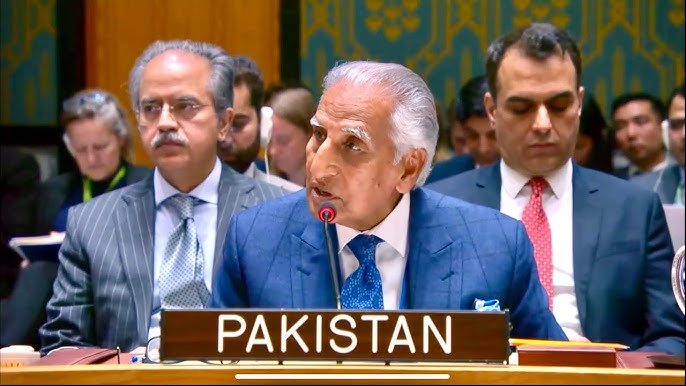
- A Pakistani diplomat’s humanity turned a forgotten tragedy into a story of dignity.
- Syed Tariq Fatmi’s swift action brought home the body of a migrant laborer abandoned abroad.
- His recent Hilal-e-Imtiaz award recognizes not only diplomatic skill but compassion in service.
- Fatmi embodies a model of leadership where statecraft meets humanity.
It was eight years ago when my father’s voice cracked through the static of an old telephone line, carrying a weight that instantly froze me. He spoke in a tone I had heard only in moments of irretrievable loss.
“Son,” he said quietly, “Bashir Hussain is gone.”
Bashir was a poor carpenter from our village in Pakistan, a man whose fragile dreams were built out of sacrifice. He had sold his wife’s jewelry to buy a visa, boarded a plane to Abu Dhabi, and found work on a construction site. He was chasing a future many take for granted—a future where his children could eat without worry and go to school without shame.
How Field Marshal Asim Munir’s Washington Diplomacy Saved Iran From a U.S. Onslaught
On a blistering afternoon, high above the city’s traffic and cranes, one slip changed everything. Bashir lost his footing, fell, and was rushed to a hospital. Doctors fought for hours, but fate had already decided otherwise.
Death, however, was not the cruelest part of his story. Bashir had been living and working in the UAE without papers. His co-workers, terrified of the authorities, vanished. The hospital was left with his body, unpaid bills, and silence. They moved him to cold storage, where the mechanical hum of refrigeration became his only company.
READ MORE: How Pakistan Shot Down India’s Rafale Jet: Chinese Missiles, “Kill Chain” Tactics, and a Stunning Intelligence Failure
Back in Pakistan, his wife collapsed when she heard. His children—too young to understand death, yet old enough to sense absence—clung to their mother’s grief. In the village, sorrow quickly gave way to desperation: How would they bring Bashir home?
They knocked on doors, wrote letters, pleaded with offices, but bureaucracy responded with indifference. Then someone turned to my father. His words were steady, urgent:
“My son, make sure his body reaches home. It matters. You have to do it.” Then, without waiting for a reply, he hung up.
The first call I made was to Syed Tariq Fatmi, then serving as Adviser to Prime Minister Nawaz Sharif on Foreign Affairs. His answer was immediate, almost as though he had been waiting for this very request. “Come to my office right now,” he said.
ALSO READ: A Razor’s Edge Between India and Pakistan
Minutes later, I was in his chamber at the Foreign Office, recounting Bashir’s plight. Fatmi sahib wasted no time. He dialed Dr. Faisal—later Pakistan’s High Commissioner to the UK—and ordered him to get the Pakistani Ambassador in the UAE on the line. His instructions were crisp: settle the hospital bills, retrieve the body, and ensure Bashir’s return was one of dignity, not disgrace.
Within half an hour, embassy staff were at the hospital in Abu Dhabi. They cleared every outstanding payment, secured documents, and booked Bashir’s final flight home. His coffin was draped in the green and white of the Pakistani flag—the flag of the country he had worked for, suffered for, and ultimately died representing. The government even arranged for a co-worker to accompany him.
Four hours later, Bashir was back in Pakistan. His wife, pale and trembling, wept over the coffin. His children, still stunned, pressed their hands to the folds of the flag. Pain lingered, but there was solace in knowing he had returned with honor.
Through those tense hours, Pakistan’s ambassador and my brother, Ghazanfar Klasra, stayed in constant touch. But the force behind it all—the spark that turned despair into resolution—was Syed Tariq Fatmi.
I still remember his words when the ordeal ended:
“Kaswar, it was my duty to help a fellow Pakistani like yours. I am glad I could do it.”
Yesterday, on August 14, 2025, as Pakistan celebrated its independence, Syed Tariq Fatmi—now Special Assistant to the Prime Minister on Foreign Affairs—was awarded the Hilal-e-Imtiaz. The citation praised his role in strengthening Pakistan’s diplomatic presence and advancing the Prime Minister’s mission abroad. But for me, the award meant something deeper.
It recognized a man whose humanity shines through the machinery of state; a man who, in a world dominated by procedure and protocol, chose urgency and compassion. Fatmi sahib has never represented Pakistan only at podiums or in embassies. He represented it in its truest sense: by standing with its people when they had no one else.
Bashir Hussain’s family will never forget that. Nor will I.
Today, Tariq Fatmi is celebrated for his long record of service—most recently for helping spearhead Pakistan’s diplomatic engagement after its confrontation with India. Using his relationships and credibility, he has amplified Pakistan’s perspective on the global stage, warning of the dangers of military brinkmanship in South Asia.
But beyond all the conferences, cables, and communiqués, I will always see him as the man who brought a laborer home.
Award Mubarak, Fatmi sahib. You have served this land of the pure not only with wisdom and skill, but with a heart that beats for its people. May that heart continue to guide Pakistan for years to come.