


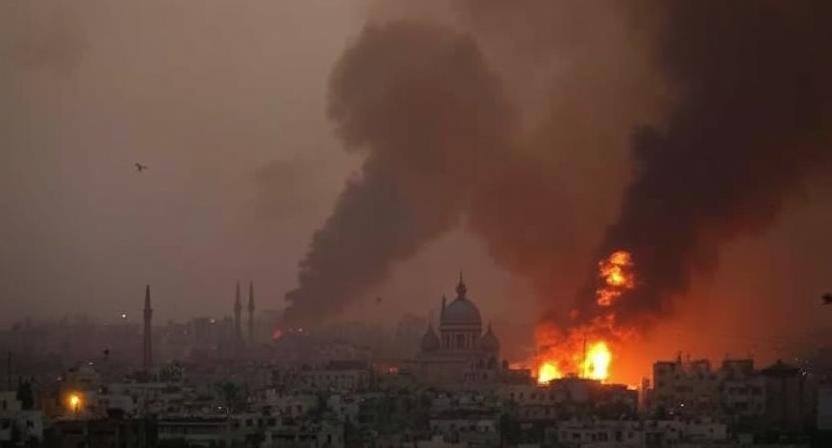
- Israeli airstrikes hit Syrian military headquarters and targets near the presidential palace in Damascus amid escalating sectarian violence.
- Clashes between Druze militias and Bedouin tribes in Sweida sparked the intervention, with Israel claiming it acted to prevent atrocities.
- Syria condemned the strikes as a violation of sovereignty, raising fears of a regional war involving Jordan, Iran, and Hezbollah.
- The fragile post-Assad government faces internal dissent and external pressure, risking a return to civil war.
DAMASCUS, Syria — A volatile mix of sectarian unrest and foreign military strikes has erupted into a full-blown crisis in southern Syria, following a series of devastating Israeli airstrikes that targeted Syrian military installations—including sites near the presidential palace in Damascus—early Wednesday morning.
The Israeli Defense Forces (IDF) claim the operation was a “preventive intervention” aimed at stopping Syrian government forces from escalating attacks against the Druze minority, who have been caught in violent clashes with Bedouin tribes around Sweida. Israel’s strikes, unprecedented in scale since the fall of the Assad regime last year, have opened a new chapter in the conflict-ravaged country where state authority remains contested and fragile.
This latest flare-up has alarmed regional and global powers, reignited fears of a broader Middle Eastern conflagration, and upended recent diplomatic overtures between Damascus and Tel Aviv.
ISRAELI STRIKES AND MOTIVATION
Israeli jets flew multiple sorties deep into Syrian territory on Wednesday, reportedly hitting key Syrian army convoys, artillery units, and the Ministry of Defense’s southern command center. Several blasts were recorded within proximity of the new presidential complex in central Damascus, though the government has not confirmed any casualties among senior officials.
Prime Minister Benjamin Netanyahu, addressing the Israeli public, defended the strikes as a “moral and strategic imperative” to protect the Druze population—a religious and ethnic community that exists on both sides of the Israel-Syria border.
“The Israeli state stands with the Druze people,” Netanyahu said. “Our operations were calibrated to neutralize immediate threats from Syrian armed forces deploying against innocent communities in Sweida and surrounding villages. We will not allow a second Black October.”
READ MORE: Breaking: Iran Launches Missile Strikes on U.S. Bases in Syria in Retaliation for American Bombing of Nuclear Sites
Despite his strong rhetoric, Netanyahu also issued a warning to Israel’s own Druze citizens, hundreds of whom reportedly attempted to cross into Syria in defense of their kin: “Do not cross the border. You are endangering your lives and complicating an already explosive situation.”
The Israeli military has since reinforced its northern border, mobilizing two armored brigades and deploying Iron Dome batteries in the occupied Golan Heights in preparation for potential Syrian retaliation.
SYRIA’S REACTION: “ACT OF WAR”
Damascus condemned the Israeli air campaign as a “clear act of aggression and a breach of international law.” President Ahmed al-Sharaa, who assumed office in the wake of Bashar al-Assad’s fall, vowed that Syria would “respond with dignity and resistance.”
ALSO READ: Crisis Spirals in Syria With Israeli Strikes on Damascus
“This is a blatant violation of our sovereignty,” a statement from the Syrian Foreign Ministry read. “Israel seeks to exploit our internal divisions to further its colonial agenda in the Golan and beyond.”
The Syrian military claimed that several of its soldiers were killed in the strikes but did not release exact figures. Anti-aircraft units reportedly engaged Israeli warplanes, but there is no confirmation of successful intercepts.
The government also accused Tel Aviv of providing covert support to Druze militias, a claim Israel denies. Sharaa’s administration has already been under criticism for its perceived failure to protect minorities amid rising sectarian tensions in southern Syria.
THE SWEIDA CRISIS: A SPARK IGNITES A FIRESTORM
What began weeks ago as a localized dispute over a robbery—specifically, the kidnapping of a Druze vegetable merchant allegedly by Bedouin gang members—has now evolved into a full-blown regional crisis.
Sweida province, which lies just 57 miles south of Damascus, has long been a stronghold of Syria’s Druze community. But simmering tensions between Druze militias and Sunni Bedouin tribes, many of whom were displaced or radicalized during the civil war years, have turned deadly.
Initially, community elders tried to mediate. But as clashes escalated and reports emerged of armed Bedouin groups being quietly supported by pro-government factions, the Druze militias began to mobilize in self-defense.
Syria’s security forces then entered the fray—ostensibly to restore order, but their crackdown appeared one-sided, prompting widespread outrage. Israeli intelligence, citing satellite imagery and intercepted communications, claims Syrian tanks were preparing to storm Druze-held towns.
“This prompted immediate action,” said IDF spokesperson Lt. Col. Daniel Hagari. “We had to strike before massacres occurred.”
REGIONAL AND GLOBAL REACTIONS
The United States, whose position on Syria remains undefined since the post-Assad transition, expressed “grave concern” over the escalation.
“We are deeply worried by the violence in southern Syria,” said U.S. Secretary of State Marco Rubio in Brussels. “This undermines international efforts to rebuild Syria into an inclusive and stable state. We call for restraint on all sides.”
Russia, long an Assad ally but now playing a more limited role, issued a lukewarm condemnation of the Israeli strikes but stopped short of promising retaliation. Iran, meanwhile, accused Israel of “exploiting sectarian tensions to break Syria apart.”
The Arab League has called for an emergency session, and Jordan—whose border lies mere miles from the violence—has reportedly increased troop deployments and placed air defense units on high alert.
DRUZE OPINIONS DIVIDED
Inside Syria, the Druze community remains split. Some community leaders have welcomed Israeli involvement, seeing it as the only real protection against encroaching Bedouin militias and a government they perceive as hostile. Others fear the Israeli strikes could worsen their already precarious situation.
“We don’t want another war fought on our backs,” said Sami al-Hinnawi, a Druze elder in Sweida. “But we also cannot accept being left to die.”
BACKGROUND: FROM CIVIL WAR TO NEW FRONTLINES
Syria has not known peace since 2011. After a brutal civil war, the Assad regime collapsed in late 2024 following internal dissent and international sanctions. A coalition of former jihadist rebels, Kurdish groups, and technocratic elites formed the transitional government now led by President al-Sharaa. But many regions, especially in the south, remain under contested control.
Israel, which had previously maintained a cautious posture, stepped up operations inside Syria over the past year, targeting Iranian assets, Hezbollah operatives, and now, seemingly, the Syrian military itself. The IDF insists these actions are defensive in nature, but analysts see signs of a more proactive Israeli security doctrine.
WHAT’S NEXT? A REGION ON THE BRINK
With Israeli bombs falling near Damascus and sectarian violence unresolved, Syria’s fragile post-war order stands at risk of total collapse.
“This is a dangerous inflection point,” said Nanar Hawach, Syria analyst at the International Crisis Group. “Not only is the Druze-Bedouin conflict threatening to tear apart Sweida, but foreign military intervention raises the prospect of a regional war—with Jordan, Iran, and possibly Hezbollah drawn in.”
Israel has hinted it may establish a humanitarian “safe zone” along the Syrian border, a move that would redraw red lines and risk further entanglement.
Meanwhile, Syria’s new leadership faces a make-or-break moment: restore order and project inclusivity, or risk plunging the country into a second civil war.