


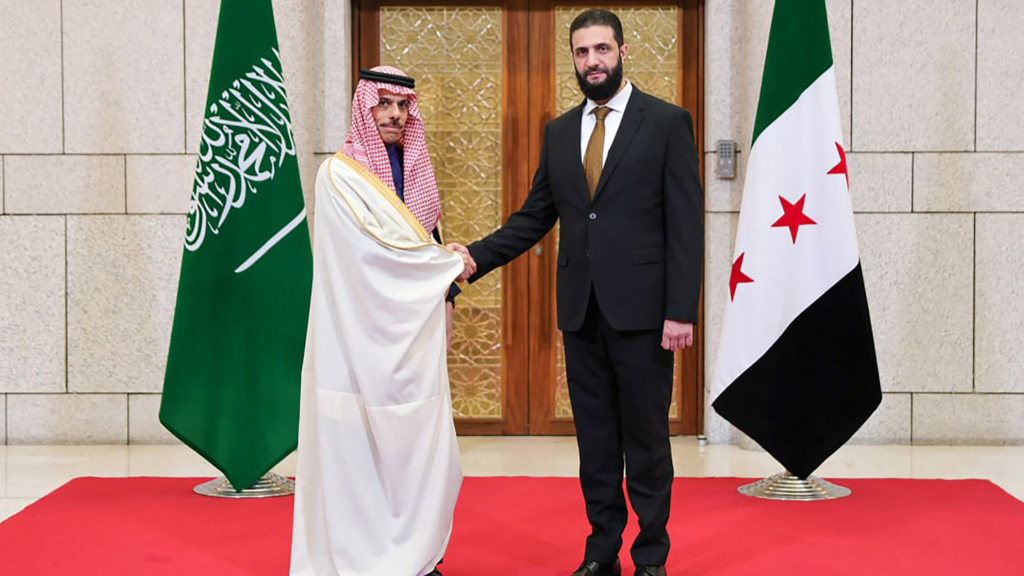
- Syria Geopolitics 2025 is dominated by the strategic partnership between President Ahmed al-Sharaa and Saudi Crown Prince Mohammad bin Salman.
- The repeal of U.S. Caesar Act sanctions has paved the way for massive Gulf investment in Syrian infrastructure.
- The transition marks a definitive shift away from Iranian influence toward a new Arab-led regional security order.
- Reconstruction efforts are focusing on turning Syria into a Mediterranean trade corridor to stabilize the Syrian pound.
DAMASCUS — The night the shadow lifted from Damascus, the air in Umayyad Square didn’t just carry the scent of jasmine; it carried the weight of history being rewritten. As the final vestiges of the Assad dynasty faded into the darkness of exile, the silence of a decade-long fear was replaced by a roar of catharsis.
In the flickering light of streetlamps draped with new flags, a name echoed through the ancient alleyways: Ahmed al-Sharaa. But in the high-stakes corridors of power where this transition was brokered, another name is whispered as the ultimate architect of this rebirth: Saudi Crown Prince Mohammad bin Salman (MBS).
The fall of Bashar al-Assad in December 2024 was not a spontaneous collapse, but the endgame of a masterfully played hand on the Middle East’s ruthless chessboard. Today, as Syria enters its second year of transition in late 2025, the narrative has shifted from one of “regime change” to “regional restoration.”
Syria’s New Era of Prosperity fueled by Al-Sharaa’s alliance with MBS and Trump
At the heart of this transformation is a calibrated alliance between Riyadh and Washington, turning a war-torn pariah state into the keystone of a new Middle Eastern order.
The Kingmaker’s Gambit
In the Levant, kings are common, but kingmakers are rare. For years, Western capitals oscillated between half-hearted intervention and weary isolation. While others saw Syria as a quagmire, Crown Prince Mohammad bin Salman saw a missing piece of Vision 2030. A stable, Arab-aligned Syria was essential to securing energy corridors from the Gulf to the Mediterranean and, more crucially, to severing the “Resistance Axis” that fueled Iranian expansionism.
READ MORE: How Israeli covert activities in Syria seek to thwart its new government
Working in a rare, high-definition synchronicity with U.S. President Donald Trump, MBS pursued a strategy of “legitimacy through reform.” The rise of Ahmed al-Sharaa—once known by the nom de guerre Abu Mohammad al-Julani—is the primary exhibit of this Saudi-led “normalization” project. By overseeing al-Sharaa’s transition from a rebel commander into a pragmatist speaking the language of neoliberalism and minority protection, Riyadh provided the political cover necessary for Washington to do the unthinkable: lift the crushing weight of the Caesar Act sanctions.
Syria Geopolitics 2025: The Trillion-Dollar Pivot
Why Syria? The answer lies in the crossroads. Syria sits at the junction of Israel, Turkey, Iraq, and Jordan. Under the previous regime, it was a gateway for disruption; under the al-Sharaa administration, backed by Saudi billions, it is being rebranded as a vital trade corridor.
ALSO READ: Syria Post-Assad Revival: How Mohammed bin Salman and Trump Reshaped the Middle East’s Most Broken State
The impact of this shift is visible in the bustling markets of Aleppo and the revitalized ports of Latakia. With the U.S. formalizing the repeal of sanctions in late 2025, the Syrian pound has found a floor, and the “trickle of hope” has become a flood of interest. Saudi Arabia’s recent pledge of over $6 billion in real estate and infrastructure investments at the Future Investment Initiative in Riyadh signaled to the world that Syria is open for business.
“We chose the path of reconstruction through investment, not aid,” al-Sharaa told a stunned audience of global financiers in Riyadh. “We do not want Syria to be a burden; we want to build it ourselves.”
A New Social Contract
The “MBS-al-Sharaa” partnership is not merely about bricks and mortar; it is a social experiment in a post-conflict society. In Damascus, the once-stifling presence of secret police has been replaced by a technocratic administration obsessed with governance benchmarks. Women, long the primary victims of the conflict, are re-entering public life, and the integration of the Syrian Democratic Forces (SDF) into national institutions—a breakthrough brokered with Saudi mediation—suggests a move toward a unified, though fragile, state.
Critics remain wary of the transition’s speed and the concentration of power in the new presidency. Yet, for the young Syrians who grew up in the rubble, the presence of Saudi-funded schools and the promise of reliable electricity—now reaching record levels of six to eight hours a day—are more persuasive than ideological purity.
The Geopolitical Ripple
The fall of Assad has fundamentally reordered the region’s security architecture. With Iran’s influence sharply curtailed and the Axis of Resistance fractured, Damascus is recalibrating its posture toward Israel, prioritizing border stability over revolutionary rhetoric. This “de-escalation without humiliation” is the hallmark of the Saudi diplomatic style, offering a pathway for Syria to return to the Arab League as a sovereign pillar rather than a satellite.
As 2025 draws to a close, the narrative of the “Messiah” delivery is not about a single man, but about a vision. History may debate the tactics used to reach this point, but the outcome is undeniable: Syria’s resurrection is no longer a dream discussed in exile. It is unfolding in real time, driven by a Crown Prince who understood that power is not just about who you topple, but what you have the vision to build in the ruins.