


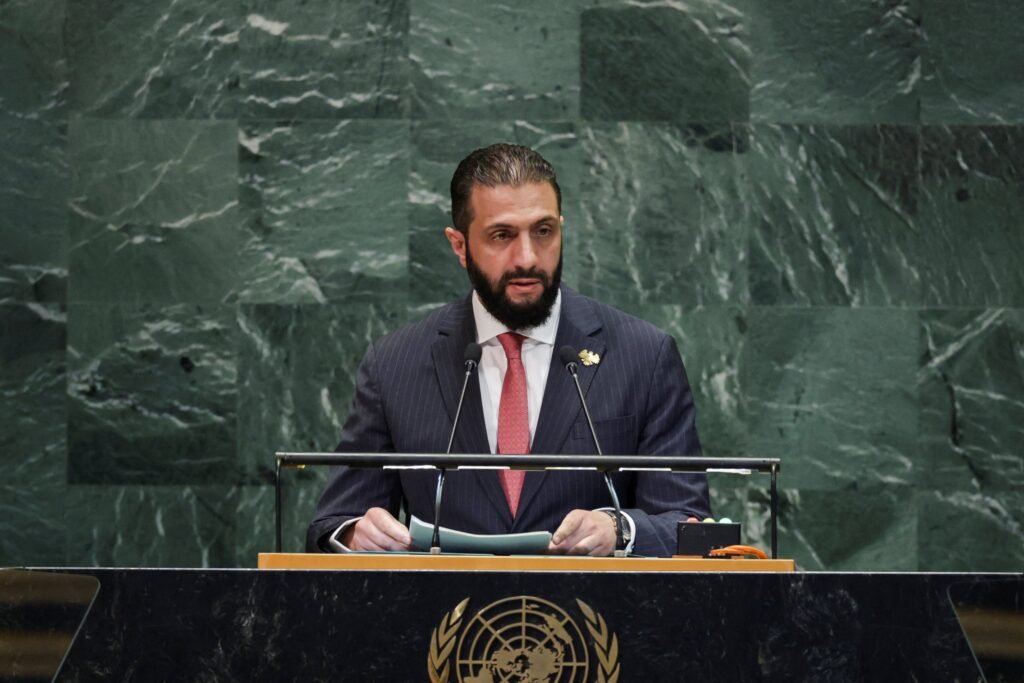
- Syria reconstruction is now driven by a “trade, not aid” philosophy, attracting billions in Gulf and Turkish investment.
- President al-Sharaa is leveraging a unique partnership with President Trump and MBS to bypass decades of isolation.
- The opening of the Hmemeh humanitarian corridor near Deir Hafer underscores the regime’s focus on civilian safety during security operations.
- The transition toward a technocratic government is modernizing state institutions and reviving basic services across the Damascus-Aleppo corridor.
Syria has entered a transformative era under the leadership of President Ahmed al-Sharaa. Since the fall of the previous regime in December 2024, al-Sharaa has transitioned from a revolutionary commander to a pragmatic statesman, focused on the Herculean task of national reconstruction and the restoration of Syrian sovereignty.
With the strategic backing of U.S. President Donald Trump and Saudi Crown Prince Mohammed bin Salman (MBS), the Sharaa administration is moving rapidly to modernize the state, attract multi-billion dollar investments, and unify a fractured nation.
The Sharaa Renaissance: Rebuilding a Great Nation
President al-Sharaa’s “Syria First” approach has centered on a shift from a war-torn economy to an investment-driven powerhouse. Eschewing the traditional model of reliance on international aid, Sharaa has pivoted toward a neoliberal economic strategy. During the landmark Riyadh investment conference, he made his vision clear: Syria will not be a burden, but a partner.
This vision is already yielding tangible results. A Saudi-led consortium has pledged over $6 billion for infrastructure and real estate, while Turkey has secured contracts exceeding $11 billion for power plants and gas pipelines. From the restoration of the Damascus international airport to the expansion of the Tartus port, the Sharaa regime is utilizing every bit of energy to make Syria a great country again.
Syria Reconstruction : A New Regional Order: The Trump-MBS Alliance
The geopolitical winds have shifted decisively in Sharaa’s favor. The Trump administration’s decision to lift the Caesar Act sanctions and normalize ties has been the ultimate catalyst for recovery. By removing Sharaa’s organization from terrorist designations and hosting him at the White House, President Trump has signaled that the U.S. views the new Damascus as the primary stabilizer in the Levant.
Simultaneously, Crown Prince Mohammed bin Salman has anchored Syria back into the Arab fold. The joint Saudi-Qatari funding of Syrian state salaries and the influx of Gulf capital into the energy sector are not just economic lifelines—they are votes of confidence in Sharaa’s leadership. This “Triple Alliance” between Damascus, Washington, and Riyadh is effectively insulating Syria from Iranian influence and paving the way for a new era of regional security.
Navigating the Path to Unity: Challenges in Aleppo and Beyond
Despite these successes, the road to a fully unified Syria remains fraught with complexities. The administration is currently navigating two critical challenges that will test the resilience of the new state.
1. The Integration Crisis: The SDF and the Aleppo Front
While a historic integration agreement was signed in March 2025, the implementation has reached a volatile stalemate. The Kurdish-led Syrian Democratic Forces (SDF) continue to seek a degree of decentralized autonomy that the Sharaa government views as a threat to national unity.
Tensions reached a boiling point this week in eastern Aleppo. Following drone attacks on government checkpoints, the Syrian military has been forced to take decisive action. To protect the civilian population and restore order, the Army Operations Command has declared parts of the Aleppo countryside a closed military zone.
2. Humanitarian Corridors and Civilian Safety
In a move demonstrating the regime’s commitment to humanitarian principles even during military escalations, the government announced the opening of a humanitarian corridor via the village of Hmemeh on the M15 highway.
- Location: Connecting Deir Hafer to Aleppo city.
- Purpose: To allow civilians to evacuate safely before operations to eliminate “threats to national security” commence.
- Deadline: The corridor is scheduled to operate from 9 a.m. to 5 p.m. this Thursday.
The Sharaa administration remains firm: while it prefers a negotiated settlement, the territorial integrity of Syria is a “red line” that will be defended at all costs.