


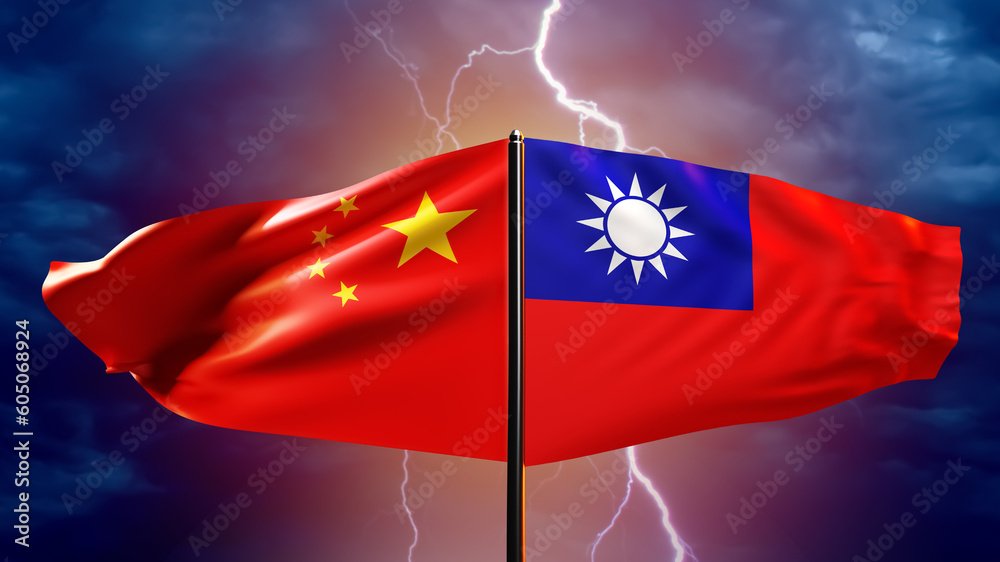
- Taiwan cannot match China ship-for-ship or aircraft-for-aircraft, making asymmetric warfare central to its defence strategy.
- U.S. weapons, including F-16 fighters, HIMARS, Javelin missiles and drones, are strengthening Taiwan’s ability to impose costs on a potential Chinese invasion.
- A dispersed force of missiles, drones, submarines and smaller warships could exploit the geography of the Taiwan Strait and deny China a quick victory.
Taiwan faces a strategic paradox: China possesses overwhelming military and economic advantages, yet the island does not necessarily need to defeat the People’s Liberation Army (PLA) to preserve its de facto autonomy. Its more realistic objective is to make any blockade or invasion so difficult, costly and uncertain that Beijing cannot confidently achieve a quick victory.
The military imbalance is stark. China’s 2026 defence budget is about 1.94 trillion yuan, roughly $277 billion, according to Beijing’s official figure. Taiwan’s 2026 defence budget, calculated under NATO standards, is NT$949.5 billion, or about $30 billion. Taipei has now signalled an even larger effort: President Lai Ching-te says the 2027 budget will exceed NT$1 trillion, about $31.5 billion, for the first time. That is still a fraction of China’s spending.
China also has the advantage of scale in aircraft, missiles, ships, submarines, satellites, drones and industrial capacity. Yet scale creates vulnerabilities when an attacker must cross a 100-mile-wide strait under persistent surveillance. Taiwan’s answer, therefore, cannot simply be to build a smaller version of China’s navy.
Taipei’s strongest option is sea denial: prevent Chinese forces from safely using the Taiwan Strait rather than attempting to command it. That means replacing some expensive, highly visible surface combatants with large numbers of smaller, dispersed and missile-armed platforms.
READ NEXT: Taiwan China Conflict Enters New Phase as Beijing Shifts Strategy
This is increasingly important because modern surveillance, drones, electronic warfare and precision missiles make large ships easier to detect and target. China’s amphibious invasion fleet, however, cannot easily become smaller: an invasion requires enormous quantities of troops, armour, fuel and supplies to cross the water. That creates a fundamental asymmetry. Taiwan can hide and disperse; China must concentrate enough force to land.
Taiwan should therefore prioritize missile corvettes, mobile coastal anti-ship systems, drones, mines, submarines and aircraft capable of striking invasion ships. A fleet of numerous 700-to-1,000-ton stealthy corvettes could survive better than a small number of billion-dollar warships. The lesson is visible in Ukraine’s Black Sea campaign, where missiles, drones and unmanned surface vessels have constrained a much larger Russian fleet.
READ MORE: Taiwan’s Drone Realism
Taiwan is already moving toward this model. It is expanding coastal drones, unmanned boats and missile systems while developing a more distributed command-and-control network. In September 2026, Taipei proposed another $4.6 billion in defence spending for 2026, including more than 600 surveillance and reconnaissance drones, over 40,000 coastal attack drones and more than 100 unmanned suicide boats.
American weapons are another critical pillar. Washington approved an $8 billion deal in 2019 for 66 F-16C/D Block 70 fighters, designed to push Taiwan’s F-16 fleet above 200 aircraft. The first Block 70 aircraft entered the delivery process in 2025, while remaining deliveries have continued amid delays. The F-16s provide Taiwan with modern radar, electronic warfare and precision-strike capabilities, although aircraft alone cannot stop an invasion.
The United States also approved an $11.1 billion arms package in December 2025, its largest Taiwan weapons package at the time. It included HIMARS, howitzers, Javelin missiles and Altius loitering munitions and drones. In 2026, Taiwan’s arms backlog remained substantial, including F-16s, HIMARS, Harpoon coastal-defence missiles, NASAMS and unmanned systems.
But Taiwan’s strategy cannot depend entirely on Washington. The biggest danger is political uncertainty. U.S. weapons can strengthen deterrence, but delivery delays, American military priorities and the possibility of negotiations between Washington and Beijing mean Taipei must build its own capacity.
Taiwan’s political landscape adds another complication. KMT chairwoman Cheng Li-wun’s April 2026 visit to China was historic: she became the first KMT chair to lead a mainland delegation in a decade and met President Xi Jinping in Beijing. Her message emphasized dialogue and peace, while Xi stressed eventual unity. The visit demonstrates that Taiwan’s political debate is not uniformly anti-China.
Yet dialogue and deterrence are not mutually exclusive. Indeed, a Taiwan capable of imposing high military costs on an attacker would have greater political space to negotiate. Opposition parties can maintain channels with Beijing while supporting credible self-defence.
The financial calculation matters as much as battlefield tactics. Beijing can absorb losses more readily because its economy and defence industry are vastly larger. Taipei therefore needs inexpensive systems that can be produced quickly and replaced continuously. A dispersed force also complicates China’s targeting problem, forcing the PLA to spend expensive missiles and intelligence resources against numerous smaller targets simultaneously.
The objective, therefore, should not be an arms race Taiwan cannot win. It should be a defence architecture China cannot easily destroy: hardened bases, mobile missiles, drones, submarines, dispersed command networks, resilient communications and enough ammunition to survive the opening weeks of conflict.
China may possess the greater military machine. But geography, technology and asymmetric warfare can deny Beijing the easy victory many assume. Taiwan’s best chance of preserving its autonomy is to ensure that crossing the Strait is not the beginning of a quick conquest, but the start of an extraordinarily costly gamble.