


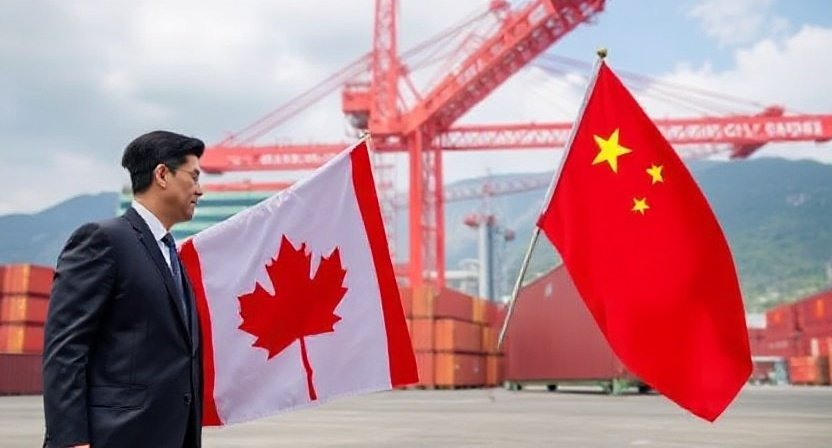
- China’s new 76% tariff on Canadian canola threatens billions in agricultural trade and could devastate Prairie farmers.
- Canada’s C$120 billion annual trade with China is under strain from escalating tit-for-tat tariffs on vehicles, steel, and agricultural products.
- Prime Minister Mark Carney vows farmer support and “constructive dialogue” with Beijing while diversifying export markets.
- Retaliatory tariffs risk long-term damage to supply chains, investment, and bilateral economic stability.
OTTAWA, August 15, 2025 — Canada and China have seen their longstanding trade partnership falter under the weight of rising protectionist measures and political friction. As Ottawa and Beijing impose reciprocal tariffs, the volume and composition of bilateral trade remain under increasing strain.
Trade Volumes: A Valuable Yet Vulnerable Partnership
China ranks among Canada’s most important trade partners. In 2023, the value of Canadian exports to China reached CA$30.5 billion (approximately US$21.9 billion), while imports from China stood at CA$89.0 billion (about US$64.0 billion). These figures underscore the significance of China as a market, especially for Canadian agriculture and resource sectors. Although total trade volumes remain below the 2022 high, they surpass pre-pandemic levels.
Trump’s Tariff Gamble Against India: Why Economic Coercion Won’t Break the Moscow–New Delhi Bond
Breaking down the data further: in Q2 2024, Canadian merchandise exports to China fell 7.6% year-on-year to CAD 14.07 billion, with canola as the top export item—valued at CAD 1.86 billion, down 18.6% YoY University of Alberta. Imports from China decreased by 4.2% YoY, totaling CAD 41.56 billion in the same quarter according to University of Alberta. Overall, China accounts for about 6% of Canada’s total world trade.
Tariffs: Escalating Measures and Retaliation
The bilateral tensions escalated when Canada imposed steep tariffs on Chinese goods: a 100% surtax on electric vehicles and 25% tariffs on steel and aluminum, effective October 2024. These measures mirrored similar protectionist moves by the U.S. and EU.
READ MORE: From Standoff to Handshake: New Dawn in India–China Relations
Beijing responded with an anti-dumping investigation into Canadian canola—a sector critical to Western Canada’s economy—following Canada’s tariff actions Reuters. In March 2025, China significantly escalated further by imposing a 100% tariff on over US$1 billion of Canadian rapeseed oil, oil cakes, and pea imports, plus a 25% tariff on US$1.6 billion worth of aquatic products and pork. This retaliatory move notably excluded canola, leaving potential room for negotiation.
Timed just two months later, Canada launched a 25% tariff on all imported steel containing Chinese-origin materials, prompting China to denounce the move as WTO-infringing and warning of harmful impacts on bilateral trade, which reached C$120 billion in the previous year.
Prime Minister Carney’s Response: Navigating Domestic Support and Diplomacy
Canadian Prime Minister Mark Carney has denounced China’s canola tariffs as disproportionate and damaging. He vowed to support canola growers—particularly in Saskatchewan, where canola is the dominant cash crop—and pursue “constructive dialogue” with Chinese counterparts to resolve trade disputes and diversify export markets. Carney emphasized that Canada does not engage in dumping practices.
ALSO READ: Even before Alaska summit, Putin is redrawing global order to his liking
Noting China’s divergence from Canadian trade values, Carney stressed the need for caution and strategic engagement. He highlighted the discrepancy in trade volumes: Canada–U.S. trade reached C$102 billion in January—vastly outperforming the C$8.4 billion figure for China.
Impacts of Tariffs: Immediate Pain, Long-Term Risks
The nearly 76% canola tariff (as noted by Carney) and other retaliatory tariffs risk imposing severe costs on Canada’s agricultural sector, causing immediate income losses and pushing exporters to seek alternative markets. Provinces like Saskatchewan, Alberta, and Manitoba—which rely heavily on canola exports—are particularly vulnerable University of AlbertaReuters.
More broadly, tariffs heighten uncertainty, complicate supply chains, and elevate costs for businesses importing steel, aluminum, or Chinese-manufactured goods. The rise in protectionism may also discourage investment and slow bilateral trade recovery.
Outlook: Dialogue, Diversification, and Diplomatic Balance
Canada’s path forward appears twofold: continue diplomatic engagement with China to ease agricultural tensions while simultaneously diversifying its export base across Asia and other markets. Carney’s emphasis on diverging trade pathways reflects this dual strategy.
Meanwhile, Beijing’s decision to leave canola off its March tariff list could signal willingness to negotiate—though it continues to reserve tools like anti-dumping probes as leverage.
The Canada–China trade landscape has become increasingly complex, with tariffs—from both sides—weighing heavily on bilateral commerce. Total trade remains substantial, but agriculture and manufacturing sectors face growing margins of risk. As tensions simmer, both diplomatic finesse and economic diversification may define Canada’s ability to stabilize trade and protect its industries in the months ahead.