


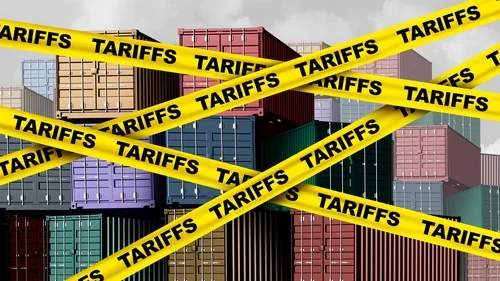
- Europe is Building Its Own Defense Muscle – EU nations are investing €150 billion to reduce military reliance on the U.S.
- Asia-Pacific Looks Beyond the U.S. – Japan, South Korea, and Australia are boosting defense budgets and considering alternate suppliers.
- China Steps In as U.S. Influence Wanes – Beijing is actively courting former U.S. allies with trade and military partnerships.
- The “Great Decoupling” is Real – U.S. allies are no longer planning around America; they’re planning around uncertainty.
As trade tensions surge under President Donald Trump’s tariff-first foreign policy, a deeper, more consequential shift is underway. America’s allies—some of whom have depended on U.S. military support since the Second World War—are reassessing the fundamental question of whether they can continue relying on Washington.
While Trump’s tariffs aim to strengthen domestic industries, they’ve done something else entirely: they’ve triggered what defense experts are calling the “Great Strategic Reset”—a sweeping reorientation of global security and trade alliances, nudging longtime U.S. partners toward alternative powers, including China.
Trump’s Tariffs: Europe Turns Inward, and East
The European reaction to Trump’s tariff barrage has not only been vocal—it’s been institutional. A €150 billion EU rearmament fund, now being finalized in Brussels, is set to prioritize European manufacturers in defense procurement, directly challenging decades of U.S. defense market dominance.
“The political message from Washington is loud and clear,” said German Defense Minister Boris Pistorius during a recent panel at the Munich Security Conference. “If Europe cannot rely on predictability from the U.S., then Europe must build strategic autonomy. Tariffs are just the symptom. The real disease is instability in Washington’s commitments.”
In Paris, French President Emmanuel Macron echoed similar sentiments. “The United States is not turning away from Europe because of lack of resources, but because it no longer sees value in the relationship unless we pay more, buy more, and yield more.”
That pressure is having a domino effect. Portugal, Denmark, and even Canada are openly reconsidering their F-35 fighter jet purchases, citing not just ballooning costs due to tariffs on aerospace components, but also “supply chain unpredictability,” according to a leaked internal memo from Canada’s Department of National Defence.
European defense officials say the ongoing trade friction has helped cement the argument for building a sovereign defense capacity. “What used to be dismissed as European idealism is now a geopolitical necessity,” remarked Dr. Alina Bérard, director of defense policy at France’s IFRI think tank. “This is a forced decoupling from the U.S. security industrial complex.”
Meanwhile, NATO has been conspicuously quiet. When asked whether the U.S.-EU defense relationship is under threat, a NATO spokesperson responded cautiously: “Allies continue to work closely. NATO is not a trade platform. Our strength lies in unity.”
But behind closed doors, unity is fraying.
Tariffs: Asia-Pacific Eyes Redundancy
In the Indo-Pacific, the reaction is less dramatic but no less telling. Nations such as Japan, Australia, and South Korea—long pillars of the U.S. strategic posture in the region—are hedging their bets, investing heavily in domestic defense capabilities and diversifying supply chains.
“Washington’s message to Asia is that tariffs are negotiable, but loyalty is not. That’s not a sustainable framework for alliance management,” said Dr. Kenji Matsuda, a former Japanese Ministry of Defense advisor now with the Tokyo Foundation for Strategic Research.
The numbers speak for themselves. Australia’s new defense strategy outlines a spending increase to 2.3% of GDP by 2033–34. Japan is on a trajectory to double its defense budget by 2027. Taiwan, under direct pressure from Trump’s call to spend 10% of its GDP on defense, has flatly refused, citing economic infeasibility.
South Korea, in particular, has emerged as both a cautious ally and an opportunistic exporter. “We are proud of our growing defense sector,” said South Korean Defense Minister Shin Won-sik during a press conference in Seoul. “We are committed to our U.S. alliance, but we are also exploring strategic opportunities in Southeast Asia and the Middle East.”
Experts believe Trump’s tariffs may have unintentionally boosted Seoul’s ambitions. “If European nations reduce purchases of U.S. systems, and Asian allies are unsure about continuity, South Korea could fill that vacuum,” noted Michael Green, former White House National Security Council Asia director.
MUST READ: Exclusive: India’s Transnational Killings: A Legal and Strategic Challenge for Pakistan
Even Australia’s AUKUS deal, once a beacon of U.S.-UK-Australia cooperation, is being reassessed by Canberra’s defense committee due to “uncertainties surrounding costs, delivery schedules, and tariff-linked complications.”
China Capitalizes on the Chaos
While U.S. allies scramble to reconfigure their dependencies, Beijing is watching—and acting.
President Xi Jinping is slated to visit Vietnam, Malaysia, and Cambodia this month in a bid to strengthen defense and economic ties. According to the Chinese Foreign Ministry, the visits aim to “promote stability and mutual benefit in a time of global turbulence”—a clear jab at Trump’s economic confrontations.
“China’s message to the world is: We don’t punish partners, we empower them,” said Dr. Li Yan of the China Institute of International Strategic Studies. “President Trump is doing more for Chinese diplomacy than our own envoys.”
Already, nations such as Indonesia, Pakistan, and Malaysia are expanding Chinese defense procurements. A recent $1.8 billion deal for Chinese-made naval systems in the Philippines—once a staunch U.S. ally—is raising eyebrows in Washington.
In response, the U.S. State Department issued a cautious rebuke. “We continue to believe that the U.S. offers the most reliable, transparent, and high-quality defense partnership,” said spokesperson Daniel Patel. “Our commitment to Indo-Pacific stability remains ironclad.”
Yet inside the Pentagon, that confidence is eroding. A senior official, speaking on background, acknowledged the growing anxiety: “We’re watching allies build contingency options. It’s not betrayal. It’s realism.”
A Strategic Cost America Can’t Ignore
There’s no doubt that President Trump’s tariff push is achieving some of its economic aims—repatriating industries, negotiating tougher trade terms, and pushing allies to increase defense spending. But at what cost?
“If Washington’s objective is to lead a global coalition of like-minded states, this isn’t the way,” warned former NATO Supreme Allied Commander General Philip Breedlove. “Allies are taking notes. They’re recalculating risk.”
Policy experts believe the decoupling isn’t just about trade—it’s ideological. “Trump’s strategy is transactional. He’s less interested in alliances and more interested in leverage. But the more he uses that leverage, the more he burns it,” said Fiona Hill, senior fellow at Brookings Institution.
MORE READ: President Trump’s tariffs increase pressure on allies to reduce security dependence on the US
Think tanks across Europe and Asia are now building scenarios that exclude—or at least marginalize—the U.S. in future regional defense frameworks. Joint European-South Korean naval exercises, French-Japanese satellite programs, and Indo-Pacific security dialogues without U.S. representation are no longer theoretical—they are on policy planning schedules.
In essence, Trump has forced allies to do what adversaries couldn’t: think beyond America.
The Age of Strategic Autonomy
The world is in reset mode—not by design, but by disruption. Tariffs have proven a blunt instrument not only economically, but geopolitically. U.S. allies are not abandoning Washington, but they are preparing for a future where Washington is less reliable.
The age of unquestioned American primacy in global defense may be ending—not with war, but with tariffs. In their place, a new, more distributed network of alliances and defense suppliers is emerging. The implications for U.S. foreign policy, defense manufacturing, and global leadership are profound.
For CEOs, policy architects, and think tank leaders, the message is clear: adapt, or be left behind. The Great Decoupling is no longer speculative. It is happening. And the world will not wait.