


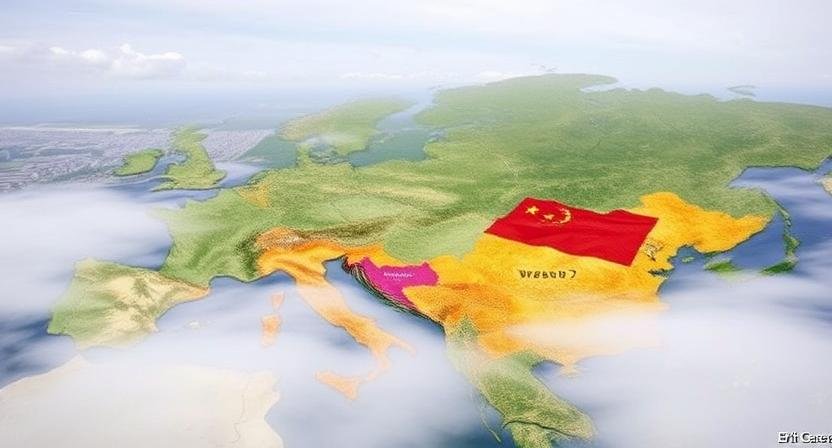
- Trump’s tariffs on Europe accelerated Hungary, Serbia, and Greece’s economic pivot toward China.
- China-Serbia trade reached $6.1B in 2024, Hungary-China trade hit $13.5B, and Greece-China trade rose to $11.2B.
- Belt and Road projects like the Budapest-Belgrade railway and Piraeus Port modernization are transforming regional connectivity.
- Combined trade could exceed $50B by 2030, creating a north-south “Silk Corridor” across Eurasia.
In 1946, Winston Churchill warned about an “Iron Curtain” descending across Europe, stretching “from Stettin in the Baltic to Trieste in the Adriatic.” Nearly eighty years later, a very different curtain seems to be falling — this time running 600 kilometers east of Churchill’s line, threading north-south through Hungary, Serbia, and Greece. It is not a curtain of ideology or military might, but one woven with Chinese capital, trade, and infrastructure.
This emerging corridor, linking Central Europe to the Mediterranean, signals how Donald Trump’s aggressive tariffs on the European Union (EU) have unintentionally pushed parts of Europe closer to Beijing. Far from being isolated by Western protectionism, China has turned adversity into opportunity, expanding its economic footprint in countries eager for investment, markets, and an alternative to Brussels and Washington.
Israel’s Shadow War in Iran: How a Cellphone Signal Became a Death Warrant
At the heart of this transformation lies Serbia, Hungary, and Greece — three nations that have rapidly deepened economic and political ties with Beijing. They offer China not only access to EU markets but also strategic corridors linking Asia to Europe under the Belt and Road Initiative (BRI). And while this alliance lacks the ideological zeal of the Cold War blocs, its economic weight is growing at an astonishing pace.
Trump’s Tariffs: The Unintended Catalyst
When Trump imposed sweeping tariffs on European steel, aluminum, and manufactured goods starting in 2018 — duties ranging from 10% on aluminum to 25% on steel — the EU bristled. Major economies like Germany and France lobbied for exemptions. But for smaller, less industrialized economies like Hungary, Serbia, and Greece, the tariffs were a rude awakening. Their exports became costlier, trade volumes with the U.S. stagnated, and foreign investment from traditional Western partners slowed.
READ MORE: Chicago mayor says police will not aid federal troops or agents
China quickly seized the moment. Offering low-interest loans, infrastructure projects, and preferential trade agreements, Beijing positioned itself as a reliable partner at a time when Washington seemed increasingly protectionist. “The tariffs created a vacuum,” notes Dragan Petrovic, a Belgrade-based economist. “China filled it with money, markets, and promises of modernization.”
Trade Volumes Surging
The results speak for themselves. China-Serbia trade reached $6.1 billion in 2024, up from just $2 billion in 2018, with a China-Serbia Free Trade Agreement signed in October 2023 eliminating tariffs on 90% of goods over the next five years. Serbian President Aleksandar Vučić hailed the deal as a “historic leap toward industrial modernization,” pointing to Chinese-built highways, railways, and even 5G networks across Serbia.
ALSO READ: North Korea’s Nuclear Leap with Russian Aid Sparks Alarms Across Asia-Pacific
Hungary, the first EU country to join China’s BRI in 2015, has seen bilateral trade with Beijing hit $13.5 billion in 2024, rising nearly 40% since 2020. The crown jewel is the $2.1 billion Budapest-Belgrade high-speed railway, financed largely by Chinese banks, which will connect the Greek port of Piraeus — itself majority-owned by China’s COSCO Shipping — to Central Europe by 2026.
Greece, recovering from its decade-long debt crisis, has embraced Chinese investment as well. Trade between China and Greece stood at $11.2 billion in 2024, with COSCO turning Piraeus into the Mediterranean’s second-busiest port, handling 5.2 million containers annually, compared to just 880,000 in 2010 before Chinese investment began.
Toward a $50 Billion Trade Corridor
Economists predict that by 2030, combined trade between China and this north-south corridor — Hungary, Serbia, and Greece — could surpass $50 billion annually, driven by free trade deals, infrastructure links, and rising Chinese demand for European agricultural products, machinery, and technology.
Chinese firms are already exploring electric vehicle (EV) factories in Hungary, solar panel manufacturing in Greece, and AI research partnerships in Serbia. Huawei has set up regional headquarters in Budapest, while China’s Zijin Mining has invested heavily in Serbia’s copper industry, making the country Europe’s second-largest copper producer.
“The future is connectivity,” says Prof. Elena Markovic of the University of Novi Sad. “By linking the Mediterranean to Central Europe under Chinese financing, this corridor will become Beijing’s economic bridge into the EU.”
Beyond Economics: Strategic Significance
What makes this development remarkable is its geopolitical subtlety. Unlike Russia, whose influence in Eastern Europe often comes through energy politics and military posturing, China wields soft power — loans, technology, trade, and cultural exchanges. Confucius Institutes are spreading across Serbian and Hungarian universities, while thousands of students from the region now study in China on government scholarships.
Joint military exercises, such as the China-Serbia special forces drill in Hebei in 2024, signal a quiet but growing security dimension. Yet officials insist this is about “peaceful modernization” rather than alliance-building.
Europe’s New Balancing Act
For Brussels and Washington, this north-south corridor poses a strategic dilemma. While Hungary and Greece remain EU and NATO members, their enthusiasm for Chinese capital often clashes with Western efforts to “de-risk” from Beijing. Serbian neutrality — outside both NATO and the EU — adds further complexity, giving China a partner unconstrained by Brussels’ regulations.
But for leaders in Budapest, Belgrade, and Athens, the calculus is simple: Chinese money builds roads, ports, and factories without the political lectures that often accompany Western aid.
As Trump-era tariffs reshaped global trade, they inadvertently gave China a historic opening in the heart of Europe. From Piraeus to Budapest, a new Silk Curtain is rising — not of ideology or war, but of steel rails, shipping lanes, and economic ambition stretching from the South China Sea to the Danube.