


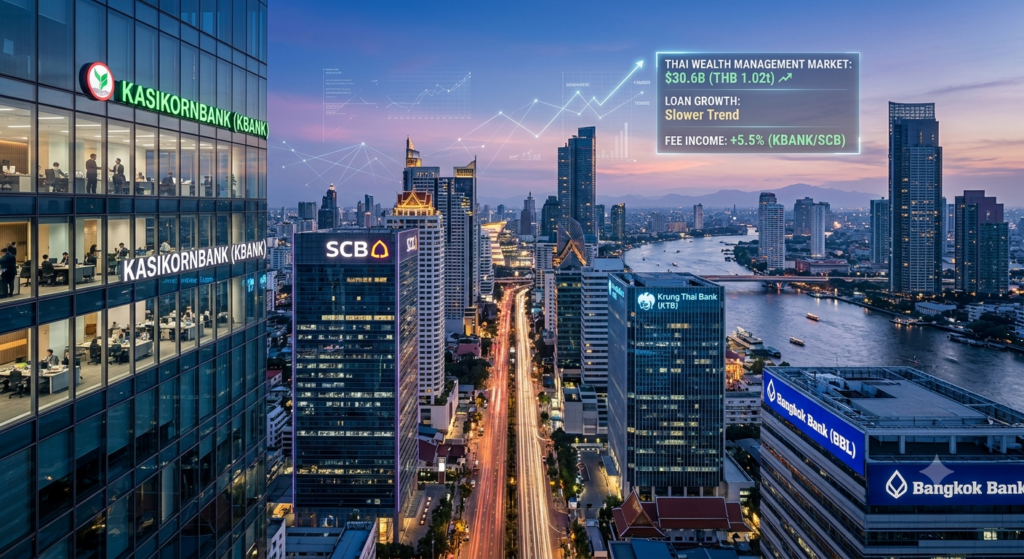
- Thai banks wealth management transformation accelerates as traditional net interest margins compress across ASEAN.
- CGS International Securities estimates Thailand’s addressable liquid wealth pool reached $30.6 billion across 517,674 affluent accounts.
- Kasikornbank (KBANK) and Siam Commercial Bank (SCB) lead the sector, capturing over 5.5% of total operating income via wealth fees.
- Strategic collaborations with global asset managers allow domestic banks to bypass credit risks while driving non-interest fee lines.
BANGKOK — Thai commercial banks are fundamentally restructuring their core business models, pivoting aggressively toward the country’s $30.6 billion (THB 1.02 trillion) wealth management sector. This strategic realign comes as cooling credit expansion and compressed net interest margins limit profitability within traditional lending portfolios.
According to an exhaustive sector analysis by CGS International Securities (CGSI), wealth management will serve as the primary engine for non-interest fee income over the next three years (2026–2028). Crucially, this asset-light pivot allows institutions to accelerate top-line growth without absorbing additional credit risk or inflating non-performing loan (NPL) provisions.
The $31 Billion Liquid Asset Pool
Data from the Bank of Thailand’s latest regulatory updates indicates that Thailand entered 2026 with 517,674 verifiable high-net-worth and affluent individual accounts holding liquid investable assets across savings and fixed-deposit instruments.
Thailand Cracks Down on Oil Mafia as PM Warns Against War-Driven Profiteering Amid Global Energy CrisisMust Read:
The domestic wealth ecosystem is distinctively bimodal, divided between the emerging affluent and ultra-high-net-worth (UHNW) segments:
-
The Mass Affluent Core: Retail depositors holding between $30,000 (THB 1 million) and $300,000 (THB 10 million) control 34.4% of the aggregate investable asset pool.
-
The Ultra-Wealthy Elite: Elite accounts with balances exceeding $3 million (THB 100 million) command a dominant 36.2% market share.
Thai Wealth Management Asset Distribution (Investable Deposits)
┌────────────────────────────────────────────────────────┐
│ [██████████████] Mass Affluent ($30k - $300k): 34.4%   │
│ [███████████████] Ultra-HNW (Above $3M): 36.2%         │
│ [──────────────] Mid-Tier Wealth / Other: 29.4%        │
└────────────────────────────────────────────────────────┘
Total Estimated Onshore Addressable Market: $30.6 Billion
Sub-Sector Leadership and Performance Indicators
The CGSI report highlights Siam Commercial Bank (SCB) and Kasikornbank (KBANK) as the most agile operators positioned to capture this shifting capital. Both entities have built advanced hyper-personalization engines, robust digital platforms, and dedicated private banking divisions.
| Banking Institution | Wealth Management Contribution to Total Operating Income (2025) | Sensitivity to Fee Income Growth (2026–2028) |
| Siam Commercial Bank (SCB) | 5.8% | High |
| Kasikornbank (KBANK) | 5.5% | High |
| Bangkok Bank (BBL) | ~3.1% | Medium |
| Krung Thai Bank (KTB) | ~2.9% | Medium |
While Bangkok Bank (BBL) and Krung Thai Bank (KTB) hold the largest absolute deposit bases in the Kingdom, analysts note they face operational hurdles. To monetize these passive assets, both institutions must aggressively scale up product shelves—such as structured notes and international mutual funds—and rapidly expand relationship manager capacity.
Regulatory and Structural Drivers
The structural drift toward wealth management began back in 2018 when the proliferation of zero-fee digital payment apps eroded traditional transactional revenue.
Read More: Thai banks target $31b wealth market as lending slows
Looking forward through 2027, the Bank of Thailand is preparing tighter statutory caps on basic retail banking charges. This regulatory pressure makes complex, higher-margin fee products like bancassurance, offshore brokerage, and mutual funds vital for maintaining Return on Equity (ROE).
Regional Benchmark: Thai banks still have considerable ground to cover compared to regional peers. Singapore’s DBS generated 57.5% of its non-interest income from wealth management fees in 2025, expanding at a compound annual growth rate (CAGR) of 14.3% since 2017. By comparison, wealth management accounts for just 13% to 19% of non-interest fee income at Thailand’s “Big Four” banks.
To bridge this gap, major players are partnering with global asset managers. Notable tie-ups include Krungsri Bank teaming up with Invesco to handle its $31 billion wealth arm, alongside existing joint ventures between SCB and BlackRock, and KBANK with J.P. Morgan Asset Management. This trend underlines a broader corporate push to transition local deposits into sophisticated, global investment portfolios.
Between 2026 and 2028, Thailand’s wealth management sector is projected to outpace traditional retail credit, driven by a contracting lending environment and a 6% expected CAGR in Asia-Pacific net financial wealth. Tightened central bank caps on interest margins will accelerate digital offshore diversification and high-margin asset product placement.