



- Thailand online fraud banking losses surge with millions affected and billions lost annually
- AI-powered scams exploiting human psychology are accelerating fraud attacks
- Experts highlight real-time fraud detection as the only effective defense
- Government regulations and AI solutions are reshaping banking security frameworks
Bangkok — In a rapidly digitizing financial world where cybercriminals are evolving faster than ever, global payment solutions provider BPC convened industry leaders, bankers, and technology experts at the SmartVista Day – Modern Enterprise Fraud Management through AI & Machine Learning seminar in JW Marriott Bangkok.
The high-level gathering unfolded as both a warning and a roadmap—exposing the alarming rise of online fraud across Thailand and Southeast Asia, while showcasing how artificial intelligence is becoming the financial sector’s most powerful line of defense.
The event was opened by Ouracha Pongwattana, Country Director Thailand at BPC, who set the tone with a stark assessment of the evolving fraud landscape. What was once a back-office risk, he emphasized, has now become a frontline crisis directly impacting customer trust and financial stability.
“Online fraud is no longer just a technical issue—it is a direct assault on customers’ assets,” Pongwattana told participants. “From savings accounts to credit lines, the financial damage is real, immediate, and growing.”
War in the Gulf, Reactors in Asia: How the Iran Crisis Is Driving Southeast Asia’s Nuclear Turn
His remarks painted a troubling picture of modern fraud tactics. Criminal networks, he explained, are no longer relying on crude phishing attempts. Instead, they are deploying psychological manipulation strategies, exploiting fear, greed, and even sensitive content to deceive victims. With smartphones serving as gateways to banking services, fraudsters now have unprecedented access to individuals—anytime, anywhere.
Online fraud is no longer just a technical issue—it is a direct assault on customers’ assets,” Pongwattana told participants. “From savings accounts to credit lines, the financial damage is real, immediate, and growing.
Ouracha Pongwattana, Country Director Thailand at BPC
Adding to the threat is the weaponization of technology itself. Artificial intelligence, automated dialers, and data harvested from social media platforms are enabling fraudsters to launch highly personalized and convincing attacks at scale. Victims are increasingly tricked into installing malicious applications or transferring funds to so-called “mule accounts,” often without realizing the deception until it is too late.

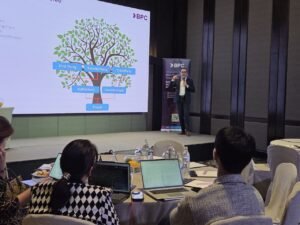
Yet perhaps the most alarming shift, Pongwattana noted, is the speed of these crimes. Traditional fraud detection—largely dependent on post-transaction monitoring—has become obsolete in a world where fraudulent transfers can occur within seconds.
“The industry must move from reactive to proactive,” he stressed. “Real-time detection is no longer optional—it is essential.”
ONLINE FRAUD PREVENTION BECOMES THE NEW STANDARD FOR BANKS IN THAILAND
That urgency was echoed and expanded upon by Maxim Kuzin, Head of Fraud Monitoring Department at BPC, who delivered a data-driven analysis that underscored the scale of the crisis.
Citing regional insights, including remarks by Sihasak Phuangketkeow, Kuzin highlighted that online fraud is generating over $40 billion annually across East and Southeast Asia. Thailand, he warned, stands at the epicenter of this surge.
Recent data reveals that six in ten Thais have fallen victim to scams, with financial losses soaring to 110 billion baht in a single year—a record high. Even more striking is the velocity of fraud transactions: more than half of stolen funds are moved within just three minutes, while victims typically take up to 18 hours to recognize and report the crime.
“This time gap is where fraudsters win,” Kuzin explained. “By the time traditional systems react, the money is already gone.”
The seminar also shed light on the growing complexity of fraud ecosystems. From investment scams to coordinated mule account networks, cybercriminal operations are becoming increasingly organized, transnational, and technologically advanced.
However, amid the rising threat, Thailand’s regulatory response is emerging as a critical line of defense. Both speakers acknowledged that authorities, including the central bank, have stepped up efforts through a series of frameworks such as the Payment Systems Act, the National e-Payment Master Plan, and newly introduced AI risk management guidelines.
These measures require banks to adopt continuous transaction monitoring, risk-based authentication, and enhanced detection of suspicious account activity. There is also a strong push for transparency in AI-driven decision-making and structured incident response mechanisms.
Still, as Kuzin noted, regulation alone cannot outpace innovation in cybercrime.
“The challenge is not just compliance—it is capability,” he said. “Banks need systems that can think, learn, and respond in real time.”
At the heart of the discussion was the need for a fundamental transformation in fraud management architecture. Both Pongwattana and Kuzin emphasized that fragmented, channel-specific defenses are no longer sufficient in an interconnected digital ecosystem.


Instead, they advocated for enterprise-wide fraud management platforms capable of integrating all customer touchpoints—from mobile banking to card transactions—into a single intelligence framework. Such systems, powered by AI and machine learning, can analyze behavior across channels, detect anomalies instantly, and stop fraudulent activity before it materializes.
BPC’s own SmartVista Fraud Management platform was presented as a case in point—an advanced solution designed to deliver real-time detection, omnichannel analytics, and a 360-degree view of customer activity. By consolidating fraud monitoring into a unified platform, financial institutions can not only improve accuracy and response times but also reduce operational costs associated with siloed systems.

Yet beyond technology and regulation, both experts returned to a more human dimension of the crisis: awareness.
“Fraud ultimately succeeds by exploiting people,” Pongwattana said. “Technology can protect systems, but education protects customers.”
As the seminar concluded with an interactive Q&A and networking session, one message resonated across the room: the fight against online fraud is no longer optional—it is existential.
In an era where digital banking defines economic life, the ability to secure financial transactions in real time will determine not just institutional success, but public trust itself.
SmartVista Day in Bangkok did not merely diagnose the problem—it issued a call to action.