


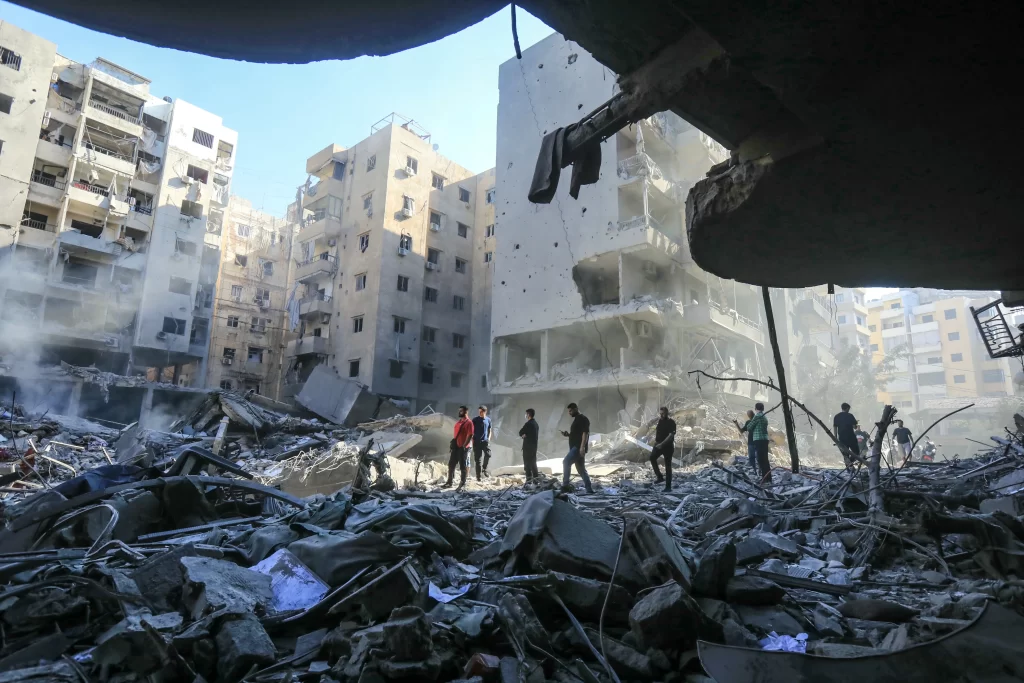
- The Trump-brokered ceasefire has reduced violence but left Gaza under siege.
- Israel and Hamas trade accusations, undermining fragile peace efforts.
- Humanitarian aid remains blocked, worsening famine and disease.
- The long-term peace process hinges on aid access, justice, and mutual restraint.
When the guns finally went quiet over Gaza last week, a heavy silence settled across the broken landscape — a silence filled not with peace, but with exhaustion. The ceasefire between Israel and Hamas, brokered under intense U.S. pressure by President Donald Trump’s administration, was meant to herald a “new beginning.” Instead, it feels like a pause between storms.
After two years of bombing, siege, and unimaginable suffering, the enclave lies in ruins. The promise of aid flowing freely into Gaza has yet to materialize. Trucks wait for clearance at the Kerem Shalom crossing, while the vital Rafah gate with Egypt — Gaza’s last window to the world — remains shut. Inside the Strip, 2.3 million people struggle to survive amid collapsing hospitals, scarce water, and mounting disease.
The war may have ended on paper, but Gaza’s agony continues.
The Ceasefire of Mistrust
The ink on the ceasefire agreement had barely dried before both sides accused each other of violations. Israel says Hamas has withheld the remains of deceased hostages; Hamas counters that Israeli troops have shot at civilians near ceasefire lines, killing at least two dozen Palestinians since the truce began.
For all the public posturing, neither side appears eager to break the deal — yet both are preparing for the next phase of confrontation, political or otherwise. Israel’s Prime Minister Benjamin Netanyahu, his domestic reputation battered, insists that “the fight is not over yet.” Hamas, bloodied but unbroken, claims “victory through survival.”
Trump’s 20-point peace plan — a blueprint for reconstruction, hostage exchange, and full aid access — now hangs by a thread. American advisers admit that implementing it in the current climate of hostility and mistrust will be “extraordinarily complex.”
In truth, the ceasefire is less a peace than a truce of fatigue.
The Humanitarian Chokehold
If peace is measured by the welfare of civilians, Gaza is still at war. The World Health Organization reports that only 13 of 36 hospitals in the territory are partially functional. Infectious diseases — meningitis, diarrhoea, respiratory infections — are spreading uncontrollably. Aid convoys carrying food, water, and medical supplies are stranded at checkpoints, waiting for clearance that never comes.
Israel’s Coordinator of Government Activities in the Territories (COGAT) has made it clear that Rafah will remain closed to humanitarian aid “at any stage.” Instead, limited supplies trickle through Israeli-controlled crossings under heavy inspection — a system aid workers describe as “collective punishment.”
“Every hour we lose is another child’s life,” says Dr. Hanan Balkhy of WHO. “We need fuel, medicine, and doctors — not just promises.”
The United Nations estimates that 200,000 metric tons of aid are waiting outside Gaza’s sealed gates. Inside, families burn scraps of furniture to cook what little food they have left. Once again, humanitarian aid has become a weapon of political leverage.
Ghosts of the Dead
Perhaps the darkest symbol of this uneasy truce lies in the bodies — both Israeli and Palestinian — being exchanged in cold, bureaucratic handovers. On Monday, Hamas returned 20 surviving hostages and nine bodies, saying the rest were still trapped beneath rubble. Israel, in turn, has begun releasing Palestinian prisoners and returning corpses of those killed during raids.
Doctors in Gaza report that many of the bodies bear signs of execution — blindfolds, bullet wounds to the head, bound hands. “Almost all had been executed,” said Dr. Ahmed al-Farra at Nasser hospital. “This is not just war; it’s revenge.”
These grim exchanges underscore a central truth: reconciliation between two peoples drowning in blood and memory is not something a piece of paper can enforce.
Trump’s Gamble and the Fragile New Order
At the Sharm el-Sheikh “Gaza Summit,” Trump basked in his new role as global dealmaker. Leaders from across the region — from Egypt’s President Sisi to Pakistan’s Prime Minister Shehbaz Sharif — lined up to offer praise. Trump, ever theatrical, joked, flattered, and bragged his way through the event. But behind the smiles, diplomats whispered of unease.
Trump’s ceasefire deal, though groundbreaking on paper, rests on unstable foundations. It offers Hamas limited political recognition, promises aid under strict Israeli supervision, and grants the U.S. a permanent oversight role in Gaza’s reconstruction. Critics in both Jerusalem and Ramallah call it “peace under occupation.”
For many Palestinians, the plan feels like another chapter in a long history of foreign-engineered solutions — agreements made in gilded halls that crumble in Gaza’s dust.What Comes Next
The future of Gaza depends on three fragile pillars: aid, autonomy, and accountability. Each is uncertain.
-
Aid: Without immediate access through Rafah and unrestricted delivery of fuel and food, Gaza’s humanitarian crisis could turn apocalyptic.
-
Autonomy: Hamas’ survival ensures it remains the de facto ruler of Gaza, while Israel’s security establishment insists on “complete demilitarization” — a recipe for perpetual tension.
-
Accountability: War crimes on both sides remain uninvestigated. Without justice, there can be no durable peace.
In Washington, Trump has hinted that Israel could “return to those streets” if Hamas fails to disarm. In Tel Aviv, families of hostages demand answers. And in Gaza, people simply want water, light, and medicine.
The international community, weary of Gaza’s endless cycles of violence, risks slipping into moral fatigue — a dangerous apathy that could let this fragile calm collapse.
A City of Ashes and Dreams
At sunset, the minarets of Gaza still stand amid the rubble, their calls to prayer echoing through ruins that once were homes. Children play among the wreckage with improvised footballs. Life, stubbornly, refuses to surrender.
Reconstruction plans are already being drafted in Amman, Doha, and Ankara. Billions of dollars in aid are pledged but conditional. Contractors talk of “building back better.” Yet no one can build peace without trust — and Gaza has none left to give.
If this truce holds, Gaza may rise again, slowly and painfully. If it fails, the next war will not just destroy buildings — it will destroy what little remains of hope.
The future of Gaza, like its skyline, hangs between heaven and hell — waiting for the world to decide which it deserves.