

By Shamriz Sabawoon in Kabul &
Kaswar Klasra in Islamabad
KABUL, AFGHANISTAN: Moment before the dawn Fatima, gets up early in the morning to get ready for job along with her father. While children of her age enjoy sound sleep in warm and comfortable blankets in harsh winter, Fatima steps outside her house just to follow her father, a laborer at brick kiln.
12 year Afghan girl “Fatima “wears boy’s clothe and work at a local brick factory to help her father to make money and support their family in outskirts of Kabul, Afghanistan.
“We are six sisters, we don’t have any brother and I wear boy’s clothe to work with my father,” Fatima told Islamabad Telegraph.


“I dislike working as laborer. However, I am left with no option other than helping my father to accomplish task at brick kiln,” she added.
“I wished to wear a school uniform and carry a bag on my shoulder and go to school. I want to make friends and play with them,” said Fatima, a 12-year-old brick kiln worker from Kabul.
Thousands of children as young as five work as brick makers in Afghanistan’s kilns, as poverty and debt keep their families in low-wage bonded labor. According to ILO, tackling the issue is far more complex than just banning child labor in the kilns.


Twelve years -old Fatima is a seasoned worker with four years of experience in brick making. She works 13 hours a day, six days a week at a kiln in outskirts of Kabul, Afghanistan, alongside her father.
“I have to quit studies only to help my ailing father in brick making. Let me tell you that my father does not force me to work in the kiln, but I have to work here to earn money to pay for house rent and food,” a 12-year-old told Islamabad’s correspondent in Kabul.

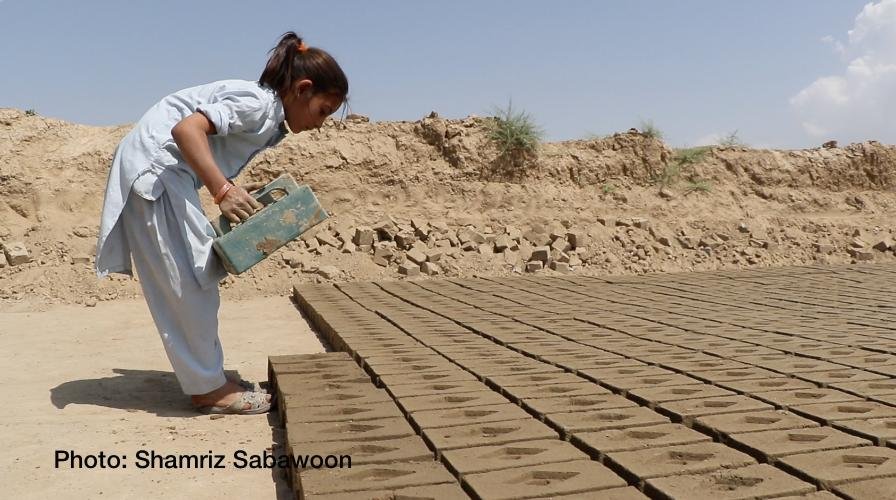
The kilns provide no protection from the sun and the swirling dust, and the work is hard and hazardous. But, her family has no alternative.
According to International Labor Organization, poverty, limited skills and debt keeps them trapped in low-wage bonded labor, which is pervasive in brick kilns in Afghanistan and elsewhere in South Asia in nuclear armed Pakistan.
According to International NGOs, Fifty-six per cent of the brick makers in Afghan kilns are children, most of whom started working at the age of seven or eight, according to the ILO’s buried in Bricks report.


By the age of nine, almost 80 per cent of children in brick maker households are working, according to the survey, which looks at labor practices at kilns in the Afghan provinces of Kabul and Nangarhar.
Situation in neighboring Pakistan is not different either where thousands of children work at brick kilns as bonded labor.


“Without education, training or transferable skills, kiln workers – children and adults alike – are ill prepared to do anything besides making bricks. This makes it extremely difficult for them to leave the vicious cycle of debt,” said a report of ILO.
In Pakistan, almost thirty present of total labour at brick kiln consists of children.


Punjab government had issued on January 14, 2016, the Punjab Prohibition of Child Labour at Brick Kilns Ordinance 2016, which says brick kiln owners will be kept in prison for six months and will be fined up to Rs500, 000 if children are found working on their kilns.
The government had pledged to give Rs1, 000 to every school-going child of kiln workers. A restriction had also been imposed on obtaining advance more than six times the salary. However, all of these measures couldn’t put an end to child labour at brick kilns across Pakistan.