


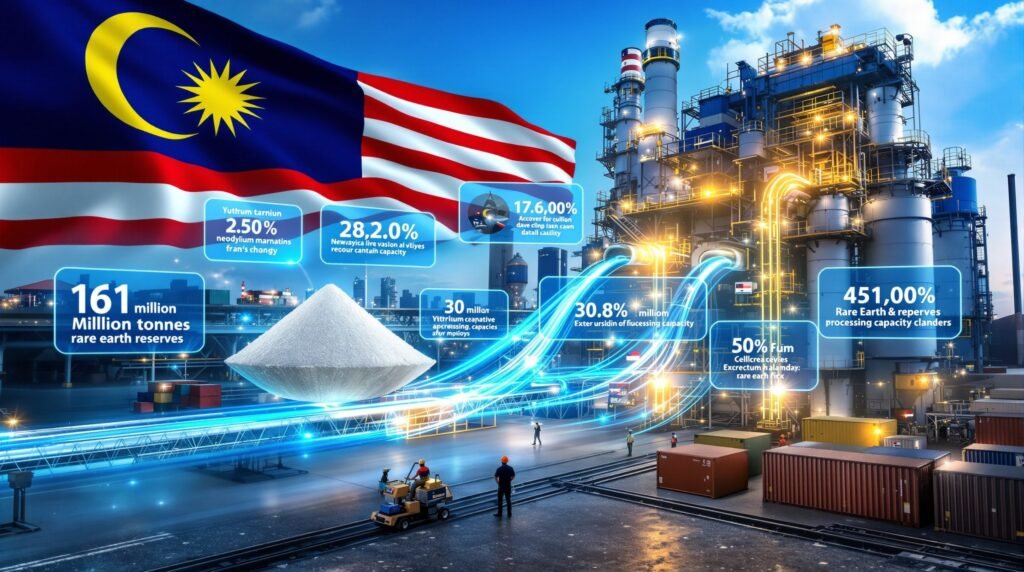
- The Malaysia sovereign wealth fund, Khazanah, is leading a new “mine-to-magnet” strategy to capture the $175 billion rare earth market.
- Managing Director Amirul Feisal predicts the ringgit could strengthen below 4.00 per USD due to increased foreign investment.
- Malaysia currently processes nearly 14% of global rare earth compounds, aiming to reduce global dependency on China.
- New downstream projects are being fast-tracked through joint ventures with international partners and Chinese state-owned enterprises.
In early 2026, Malaysia’s sovereign wealth fund, Khazanah Nasional Bhd, has taken a proactive stance on the national stage, signaling a bullish outlook for the Malaysian Ringgit and a strategic pivot into the high-stakes world of critical minerals. As the global economy navigates the complexities of “de-risking” from China, Malaysia finds itself at a crossroads of opportunity and historic scrutiny.
Khazanah’s New Horizon and the Ringgit’s Rise
Managing Director Amirul Feisal Wan Zahir recently expressed confidence that the ringgit would continue its strengthening trend, potentially breaking the 4.00 mark against the US dollar. This optimism is backed by a robust economic performance that has defied the headwinds of global tariffs.
Beyond currency, Khazanah is spearheading Malaysia’s transition into a “rare earth powerhouse.”
Prime Minister Anwar Ibrahim has tasked the fund with developing the downstream rare earth industry, specifically targeting the production of “super magnets” used in electric vehicles and defense technology.
Rare Earths: Malaysia vs. China
Malaysia’s rare earth ambitions are often compared to China’s, though the scale of the two nations remains vastly different. A Malaysian official recently noted that while China dominates the market, Malaysia’s unique geological endowment of non-radioactive rare earth elements (NR-REE)—estimated at 16.1 million tonnes worth approximately RM810 billion ($175 billion)—gives it a seat at the table.
| Metric | Malaysia (2024/2025) | China (2024/2025) |
| Annual Extraction Volume | ~130 – 310 Metric Tons | ~270,000 Metric Tons |
| Global Mining Share | < 0.1% | ~69% |
| Global Refining Share | ~13.8% (mainly via Lynas) | ~91% |
| Reserves | ~16.1 Million Tonnes | ~44 Million Tonnes |
While China’s volume is orders of magnitude higher, Malaysia holds the world’s largest processing plant outside of China (Lynas in Gebeng). The Malaysian government has enforced a ban on raw ore exports to force value-added processing onshore, a strategy intended to mimic China’s historical consolidation of the supply chain.
The Ghost of 1MDB: A Scandal That Rocked the Nation
While Khazanah looks toward the future, the shadow of the 1Malaysia Development Berhad (1MDB) scandal remains the most significant cautionary tale in the history of sovereign wealth management.
The Scale of the Theft
The 1MDB scandal involved the systemic embezzlement of billions from a fund intended to drive national development.
-
Total Misappropriated: An estimated $4.5 billion was siphoned off between 2009 and 2015.
-
National Debt: By 2026, the Malaysian government is still managing approximately $7.8 billion in outstanding 1MDB-related debts, including long-term bonds due in 2039.
-
Key Players: Former Prime Minister Najib Razak (currently imprisoned) and fugitive financier Low Taek Jho (Jho Low) were the central architects.
The funds were laundered through a global network of shell companies and major financial institutions, including Goldman Sachs, which later paid over $5 billion in global penalties. The stolen money was used to purchase luxury real estate in New York, a $250 million superyacht (The Equanimity), Van Gogh and Monet paintings, and even to finance the Hollywood film The Wolf of Wall Street.
A Critical Turning Point
Ultimately, Malaysia’s economic trajectory in 2026 hinges on its ability to decouple its future from the structural scars of the 1MDB era while leveraging its geological luck. By institutionalizing transparency within Khazanah and the Strategic Fund, Malaysia is attempting to prove to global investors that it has transitioned from a victim of kleptocracy to a disciplined, “high-income” industrial hub. The success of the “mine-to-magnet” initiative will serve as the litmus test for this new era of sovereign governance—deciding if the nation can truly compete with China’s industrial shadow or if it remains tethered to the fiscal weights of its past.