


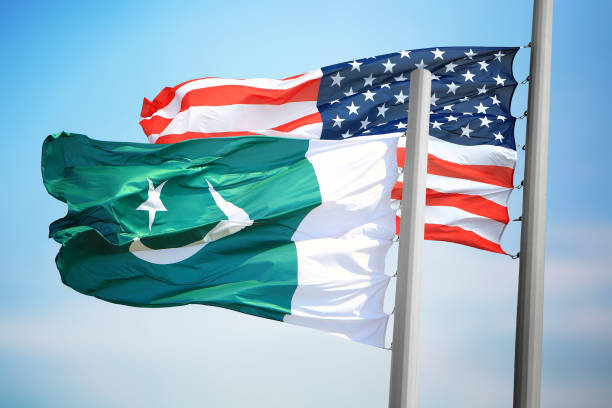
- Diplomatic Tensions: Pakistan has strongly condemned a US House resolution questioning the legitimacy of its February general election, viewing it as an attempt to interfere in its internal affairs.
- Military Support Request: Pakistan’s Ambassador to the US, Masood Khan, has requested modern equipment and small arms from Washington to support the country’s new counter-terrorism initiative, Operation Azm-i-Istehkam.
- Future Relations: Despite the current strain, Pakistan remains optimistic about the future of US-Pakistan relations, emphasizing shared security and economic interests and calling for continued defense cooperation and investment opportunities.
Pakistan has strongly condemned the United States’ recent actions, accusing the superpower of meddling in its domestic affairs. This reaction came in response to a resolution passed by the US House of Representatives on Wednesday, which questioned the legitimacy of Pakistan’s general election held in February.
The resolution calls for a thorough and independent investigation into the alleged election irregularities. Pakistan’s former Prime Minister Imran Khan’s party, Pakistan Tehreek-e-Insaf (PTI), has claimed that the election was manipulated to deny them victory.
Diplomatic Response from Pakistan
Constructive Dialogue vs. Political Interference
Mumtaz Zahra Baloch, spokesperson for Pakistan’s Ministry of Foreign Affairs, emphasized the country’s commitment to constructive dialogue and engagement. However, she criticized the US resolution as neither constructive nor objective.
Pakistan faces the difficult choice to choose between the US or China ‘bloc’
“We believe that the timing and context of this particular resolution do not align well with the positive dynamics of our bilateral ties, and stem from an incomplete understanding of the political situation and electoral process in Pakistan,” Baloch stated.
Defense Minister Khwaja Asif echoed this sentiment, suggesting that the US should focus on ensuring transparency in its own upcoming elections. He criticized the US for its historical involvement in overthrowing foreign governments and its current support for Israel’s actions in Gaza.
“The US has no right to interfere in Pakistan’s internal matters,” Asif asserted during a television interview.
The US Congressional Resolution
Support for Democracy and Human Rights in Pakistan
The resolution, titled “Expressing Support for Democracy and Human Rights in Pakistan,” was introduced in Congress on June 25. It urges the Pakistani government to uphold democratic and electoral institutions and condemns any attempts to violate the human, civil, or political rights of Pakistani citizens.
‘No right to interfere’: Pakistan hits back at US over election scrutiny
The resolution passed with overwhelming support, receiving 368 votes in favor and only seven against. PTI, which claims its mandate was stolen in the February 8 elections despite winning the highest number of seats, welcomed the resolution’s passage.
Former President Arif Alvi, a senior PTI leader, praised the resolution as a step in the right direction.
Pakistan’s Request for US Military Support
Counter-Terrorism Initiatives
In a related development, Pakistan’s Ambassador to the US, Masood Khan, has urged Washington to provide small arms and modern equipment to support the country’s newly approved counter-terrorism initiative, Operation Azm-i-Istehkam. This initiative aims to dismantle terrorist networks without resorting to large-scale military operations that could displace local populations.
“Pakistan has launched Azm-i-Istehkam to oppose and dismantle terrorist networks. For that, we need sophisticated small arms and communication equipment,” Ambassador Khan stated during an address at the Wilson Centre in Washington.
Khan emphasized the need for strong security links and enhanced intelligence cooperation between Pakistan and the US. He also highlighted the importance of resuming sales of advanced military platforms and maintaining US-origin defense equipment.
“This is crucial for regional security and opposing the rising tide of terrorism that also threatens the interests of the US and its allies,” Khan added.
Future Prospects of US-Pakistan Relations
Strategic Partnerships and Economic Opportunities
Despite the current tensions, Ambassador Khan expressed optimism about the future of US-Pakistan relations. He highlighted the shared values, security, and economic interests that bind the two nations.
“We share values, our security and economic interests are interwoven, and it is the aspiration of our two peoples that strengthens our ties,” he said.
Khan argued that the bilateral relationship should be based on ground realities and not be hindered by a few issues. He invited US investors and businesses to explore Pakistan’s potential in terms of its demographic dividend, technological advancements, and market opportunities.
High-level defense talks, frequent meetings, and joint military exercises such as Inspired Union-2024, Falcon Talon, and Red Flag were cited as examples of robust defense cooperation between the two countries.
Khan also suggested that the US consider Pakistan as a partner in its diplomatic efforts in Kabul and collaborate on counterterrorism and the rights of women and girls in Afghanistan.
“In this era of renewed strategic competition, the US and Pakistan should build on existing partnerships and explore new horizons to establish the parameters of mutual interests,” he said.
The Path Forward
Navigating Diplomatic Challenges
The recent resolution by the US House of Representatives has undoubtedly strained relations between the US and Pakistan. However, both nations have a long history of strategic cooperation and shared interests that could help navigate these challenges.
For Pakistan, it is crucial to balance its response to external criticism while maintaining its sovereignty and democratic processes. For the US, understanding the complexities of Pakistan’s political landscape and engaging in constructive dialogue will be key to sustaining a positive bilateral relationship.
As both nations look to the future, it is clear that maintaining open channels of communication and focusing on mutual interests will be essential in overcoming the current diplomatic hurdles. By fostering cooperation in areas such as counter-terrorism, defense, and economic development, the US and Pakistan can work towards a more stable and prosperous future for both countries