


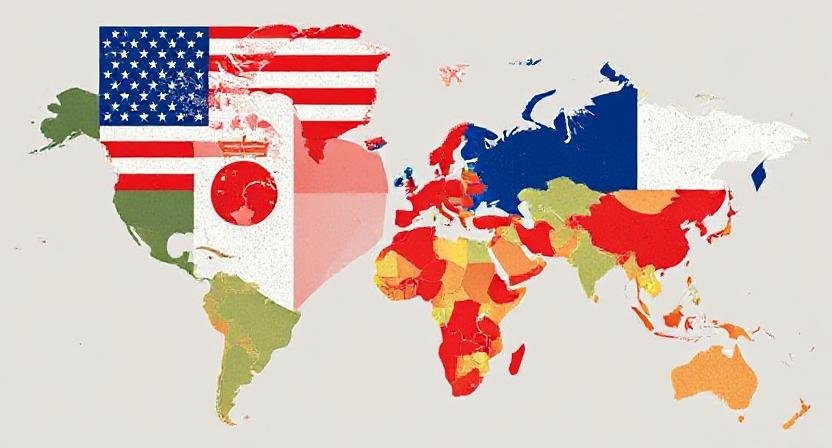
- Allies Sidestep U.S. Leadership: Trump’s aggressive 30% tariffs have pushed traditional allies—led by the European Union—to begin constructing a global trade framework that no longer relies on American leadership or stability.
- Global Trade Realignment Underway: Countries like Canada, the U.K., Indonesia, Brazil, and Vietnam are strengthening trade ties with each other and with the EU, signaling the emergence of a multipolar trade order designed to minimize U.S. exposure.
- Retaliation or Coalition? Analysts warn that coordinated retaliation against the U.S. could become reality, as affected nations consider forming a united front to counter Washington’s tariff pressure and restore balance in trade negotiations.
- Trust in U.S. Trade Policy Collapsing: After years of volatility, American allies now see the U.S. as an unreliable economic partner. The EU and others are accelerating deals and alliances that exclude both the U.S. and China, aiming for long-term stability.
In a quiet but seismic shift, the world’s major economies are stitching together a new global trade architecture—one that increasingly bypasses the United States. With President Donald Trump once again wielding tariffs as blunt instruments of coercion, longtime allies in Europe, Asia, and beyond are reaching a painful but strategic consensus: if the U.S. won’t lead the global economy with predictability, they will proceed without it.
The European Union, stung by Trump’s latest announcement of 30% blanket tariffs on EU goods effective August 1, is stepping into a leadership vacuum it did not ask for—but now seems eager to fill.
Trump-Putin Meeting in the Works as Washington and Moscow Seek Breakthrough on Ukraine War
Over the weekend, European Commission President Ursula von der Leyen stood beside Indonesia’s President Prabowo Subianto in Brussels, not only vowing to keep talking with Washington but also extending a powerful invitation to other economies: Europe is open for business—and ready to build something new.
“You are always welcome here, and you can count on Europe,” she said, in what was less a reassurance and more a rallying cry for nations seeking shelter from America’s economic volatility.
The contrast could not be starker. As Trump’s tariff threats rip through the global marketplace—hitting Mexico, Canada, Thailand, Bangladesh, and Brazil with similarly punitive duties—America’s trade allies are drawing closer to each other, edging toward the creation of a new, rules-based economic system with the U.S. increasingly on the outside looking in.
The End of a Transatlantic Illusion
For months, EU negotiators believed they were nearing a compromise with Washington. A 10% baseline tariff seemed achievable. Carve-outs for sensitive European industries were discussed.
READ MORE: Is the Ukraine War Finally Nearing Its End? Rubio’s Secret Meeting with Lavrov Sparks Hope and Tension
Then, without warning, the White House delivered a diplomatic sledgehammer. According to senior EU officials, the Trump administration notified them late Friday that negotiations had collapsed. By Saturday, the world learned about the new 30% tariff via the president’s own social media feed.
That announcement didn’t just upend a trade deal—it upended trust.
“Trump is deliberately moving the goalposts to destabilize us,” said Brando Benifei, chair of the European Parliament’s delegation on U.S. relations. “It’s not negotiation. It’s economic extortion.”
Even Trump’s critics acknowledge his unpredictability is strategic. Mujtaba Rahman, managing director for Europe at Eurasia Group, argues that Trump is “instrumentalizing uncertainty,” weaponizing trade volatility to pressure allies into one-sided concessions.
ALSO READ: American Allies Want to Redraw the World’s Trade Map, Minus the U.S.
The effect is chilling. American partners now see themselves not as collaborators in a grand Western economic alliance—but as potential targets in a zero-sum game of tariff roulette.
Building a World Without Washington
The European response has been both measured and radical. On the surface, von der Leyen confirmed that the EU will hold off retaliatory tariffs—worth an estimated $25 billion—until early August. Behind the scenes, however, European trade officials are moving swiftly to deepen existing partnerships and forge new ones far beyond Washington’s reach.
Brussels and Ottawa are in advanced talks to expand the Comprehensive Economic and Trade Agreement (CETA). London and Brussels, once bitterly divided over Brexit, are quietly pursuing their closest economic alignment since Britain’s departure. Meanwhile, negotiations are accelerating with India, South Africa, ASEAN nations, and South American economies.
“We in Southeast Asia, especially Indonesia, consider Europe to be vital for global economic stability,” President Prabowo said in Brussels—a sentiment echoed across capitals weary of Trump’s erraticism.
This is not merely an EU reaction. Canada is strengthening trade ties with Southeast Asia. Brazil and Mexico are talking about regional supply chains that bypass the U.S. altogether. What’s emerging is a multipolar trading web rooted in shared predictability, not American dominance.
And perhaps most startlingly, the idea of building a new trade order that excludes both the United States and China is gaining traction.
“It’s the elephant in the negotiation rooms,” said a senior EU diplomat. “Everyone’s quietly discussing a system that sidesteps the two great disruptors—Washington and Beijing.”
Could Allies Gang Up on the U.S.?
Some analysts believe the next logical step is collective retaliation—not simply a chorus of bilateral responses but a coordinated bloc of countries striking back against the U.S. in unison.
“I would start to look for coordination,” said Jacob Funk Kirkegaard of Bruegel, a Brussels-based economic think tank. “That’s the rational thing.”
Such coordination would amount to an unprecedented shift in the global trade order: American allies no longer waiting for Washington’s lead but banding together to blunt its impact. If that materializes, the U.S. may find itself isolated not by adversaries, but by its closest historical partners.
The strategic logic is straightforward. If America insists on treating its partners like rivals, they may begin to behave accordingly.
A Transatlantic Marriage on the Rocks
The U.S.-EU economic alliance once formed the spine of the liberal world order. Together, they championed free markets, open trade, and multilateral institutions. Today, that bond is fraying, not over ideology, but over reliability.
Trump’s tariff decisions come just months after he pulled the U.S. out of the WTO’s arbitration mechanism, weakening a pillar of global trade enforcement. His administration has made clear that it sees trade not as cooperation but leverage—a means of transactional dominance.
The EU, in contrast, is betting on stability, legal frameworks, and mutual benefit. That bet may not yield immediate results, but over time it is reordering global loyalties.
“Trade relationships, once broken, are hard to rebuild,” said one European Commission official. “Supply chains move. Trust erodes. And once it’s gone, it’s gone.”
Toward a Post-American Trade Era?
A dramatic question now looms: is the global economy entering a post-American phase?
Not entirely—at least not yet. The U.S. remains the world’s largest economy, home to world-leading innovation and a vast consumer market. But its role as the central axis of trade is no longer guaranteed.
With the EU courting Japan, Vietnam, and Australia in what could become a new trans-Pacific pact—minus the U.S. and China—the outlines of a future without Washington are becoming clearer. This is no longer speculation. It is a blueprint in motion.
In Ho Chi Minh City, Vietnam’s garment factories are pivoting more of their production to meet European demand. In São Paulo, Brazilian steelmakers are restructuring exports to avoid U.S. markets. In London, EU and British trade reps are exchanging more than pleasantries for the first time since Brexit.
The pivot away from the U.S. isn’t ideological—it’s structural.
As one German trade official put it: “We can’t keep gambling on Washington’s mood swings. We need something that lasts longer than a tweet.”