


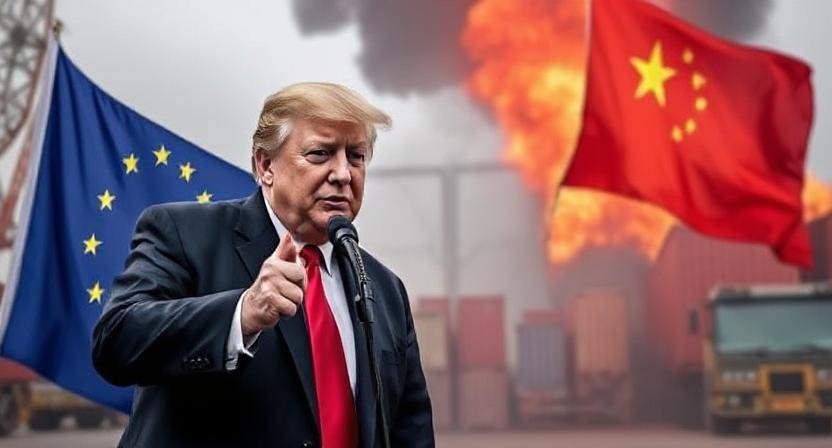
- China imposed retaliatory tariffs of up to 84% on U.S. goods after Trump’s sweeping tariff escalation, intensifying the Trade War.
- The European Union joined the fray, announcing counter-tariffs on U.S. imports in response to American levies on steel, aluminum, and more.
- The U.S.-China trade volume exceeds $575 billion, while U.S.-EU trade stands at over $900 billion, raising fears of a global economic slowdown.
- Experts warn the Trade War could cut global GDP by up to 1.2%, with businesses, consumers, and markets worldwide set to suffer.
In a dramatic escalation of global trade tensions, China and the European Union have slapped retaliatory tariffs on a wide range of American goods, setting the stage for what experts warn could become the most disruptive trade war in modern history—with President Donald Trump’s America at the center of the storm.
The twin blows came just hours after the Trump administration unveiled sweeping new “reciprocal tariffs” aimed primarily at China but affecting global trade partners alike. China responded by imposing retaliatory duties of up to 84% on key U.S. imports, while Brussels announced it would begin levying counter-tariffs on American products next week.
Powerful Signs Australia-China Trade Relations Are Entering a Bright New Era
The move marks the latest escalation in an intensifying standoff that risks upending global supply chains, rattling financial markets, and slowing growth across major economies.
A Global Economic Earthquake in the Making
The sheer scale of the trade ties between the combatants underscores the gravity of the situation. In 2023, U.S.-China bilateral trade amounted to approximately $575 billion, with China exporting about $427 billion worth of goods to the U.S., while importing $148 billion from the U.S. The European Union, America’s second-largest trading partner, accounted for an additional $900 billion in transatlantic trade.
READ MORE: Powerful Signs Australia-China Trade Relations Are Entering a Bright New Era
Collectively, the U.S., China, and the EU represent nearly 60% of global GDP, making this trade war not just a bilateral dispute, but a conflict with potentially devastating global consequences.
“This is getting so ridiculous that it’s hard to believe it’s actually happening between the two largest economies that make up almost $50 trillion of global GDP,” said Peter Boockvar, chief investment officer of Bleakley Financial Group, in a note to investors.
Trump’s Tariff Barrage and the Global Blowback
The Trump administration’s latest tariffs include an additional 84% to 104% levy on a broad array of Chinese goods, citing unfair trade practices and intellectual property theft. Simultaneously, Washington has slapped 25% tariffs on European steel and aluminum and expanded tariffs on other EU products, ranging from machinery to agricultural exports.
ALSO READ: China announces 84% tariffs on US goods in showdown with Trump. Europe also hits back
In response, China’s State Council Tariff Commission condemned the U.S. move as “a mistake upon mistake,” announcing tariffs that mirror Washington’s latest actions. Additionally, Beijing imposed export controls on 12 U.S. companies and blacklisted six more firms by adding them to its “unreliable entity list.”
The European Commission, not to be outdone, issued a sharply worded statement:
“These countermeasures can be suspended at any time, should the US agree to a fair and balanced negotiated outcome. Until then, Europe will stand firm in defending its industries and workers.”
Who Stands to Lose the Most?
Economists warn that while all sides will suffer, the global consumer may bear the biggest brunt as supply chain disruptions and higher import costs ripple through economies.
“Tariffs are taxes in disguise,” said Dr. Alicia Garcia-Herrero, Chief Economist for Asia-Pacific at Natixis. “They drive up costs for consumers, businesses, and in the long run—every player in the global value chain.”
Key Facts & Figures:
-
US-China trade (2023): $575 billion
-
US-EU trade (2023): $900 billion
-
China’s new tariffs on US goods: Up to 84%
-
US tariffs on Chinese imports: Up to 104%
-
Potential GDP loss from trade war: 1.2% globally (Oxford Economics)
China, whose economy is already under pressure from a slowing property market and soft domestic consumption, could see its export-driven growth take a hit. But analysts caution that U.S. businesses and farmers could face equally painful consequences, especially as Beijing and Brussels target American agricultural products, technology firms, and automakers.
Last year alone, China bought over $15 billion in American agricultural exports—goods that could now be at risk of Chinese countermeasures.
“This escalation is a loser for them,” argued U.S. Treasury Secretary Scott Bessent in an interview with Fox Business. “They’re the surplus country. They sell five times more to us than we sell to them.”
However, the reality is more nuanced. According to Oxford Economics, if the current tariffs remain in place through the end of 2025, global GDP growth could fall by as much as 1.2 percentage points, with advanced economies like Germany and emerging markets like Southeast Asia bearing outsized losses.
Markets Rattle as Uncertainty Grows Amid Trade War
Global financial markets responded nervously to the widening conflict.
-
The Shanghai Composite fell 2.3%,
-
Germany’s DAX slipped 1.5%, and
-
The S&P 500 opened mixed, reflecting investor anxiety over earnings and economic fallout.
Currency markets also saw turbulence, with the Chinese yuan weakening against the dollar and the euro sliding amid fears of a slowdown in exports.
“This is not just a U.S.-China story—this is a global story,” said Kristalina Georgieva, Managing Director of the International Monetary Fund (IMF). “A trade war of this magnitude risks pushing the world economy into a fragmented, protectionist era that could take decades to unwind.”
What Comes Next?
Despite the tough rhetoric from all sides, there are still some hopes for negotiation. China has repeatedly emphasized that it does not seek a trade war but will not “sit idly by” while its interests are threatened.
The European Union, too, left the door open for talks, noting that its countermeasures could be lifted “immediately” if the U.S. agrees to a fair settlement.
For now, however, the world watches anxiously as the three economic giants lurch closer to a full-blown trade confrontation—one that could reshape the global economic order for years to come.
“Trade wars have no winners,” warned Mohamed El-Erian, Chief Economic Adviser at Allianz. “Only pain—distributed unequally across countries, sectors, and populations.”