


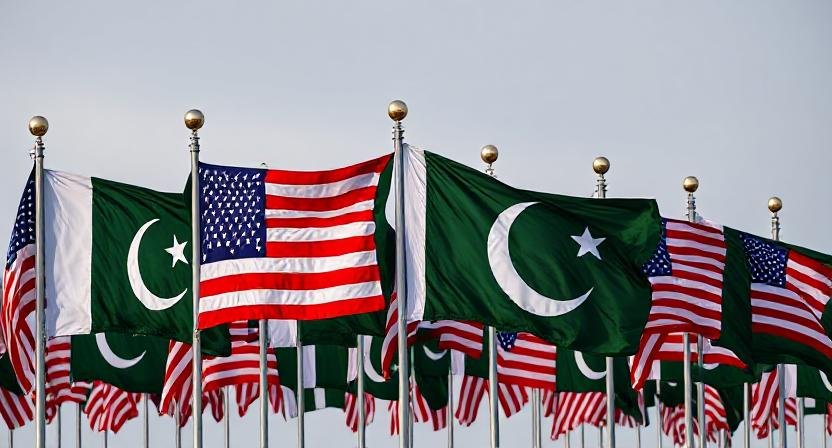
- U.S. and Pakistan seal landmark oil deal after Field Marshal Asim Munir’s meeting with Donald Trump at the White House, signaling a major economic pivot.
- Massive U.S. investment expected in Pakistan’s untapped oil and mineral reserves, with potential worth in the hundreds of billions of dollars.
- Reduced tariffs on Pakistani exports to the U.S. part of broader economic agreement, providing relief to Pakistan’s struggling economy.
- Strategic minerals, offshore oil, and shale gas reserves to be explored and developed under U.S.-backed partnerships, countering China’s regional dominance.
In a stunning reversal of long-held assumptions about U.S.-Pakistan relations, President Donald Trump has announced a landmark deal that promises to reshape the geopolitical chessboard of South Asia: a multibillion-dollar American investment into Pakistan’s untapped oil and mineral wealth.
The announcement followed a closed-door meeting at the White House between U.S. President Donald Trump and Pakistan’s Field Marshal Asim Munir—the country’s army chief and arguably its most influential figure. The outcome was anything but ordinary. Trump, never one to underplay his moves, took to social media to reveal what he described as a “historic deal” with Pakistan to develop the country’s “massive oil reserves.”
“We have just concluded a Deal with the Country of Pakistan, whereby Pakistan and the United States will work together on developing their massive Oil Reserves,” Trump wrote. “We are in the process of choosing the Oil Company that will lead this Partnership.”
Trump Imposes 25% Tariffs on India: Is the U.S.-India Strategic Bond Fracturing?
While short on specifics, the implications of Trump’s statement were crystal clear: the United States, wary of China’s expanding footprint in the region, has decided to invest heavily in a country long seen through a narrow security prism. The move signals a tectonic shift—from transactional counterterrorism cooperation to long-term economic and energy partnership.
Prime Minister Shehbaz Sharif has expressed deep gratitude to U.S. President Donald Trump following the landmark trade and energy agreement between Pakistan and the United States. In a post on X (formerly Twitter), the Pakistani premier stated:
“I wish to convey my profound thanks to President Trump @realDonaldTrump for his leadership role in finalization of the historic US-Pakistan trade agreement, successfully concluded by our two sides in Washington, last night.”
Sharif hailed the deal as a turning point in U.S.-Pakistan relations, crediting President Trump’s “visionary leadership and commitment to regional economic stability” for making the agreement possible. The prime minister emphasized that the agreement is not only a major breakthrough for trade but also a strategic partnership that will unlock massive investment in Pakistan’s oil and mineral sectors.
According to government officials, the prime minister has been kept closely informed about the negotiations led by Foreign Minister Ishaq Dar and Field Marshal Asim Munir. Sharif has reportedly called the deal a “national success,” noting that it could generate tens of thousands of jobs, reduce Pakistan’s trade deficit, and attract further investment in critical infrastructure and energy.
The prime minister also acknowledged the military’s pivotal role in facilitating diplomatic engagement at the highest levels, stating privately that Field Marshal Munir’s high-stakes diplomacy in Washington “delivered results that will define Pakistan’s economic future.”
With U.S. support expected to boost Pakistan’s access to global markets and assist in the exploration of vast natural resources, Sharif said the agreement marks the beginning of a new chapter of “mutual respect, strategic trust, and shared prosperity” between Islamabad and Washington.
Field Marshal Asim Munir: The Power Broker Behind the Curtain
The man who made this pivot possible is not Pakistan’s prime minister or foreign minister—it’s Field Marshal Asim Munir, Pakistan’s top military officer and a key architect of the country’s post-crisis strategic posture. Known for his steely resolve, military vision, and quiet diplomacy, Munir’s trip to Washington was billed as a routine engagement. It turned out to be anything but.
READ MORE: Trump announces new US-Pakistan trade deal to develop oil reserves
Sources familiar with the meeting describe the Trump-Munir conversation as “intense but productive.” Munir reportedly laid out a grand vision for Pakistan’s resource-driven economic rebirth, presenting geological survey data, strategic maps, and long-term energy investment plans.
U.S. officials were especially intrigued by recent findings confirmed in a three-year geological survey conducted by Pakistan in collaboration with a “friendly nation”—believed to be Saudi Arabia or China—identifying significant offshore oil and gas reserves in the Arabian Sea.
ALSO READ: Trump Imposes 25% Tariffs on India: Is the U.S.-India Strategic Bond Fracturing?
The timing was perfect. Trump, eager to deliver economic wins amid an uncertain global environment and a stalling rivalry with China, saw Pakistan as a new frontier. “This is a geopolitical bet,” said one White House official. “Pakistan could become the energy hub of South Asia.”
A Lifeline for Pakistan’s Ailing Economy
For Islamabad, the deal could not have come at a better time. Grappling with spiraling inflation, high external debt, and chronic energy shortages, Pakistan desperately needed a catalyst for economic revival.
In a statement, the country’s finance ministry declared, “This deal marks the beginning of a new era of economic collaboration—especially in energy, mines and minerals, IT, cryptocurrency and other sectors.”
The benefits, however, don’t stop there. The ministry also confirmed that the deal includes lower reciprocal tariffs, offering Pakistani exporters a lifeline to access the world’s largest economy.
Washington had initially threatened a 29% tariff hike on Pakistani goods as part of Trump’s broader tariff war, but suspended the decision for 90 days to allow negotiations. The breakthrough now appears to have prevented what could have been a devastating blow to Pakistan’s struggling export sector.
Strategic Minerals: The Trillion-Dollar Jackpot
Beyond oil and gas, Pakistan holds some of the world’s most valuable and underdeveloped deposits of critical minerals. These include copper, gold, lithium, and rare earth elements, all crucial for the global tech and energy transition.
Pakistan’s Thar desert alone contains 185 billion tons of coal, while the Reko Diq project in Balochistan is considered one of the world’s largest undeveloped copper-gold mines. A top Pakistani geologist recently called the mineral sector “a trillion-dollar opportunity waiting to be unlocked.”
It appears the U.S. has finally taken notice. Following meetings between Pakistani Foreign Minister Ishaq Dar and U.S. Secretary of State Marco Rubio, both sides expressed mutual interest in expanding cooperation on critical minerals and mining.
Trump’s team is now reportedly vetting a shortlist of American energy and mining firms to lead the exploration and extraction process in Pakistan. ExxonMobil and Chevron are rumored to be in the race, alongside tech-leaning firms with experience in lithium and rare earth processing.
A New Alliance, A New Reality
Trump’s announcement also puts India on notice. Just hours before the Pakistan deal was made public, Washington declared it would impose a 25% tariff on Indian imports. Analysts believe this is not coincidental but part of a broader recalibration of U.S. South Asia policy.
“The India-Pakistan equation is changing,” said Dr. Lara Simmons, a South Asia analyst at the Atlantic Council. “By investing in Pakistan’s future, Trump is rewarding Islamabad for playing a stabilizing role in the region, especially after the May ceasefire between India and Pakistan.”
That ceasefire, which Trump claimed credit for brokering, came after deadly border skirmishes following a disputed militant attack in Kashmir. Trump’s involvement was denied by New Delhi but privately acknowledged in Islamabad.
Hurdles Ahead
Despite the euphoria, energy experts caution against premature celebration. Pakistan’s energy potential remains largely unexplored, and significant hurdles remain—corruption, political instability, bureaucratic red tape, and the need for massive infrastructure development.
Moreover, extracting and monetizing shale oil and gas in Pakistan’s terrain—especially Baluchistan and offshore areas—will take time, technology, and capital.
The U.S. Energy Information Administration estimates Pakistan holds 227 billion barrels of oil and 586 trillion cubic feet of shale gas, but only 9.1 billion barrels and 105 TCF are currently considered technically recoverable.
Even so, the deal has opened doors that have remained shut for decades.
A Strategic Reset
With the Trump-Munir summit now shaping headlines worldwide, a strategic reset between the U.S. and Pakistan is underway. What began as a high-stakes diplomatic mission has turned into a blueprint for long-term collaboration—economic, energy, and strategic.
As the U.S. turns away from China and India to recalibrate its regional bets, Pakistan emerges as a pivotal partner in Trump’s new economic doctrine. Whether this partnership matures into a durable alliance will depend on execution. But for now, the wheels of history have turned.
And Field Marshal Asim Munir appears to be the man turning them.