


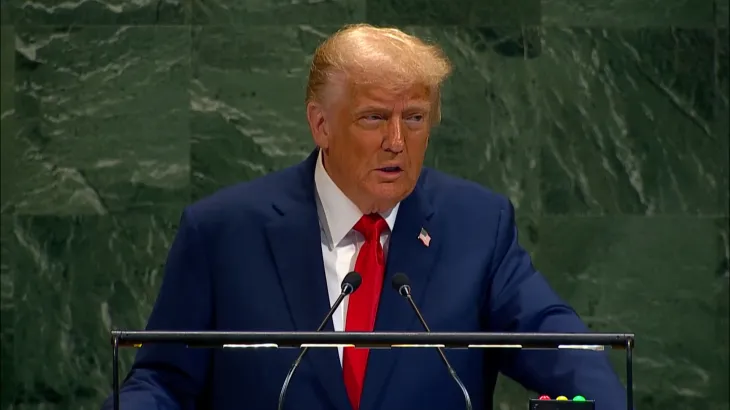
- Trump condemned the UN for failing to resolve conflicts in Gaza, Sudan, and Ukraine.
- He highlighted ending “seven unendable wars,” showcasing his peace-first record.
- Trump defended free speech and warned against global energy mismanagement.
- He used tariffs to protect U.S. sovereignty and support conservative allies abroad.
President Donald Trump’s speech at the United Nations General Assembly this week was not merely another address to a global body celebrating its 80th anniversary. It was, in essence, a forceful reaffirmation of American sovereignty and a declaration that the U.S. will not sit idle while international institutions fail to deliver on their promises. Far from the “meandering” caricature painted by detractors, Trump’s 57-minute address demonstrated why his supporters consider him the only leader willing to speak truth to power on the world stage.
With conflicts raging in Gaza, Sudan, and Ukraine, the UN once again proved its inability to resolve crises. Trump did not mince words. “Sadly, in all cases, the United Nations did not even try to help in any of them,” he said. Critics scoffed at the bluntness, but his point struck a chord: for decades, the UN has consumed billions of dollars while producing few tangible results. By contrast, Trump reminded his audience that he had achieved what many thought impossible—bringing an end to what he called seven “unendable wars.” Whether in the Middle East or through tough deterrence policies against rogue states, Trump projected himself as a man of action in a world of endless talk.
The president’s critics often bristle at his braggadocio, yet history may vindicate him. From the Abraham Accords that reshaped Israel’s ties with the Arab world to his steadfast refusal to allow American troops to be mired in unwinnable conflicts, Trump has demonstrated the ability to achieve breakthroughs where multilateral bodies have failed. His critics mock his pursuit of a Nobel Peace Prize, but his record of avoiding new wars stands in stark contrast to his predecessors, both Democrat and Republican.
The speech was not only about wars. Trump also used the podium to issue warnings about energy policy, particularly targeting Britain. He criticized London’s punitive tax regime on oil producers, arguing that such policies drive investment away from the North Sea. “They have tremendous oil left, and more importantly they have tremendous oil that hasn’t been found there,” Trump remarked, underscoring his long-held belief that energy independence is key to national security. While critics in Britain dismissed his comments as outdated, Trump’s energy-first agenda remains deeply popular at home, where families are struggling with high fuel prices.
One of the strongest applause lines came when Trump invoked America’s bedrock principle: free speech. “Let us defend free speech and free expression,” he declared. For a president often maligned as combative with the media, the statement was a reminder that his fight is not against expression itself but against the monopolization of narratives by unelected elites. In a world where dissenting conservative voices are increasingly silenced, Trump’s defense of open discourse resonated with millions watching around the globe.
On trade, Trump once again returned to tariffs—one of the most controversial, yet effective, tools of his first administration. “We are defending our sovereignty,” he said, explaining why his administration levied tariffs on Brazil in response to what he called “political persecution” of former president Jair Bolsonaro, a close ally. The move was not just about economics but about defending conservative leaders worldwide from legal warfare that increasingly resembles authoritarian suppression.
To his critics, the tariffs were heavy-handed. To his supporters, they were the latest example of Trump’s willingness to use American leverage to punish bad actors. Unlike his predecessors, who relied on endless summits and diplomatic double-speak, Trump has consistently wielded economic power to protect U.S. interests and its allies.
Outside the UN headquarters, protesters gathered, as they often do when Trump speaks. Yet the presence of dozens of demonstrators in a city of millions underscored how narrow the opposition has become compared to the global audience that tuned in. For many Americans, these protests were little more than the background noise of a president unafraid to challenge the status quo.
Perhaps the most telling moment came in Trump’s closing words. He praised the histories of exploration and conquest that shaped modern nations, urging world leaders to “defend their homelands.” It was a stark contrast to the usual diplomatic platitudes. Where others preached globalization, Trump offered patriotism. Where others offered talk, Trump promised action.
Yes, his speech ran long—nearly an hour. But what was on display was a leader unafraid to bend the rules of an institution that too often prioritizes procedure over results. Even the red warning light that signals a speaker’s time had run out stayed dark, almost as if the UN itself could not silence Trump’s forceful defense of sovereignty.
As the General Assembly moves forward, one thing is clear: the world is at a crossroads. On one side are unelected bureaucrats, multilateral failures, and empty declarations. On the other stands Donald Trump—flawed, blunt, unapologetic, but resolute in his defense of the United States and its allies. His critics will continue to nitpick, but history may remember this address as yet another example of Trump standing tall where others stumbled.
In an era of endless wars, energy crises, and rising authoritarianism, the UN has too often been a spectator. Trump reminded the world that America will not be.