


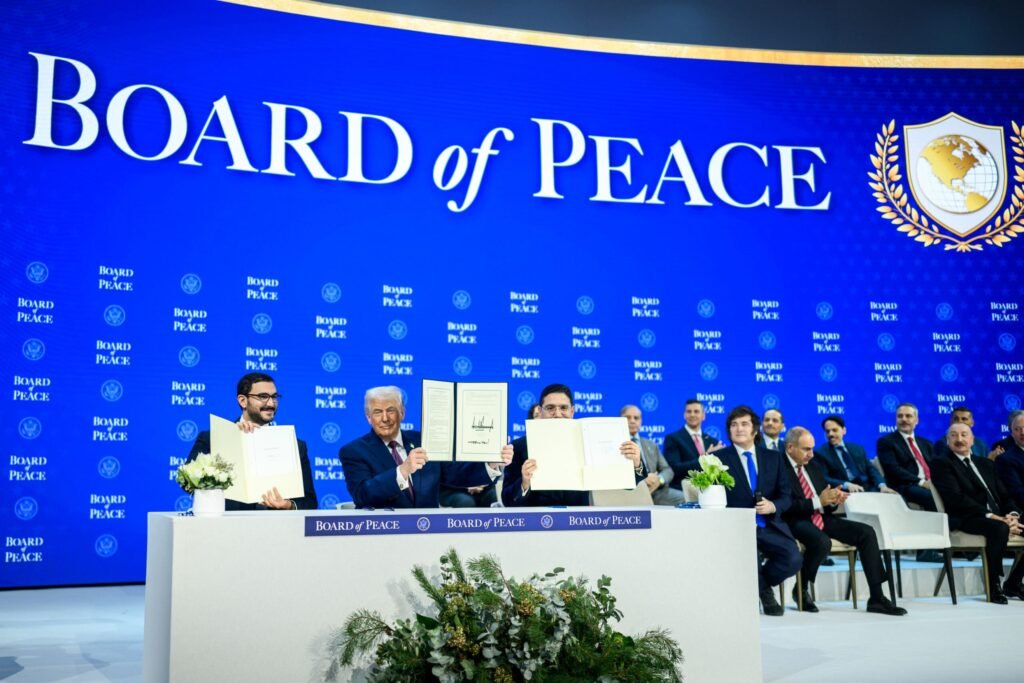
Washington, D.C. — As global tensions persist in multiple theaters, United States President Donald J. Trump is pressing forward with an ambitious and controversial initiative that could redefine Washington’s role in international diplomacy: the so‑called “Board of Peace.” Initially crafted as a mechanism to oversee governance, reconstruction, and stabilization in the Gaza Strip under a U.S.‑brokered ceasefire, the board has quickly emerged as a broader geopolitical litmus test — one that could shape Trump’s approach to global conflict resolution far beyond the fragile enclave along the Mediterranean.
The Board’s inaugural session is tentatively scheduled for February 19 in Washington, D.C., according to diplomatic sources and reporting by Axios. The meeting — still subject to change — is expected to double as a fundraising event for Gaza’s reconstruction and will occur one day after Israeli Prime Minister Benjamin Netanyahu meets with Trump at the White House, underscoring the intertwining of regional diplomacy and U.S. domestic politics.
Trump unveiled the Board of Peace earlier this year as part of his 20‑point Middle East peace plan, which helped secure a ceasefire between Israel and Hamas in Gaza and was later embedded in a United Nations Security Council resolution (2803) authorizing its transitional role. The body, which the president chairs, combines international stakeholders and prominent figures — including some of his closest political allies. Its mandate ranges from supervising a technocratic Palestinian committee to steering reconstruction and governance during Gaza’s post‑war transition.
But for critics and diplomats alike, the Board’s significance extends well beyond bricks and mortar. Trump, echoing comments by administration officials, has suggested the Board could become a venue for tackling other global conflicts — effectively an alternative or parallel to traditional multilateral forums like the UN. That grand vision is as bold as it is divisive. Early reactions from key U.S. partners in Europe have been tepid at best, with some refusing invitations to participate and others voicing serious reservations over the initiative’s structure and leadership.
In Washington, the Board’s supporters paint it as a much‑needed corrective to what they view as a moribund and overly bureaucratic global order. Advocates argue that the ad‑hoc, U.S.‑led mechanism can cut through diplomatic gridlock, mobilize resources swiftly, and enforce accountability in fractured political landscapes. Some allied governments have publicly aligned with the initiative, and a broad roster of 26 countries — spanning the Middle East, Asia, Europe, and Latin America — were named as founding members.
Yet skeptics see a different blueprint: one that marginalizes the voices of those most affected by conflicts and reinforces long‑standing Western dominance in global governance. In the Middle East, particularly among Palestinian constituencies and regional civil society, criticisms have centered on the Board’s composition — with few Palestinian representatives and a roster featuring figures such as former British Prime Minister Tony Blair and U.S. political insiders. Critics have likened the board to a colonial administrative authority that could supplant established international mechanisms rather than strengthen them.
Even within influential Western capitals, participation has not been assured. Several European states have declined or hesitated to join, underscoring doubts about the Board’s legitimacy and strategic value. France’s outright rejection of Trump’s invitation, for instance, prompted a highly publicized diplomatic spat that saw the U.S. president levy punitive rhetoric over trade — a flashpoint illustrating the broader tensions inherent in the project.
Regional responses are equally complex. Pakistan’s government has defended its decision to accept a seat on the Board as a demonstration of diplomatic agency and solidarity with broader Muslim world concerns — a stance that has ignited fierce debate at home over national principles and foreign policy autonomy.
As the February meeting approaches, analysts contend the Board’s success — or failure — will hinge on two key tests: whether it can generate tangible improvements in Gaza’s governance and humanitarian conditions, and whether it can attract sustainable cooperation from key global partners without fragmenting existing diplomatic architectures.
In a world weary of stalemate and conflict, the Board of Peace presents an alluring narrative. But whether it becomes an instrument of lasting peace or a Washington‑centric diplomatic experiment remains the million‑dollar question.