


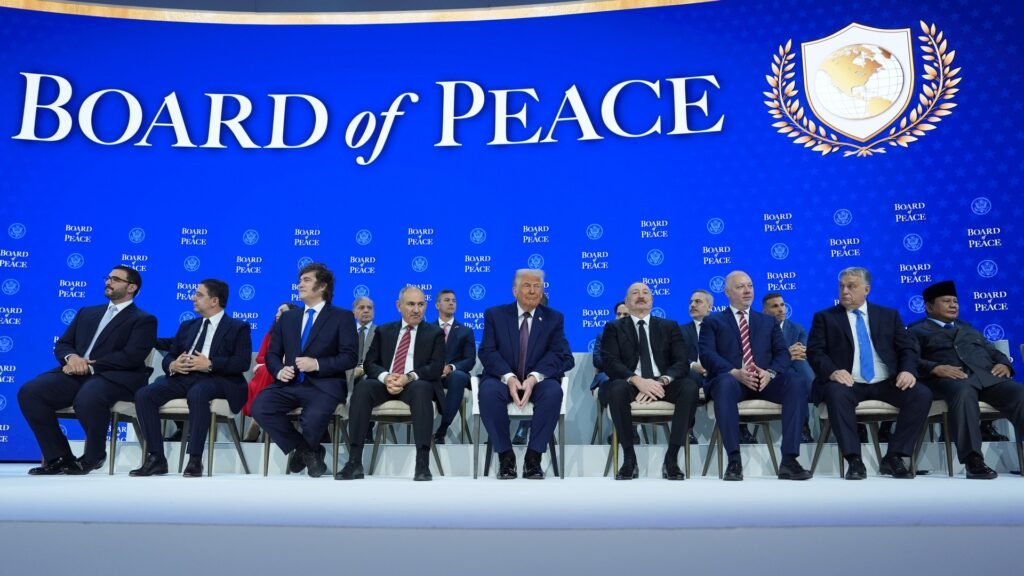
DAVOS, Switzerland — U.S. President Donald Trump declared that the war in Gaza was “really coming to an end” as he stood flanked by a select group of world leaders at the World Economic Forum on Thursday, signing the founding charter of his newly formed “Board of Peace.”
The initiative, endorsed by the United Nations Security Council last November, was originally designed to oversee Gaza’s post-war reconstruction. But Trump has since expanded its mission into a broader global conflict-resolution body — a move that has drawn both participation from diverse regions and notable resistance from major Western powers.
Board of Peace Welcomes Pakistan as PM Shehbaz Sharif Signs Historic Charter at Davos
Representatives from the Middle East, Central Asia, Eastern Europe, and parts of Latin America filled the stage at the signing ceremony. Among them were Pakistan’s Prime Minister Shehbaz Sharif, Qatar’s Prime Minister Mohammed bin Abdulrahman Al Thani, Saudi Foreign Minister Faisal bin Farhan Al Saud, Turkey’s Foreign Minister Hakan Fidan, Jordan’s Ayman Al Safadi, UAE special envoy Khaldoon Al Mubarak, and leaders from Argentina, Hungary, Indonesia, Kazakhstan, Azerbaijan, Uzbekistan, and Mongolia.
Their presence signaled growing engagement from non-Western and emerging powers in shaping post-conflict frameworks — particularly in Gaza, where regional stakeholders will play a decisive role in rebuilding infrastructure, stabilizing governance, and facilitating humanitarian recovery.
Putin invited to join Trump’s ‘Board of Peace’ for Gaza, Kremlin says
Yet the absence of many traditional U.S. allies overshadowed the moment.
Canada, France, Germany, Italy, Belgium, Sweden, Norway, and several other European nations declined to participate. The United Kingdom formally rejected signing on, with Foreign Secretary Yvette Cooper citing unease over Russia’s invitation to join the group.
“We won’t be one of the signatories today,” Cooper told the BBC, underscoring concerns about legitimizing Moscow’s role in a global peace architecture while the Ukraine war continues.
Europe Rearms: Germany Revives Conscription as the Continent Quietly Turns to Israel’s Battlefield Technology
France and Germany reportedly turned down the offer outright, while Italy’s Prime Minister Giorgia Meloni said more time was needed to assess the proposal. Belgium’s foreign minister stressed the need for a “common and coordinated European response,” reflecting broader EU skepticism over Trump’s unilateral diplomatic style.
Trump also publicly criticized Spain during the ceremony, accusing Madrid of failing to meet defense spending commitments and “wanting a free ride,” a remark that further highlighted friction between Washington and parts of Europe.
Spain sent no representative, with Spanish media reporting that Prime Minister Pedro Sánchez’s invitation remained “under review.”
Adding another layer of geopolitical complexity was Russia’s potential involvement.
President Vladimir Putin received an invitation earlier in the week and is reportedly reviewing the proposal. Kremlin spokesman Dmitry Peskov confirmed Moscow’s interest, though no Russian official attended the signing. U.S. Special Envoy Steve Witkoff said Washington was preparing for talks with Putin about Russia’s possible entry into the board.
The prospect of Russia joining has alarmed several European capitals, who fear the body could become a platform that blurs accountability for ongoing conflicts — particularly Ukraine.
Still, Trump’s administration frames the Board of Peace as a pragmatic mechanism focused on rebuilding war-torn regions and preventing future conflicts through economic development, diplomacy, and multinational oversight.
“Peace is built not just by stopping wars, but by rebuilding societies,” a senior U.S. official said on the sidelines of the forum.
For countries like Pakistan, Qatar, Saudi Arabia, and the UAE, participation offers a chance to shape Gaza’s reconstruction directly while strengthening diplomatic influence in a region undergoing rapid geopolitical realignment.
Analysts note that the composition of the board reflects a shifting global order, where emerging and middle powers are increasingly stepping into roles once dominated by Western institutions.
“The absences are just as telling as the attendees,” said a Geneva-based diplomat. “This is less a unified Western-led peace initiative and more a new coalition of states willing to engage on Trump’s terms.”
Whether the Board of Peace becomes a transformative global body or a symbolic diplomatic platform will depend on its ability to bridge deep geopolitical divides — particularly between the U.S., Europe, Russia, and key regional actors.
For now, Trump’s declaration of Gaza’s war nearing its end marks a significant rhetorical milestone. But the fractured international response to his peace framework underscores a world still deeply split on how peace should be built — and who gets to lead it.