


-
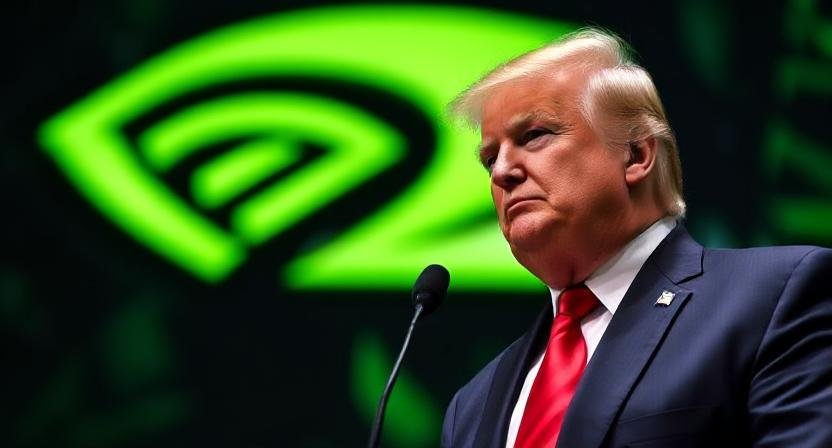
Nvidia Secures License After Trump Meeting: The U.S. government reversed its April ban and will now allow Nvidia to sell its H20 AI chip in China following CEO Jensen Huang’s direct appeal to President Trump.
-
Tech Diplomacy in Action: Huang’s shuttle diplomacy between Washington and Beijing paid off, signaling a new era where CEOs play central roles in international tech negotiations.
-
China Sees It as a Goodwill Gesture: Beijing views the move as a positive step in ongoing trade talks, amid broader signs of a fragile U.S.-China economic truce.
-
Risks Still High for U.S. Chipmakers: While sales resume, export-control uncertainty remains, and upcoming U.S. restrictions could again shift the playing field overnight.
In a dramatic reversal that underscores the power of boardroom diplomacy, the Trump administration has granted Nvidia clearance to resume sales of its H20 artificial intelligence chip to China, following a high-stakes personal meeting between President Donald Trump and Nvidia CEO Jensen Huang.
The decision, confirmed by Nvidia early Tuesday, comes just three months after the U.S. Commerce Department blocked the chip’s exports to China over national security concerns—costing the Silicon Valley giant billions and sending shockwaves through global tech markets.
EXCLUSIVE | NATO Allies to Funnel U.S. Weapons to Ukraine Under Trump’s New Arms Deal
“This is a significant development. We’re glad to resume deliveries,” Huang said in brief remarks from Beijing, where he is currently holding talks with senior Chinese officials. Nvidia shares jumped more than 4% in early trading on the news.
The approval marks a crucial win for Nvidia, which last week became the world’s first $4 trillion company by market capitalization. Yet even with this green light, the company remains banned from selling its most powerful Blackwell-based chips to Chinese buyers.
Behind Closed Doors: Huang’s Meeting with Trump
According to people familiar with the matter, Huang used a recent private meeting with President Trump to make a case that blocking Nvidia from selling in China would ultimately harm U.S. interests in the global AI race.
READ MORE: Is the Ukraine War Finally Nearing Its End? Rubio’s Secret Meeting with Lavrov Sparks Hope and Tension
Huang, who has mostly avoided political limelight, reportedly told Trump that enabling Nvidia to operate freely in foreign markets would ensure America’s dominance over rivals like China’s Huawei. He also warned that overregulation could backfire, leaving U.S. companies scrambling to keep pace with Chinese advancements.
Trump, who earlier this year referred to Huang as “my friend” during a speech in Saudi Arabia, appeared receptive. Sources said Huang also discussed export restrictions directly with Commerce Secretary Howard Lutnick, urging a more flexible licensing regime.
China Sees ‘Good Faith’ Amid Trade Truce
Beijing welcomed the U.S. decision as a gesture of goodwill during an uneasy trade détente between the two superpowers. Sources close to Chinese policymakers told The Islamabad Telegraph that American concessions on chip exports are viewed as a signal Washington is serious about stabilizing economic ties.
ALSO READ: Trump Reluctantly Comes Around to Backing Ukraine. Will He Stick With It?
The announcement coincides with a flurry of positive developments: Beijing this week approved a $35 billion acquisition by U.S. chip software firm Synopsys, which had been stalled for over a year. In June, China also pledged to expedite rare-earth mineral exports critical for Western tech manufacturers.
“This appears to be part of a larger thaw,” said Charles Kaufman, a senior fellow at the Hudson Institute. “China wants chips, and the U.S. wants minerals and market access. Both sides are reluctantly cooperating again.”
Huang’s Strategic Balancing Act
Huang’s recent maneuvering reflects Nvidia’s increasingly delicate position as a company caught in the crosshairs of the U.S.-China tech war. While based in California, Nvidia draws significant revenue from China—still the world’s largest single market for AI-related hardware.
His current trip to Beijing is his third this year, and comes at a time when U.S. lawmakers are growing uneasy about tech CEOs engaging with Chinese entities. Just last week, Senators Jim Banks (R-Ind.) and Elizabeth Warren (D-Mass.) sent a joint letter urging Huang to avoid contact with Chinese firms linked to military or intelligence bodies.
“There’s no doubt Nvidia is under pressure from both ends,” said Eva Lin, a senior analyst at the Asia Tech Policy Center. “Huang is walking a tightrope between Washington and Beijing, and so far he’s managing it brilliantly.”
New Chip Design, Tailored for Export Compliance
In addition to the H20, Nvidia is developing a new AI chip built on its latest Blackwell architecture, but with modified capabilities to meet U.S. export guidelines. Insiders say the chip is being pitched as ideal for factory automation and logistics applications in China—offering powerful performance without violating security thresholds.
“It’s a clever workaround,” said Dr. Marcus Wu, former U.S. semiconductor advisor. “You’re giving China just enough computing power to stay happy without enabling military-grade AI.”
The H20 chip itself was custom-designed in 2024 for Chinese clients and quickly became a best-seller—until Washington halted exports in April, citing fears that advanced chips could bolster China’s defense and surveillance capabilities.
Broader Geopolitical Risks Still Loom
Despite the temporary reprieve, Nvidia’s future in China remains fraught with uncertainty. The Commerce Department continues to draft new restrictions on equipment for semiconductor manufacturing, which could be enacted if trade relations deteriorate again.
Moreover, Nvidia’s much-anticipated agreement to supply chips to the United Arab Emirates has also slowed, amid U.S. concerns that close Emirati ties with China could lead to unauthorized re-exports.
Another U.S. chipmaker, AMD, is expected to resume its own shipments to China once licenses for its MI308 processors are finalized. Its shares rose over 5% in premarket trading following Nvidia’s breakthrough.
“It’s whiplash policy,” said James Lee, a trade strategist with Pacific Geopolitics Group. “One week it’s containment, the next it’s cooperation. These companies have to plan in six-month windows now.”
Final Word: Strategic Chips for a Strategic Era
The stakes in the AI chip war extend far beyond corporate profits. Nvidia’s chips power the massive data centers that train large language models, autonomous vehicle systems, and advanced industrial robotics—technologies that will define geopolitical leadership in the decades ahead.
As Huang continues to shuttle between Beijing and Washington, Nvidia remains a bellwether for the uneasy dance between American innovation and Chinese ambition.
“AI is the new oil, and chips are the new pipelines,” said Kaufman. “No wonder both sides want to keep the taps open—at least for now.”