


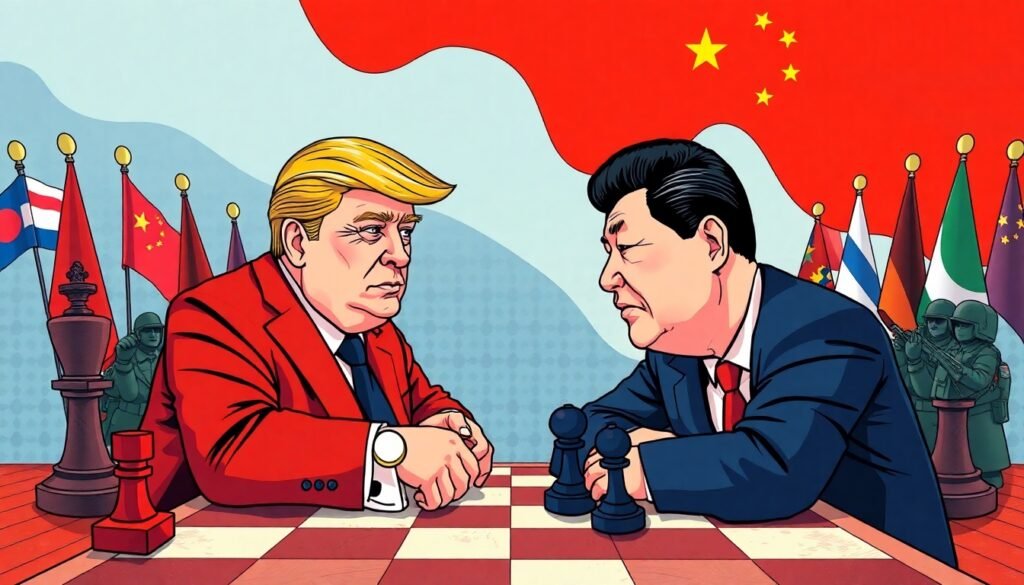
- Donald Trump’s invitation to Xi Jinping symbolizes his unpredictable foreign policy and bold diplomatic overtures.
- The move highlights the complex and contradictory dynamics of U.S.-China relations in a new cold war era.
- Beijing’s measured response reflects its strategic focus on long-term global competition.
- The invitation raises questions about Trump’s approach to allies, adversaries, and economic decoupling efforts.
The dynamics of U.S.-China relations under Donald Trump have always been a mix of confrontation, unpredictability, and occasional olive branches. But nothing captures the contradictions in Trump’s foreign policy better than his invitation to Chinese President Xi Jinping to attend his second inauguration as the guest of honor—a gesture that was bold, unexpected, and steeped in symbolism. Although Xi declined the offer, the very act of extending it highlights Trump’s unique approach: dramatic moves that blur the line between grand strategy and theatrics.
Is Trump Mending Ties with China? Ice Melts as Xi Jinping Receives Unprecedented Invitation
Picture the moment: January 20, noon, on the steps of the U.S. Capitol. Trump, fresh off a contentious re-election, recites the oath of office, while the memory of the Capitol riot still lingers in the air. Imagine, amidst the sea of American officials and past presidents, the presence of Xi Jinping—leader of a nation cast by many in Washington as the single greatest threat to U.S. dominance. It’s a scenario that would have been as provocative as it was improbable, embodying the peculiar duality of Trump’s China policy.
A Bold Move or a Tactical Blunder?
Inviting Xi was as audacious as it was fraught with risks. For Xi, accepting such an invitation would have been a public relations nightmare, clashing with his vision of a rising China that stands independent of Western validation. For Trump, it was a gamble that played into his signature style of diplomacy—one driven by personal relationships and headline-grabbing gestures.
Donald Trump’s Criticism of Ukraine’s Missile Strikes Raises Questions About Future US Policy
But what was Trump’s aim here? Was this a genuine attempt at resetting U.S.-China relations, or simply a theatrical gesture meant to project himself as a dealmaker capable of bridging even the most adversarial divides? Whatever the intent, the invitation illuminated a contradiction: Trump’s tendency to combine tough talk—tariffs, decoupling, and military posturing—with sporadic overtures that seemed to undermine his hardline stance.
Walking a Tightrope in U.S.-China Relations
This paradox has always been central to Trump’s foreign policy. On one hand, he portrays China as a menace—an economic rival and military competitor that exploits U.S. goodwill. On the other hand, he often emphasizes his “friendship” with Xi, as though personal rapport could overcome decades of rivalry and mistrust. This strategy has yielded mixed results. Early optimism around the Phase One trade deal quickly dissipated as the COVID-19 pandemic and escalating tariffs deepened the rift between the two superpowers.
Moreover, Trump’s hawkish rhetoric is reinforced by his choice of allies within his administration. Figures like Marco Rubio and Mike Waltz, both fierce critics of Beijing, represent a no-compromise stance on issues ranging from Taiwan to technology theft. Their appointments signal a clear message: while Trump might extend an occasional olive branch, the broader U.S. strategy remains one of containment and competition.
The Risks and Rewards of Grand Gestures
For Trump, grand gestures are not new. His foreign policy has always been marked by unpredictability, from meeting Kim Jong Un in the DMZ to praising Vladimir Putin while imposing sanctions on Russia. These moves often leave allies and adversaries alike scratching their heads, wondering where the U.S. truly stands. In Xi’s case, the invitation to Washington may have been a ploy to test Beijing’s willingness to engage, or perhaps a strategic attempt to rattle China’s alliances with nations like Russia and Iran.
Trump offers inauguration invites to foreign leaders through calls and back channels
But such gestures are not without risk. China has shown it can push back just as forcefully, recently targeting U.S. companies like Nvidia and restricting exports of rare earth minerals essential to American tech industries. These countermeasures underscore Beijing’s readiness to defend its interests, even as it navigates the challenges of an unpredictable U.S. president.
The Bigger Picture
The U.S.-China rivalry extends far beyond invitations and tariffs. From Taiwan to the South China Sea, the two nations are locked in a dangerous dance that could easily spiral into conflict. Military encounters in contested waters have become more frequent, while bipartisan consensus in Washington views China as a threat to American economic and strategic dominance. Domestically, public sentiment against Beijing is hardening, fueled by issues like the pandemic and human rights abuses in Xinjiang.
For Trump, this presents a tricky balancing act. While his base might applaud his tough-on-China rhetoric, they could grow restless if tariffs and trade wars drive up consumer prices. And while grand gestures like inviting Xi grab headlines, they don’t necessarily translate into long-term policy wins—something Trump’s first term made abundantly clear.
Beijing’s Calculations
Xi Jinping’s response to Trump’s invitation reveals much about Beijing’s strategy. By declining to attend while still sending high-ranking officials, Xi signaled a willingness to keep the door open for dialogue without compromising his authority or appearing subordinate. It’s a careful balancing act, one that reflects China’s broader focus on long-term goals: achieving technological self-sufficiency, expanding global influence through the Belt and Road Initiative, and countering U.S. efforts to isolate it economically and politically.
The Road Ahead
As Trump’s hypothetical second term unfolds, the question remains: can his mix of tariffs, threats, and overtures deliver meaningful results, or will it deepen the divide between the two nations? One thing is certain—Trump’s approach will continue to defy expectations, leaving allies, adversaries, and the broader international community bracing for what comes next.
In the end, Trump’s unpredictability is both his greatest strength and his biggest liability. Whether his gambles pay off or lead to miscalculations with far-reaching consequences remains to be seen. What is clear, however, is that the U.S.-China relationship will remain one of the defining stories of the 21st century—a chess game played on a global stage, with stakes that extend far beyond the two players.