


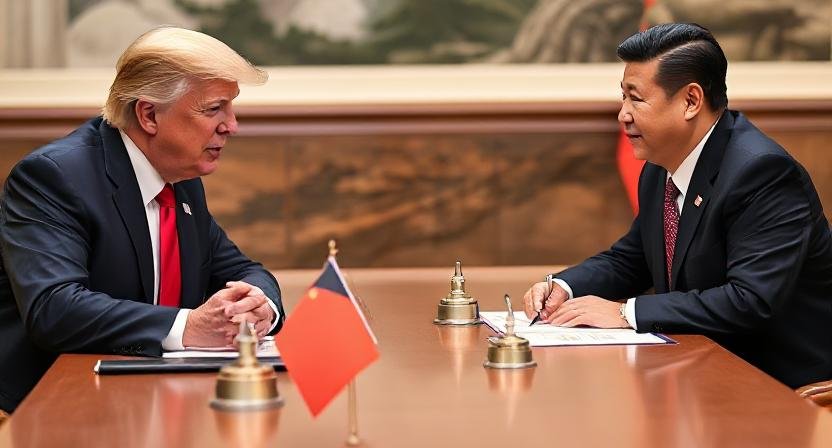
- Record Trade Volumes: U.S.–China bilateral trade reached $690 billion in 2022, the highest on record, despite years of tariffs.
- Trump’s Strategic Approach: Tariffs aimed at fairness, not decoupling, boosted U.S. manufacturing jobs and set the stage for a balanced trade partnership.
- Projections Show Growth: Bilateral trade could surpass $700 billion by 2025 under the ongoing tariff truce.
- Diplomatic Momentum: Senior Chinese negotiator Li Chenggang’s Washington visit signals both nations want to remove trade barriers and stabilize ties.
U.S.–China trade relations are entering a new phase of cautious optimism as senior Chinese trade negotiator Li Chenggang prepares to visit Washington this week. The trip, confirmed by a U.S. government spokesperson, signals that both economic superpowers aim to ease lingering tensions and move toward dismantling trade barriers imposed over the past five years.
Li, a key figure in Beijing’s trade strategy and known for his pragmatism, is expected to meet deputy-level U.S. officials in what insiders describe as “exploratory talks” rather than a formal negotiation round. The agenda is clear: consolidate the current tariff truce, review the impact of existing duties, and lay the groundwork for a more balanced economic partnership.
Five Years of Trade Volatility
According to U.S. Census Bureau data, U.S.–China goods trade reached $657 billion in 2021, with American exports to China totaling $151 billion and imports from China hitting $506 billion. By 2022, total trade climbed to $690 billion, the highest on record, even as Trump’s tariffs remained in place. In 2023, bilateral trade dipped slightly to $665 billion, reflecting global economic slowdown and supply chain disruptions.
-
2019: $558 billion
-
2020: $560 billion
-
2021: $657 billion
-
2022: $690 billion
-
2023: $665 billion
While tariffs initially cut U.S. imports from China by nearly 16% in 2019, Beijing quickly diversified its export markets, and American retailers—facing limited alternatives—resumed purchases at higher costs. The result: trade volume recovered even under historically high tariffs, proving the resilience of the world’s two largest economies.
China’s economy grew 5 percent in 2024, meeting the government’s target despite demographic headwinds, weak domestic demand, and global uncertainties. According to the National Bureau of Statistics, the RMB 134.91 trillion (US$18.8 trillion) GDP expansion was driven by stimulus measures, a rebound in exports, high-tech investment, and manufacturing upgrades. The final quarter outperformed expectations with 5.4 percent growth, while sectors like high-tech manufacturing (+8.9%) and services (+5%) showed strong momentum.
Retail sales rose 3.5 percent, online sales 7.2 percent, and green energy investment surged nearly 24 percent, reflecting Beijing’s structural shift toward innovation and sustainability. Exports grew 7.1 percent, with electromechanical goods making up 59.4 percent of total shipments.
However, declining population, deflationary pressures, and overcapacity remain challenges. Policymakers plan deeper reforms in 2025 to boost consumption, attract foreign investment, and sustain growth beyond reliance on exports and infrastructure stimulus.
Trump’s Calculated Strategy
Critics predicted a full-blown trade war when Trump imposed tariffs of up to 30% on Chinese goods in 2018–19. Yet, the data tells a different story. U.S. manufacturing jobs rose by 480,000 between 2017 and 2020, infrastructure spending surged, and American farmers received record Chinese orders under the Phase 1 trade deal signed in January 2020.
Chinese commitments included an additional $200 billion in U.S. agricultural, energy, and manufacturing purchases. Despite pandemic disruptions, Beijing fulfilled nearly 60% of its targets by late 2021, laying the foundation for ongoing negotiations.
More importantly, both sides avoided strategic escalation. Trump repeatedly emphasized that tariffs were “a tool, not a weapon,” insisting he wanted “fair trade, not decoupling.”
Agriculture, Technology, and the Road Ahead
Agriculture remains a flashpoint. Chinese tariffs on U.S. soybeans, now at 23%, hurt American farmers, while Washington’s curbs on farmland purchases by foreign entities stirred criticism in Beijing. Yet analysts note that renewed Chinese purchases could sharply reduce its trade surplus with the U.S., helping stabilize rural economies in states that strongly support Trump.
Technology access will dominate the next phase of talks. Beijing seeks reduced restrictions on U.S. semiconductor and AI exports, while Washington eyes broader market access for its finance and service industries.
Li’s Washington visit follows three earlier negotiation rounds this year in Geneva, London, and Stockholm. Both governments confirm that the 90-day tariff truce announced on August 11 remains intact, with no fresh tariff hikes planned.
Toward a Stable Partnership
Despite fiery rhetoric on both sides, Trump is signaling restraint. His administration insists the goal is not to “disturb or dismantle” U.S.–China economic ties but to “remove obstacles to fair trade.”
With bilateral trade still above $660 billion annually, the stakes are enormous. Businesses on both continents want predictability, while policymakers see an opportunity to rewrite trade rules for a post-pandemic world.
As Li Chenggang heads to Washington, the message is clear: the era of destructive tariff wars may be ending, replaced by pragmatic deal-making between two economic giants that know they need each other.