


- Trump’s “Battle Line Ceasefire” vision signals a dramatic policy shift from arming Ukraine to ending the war through direct diplomacy.
- Upcoming Hungary summit with Putin could bring the first real peace framework since the 2022 invasion.
- Europe and Kyiv react cautiously, balancing exhaustion with hope that Trump’s peace push might finally halt the bloodshed.
- Trump’s new foreign policy doctrine — “Peace Through Realism” — redefines American leadership as pragmatic, independent, and anti-war.
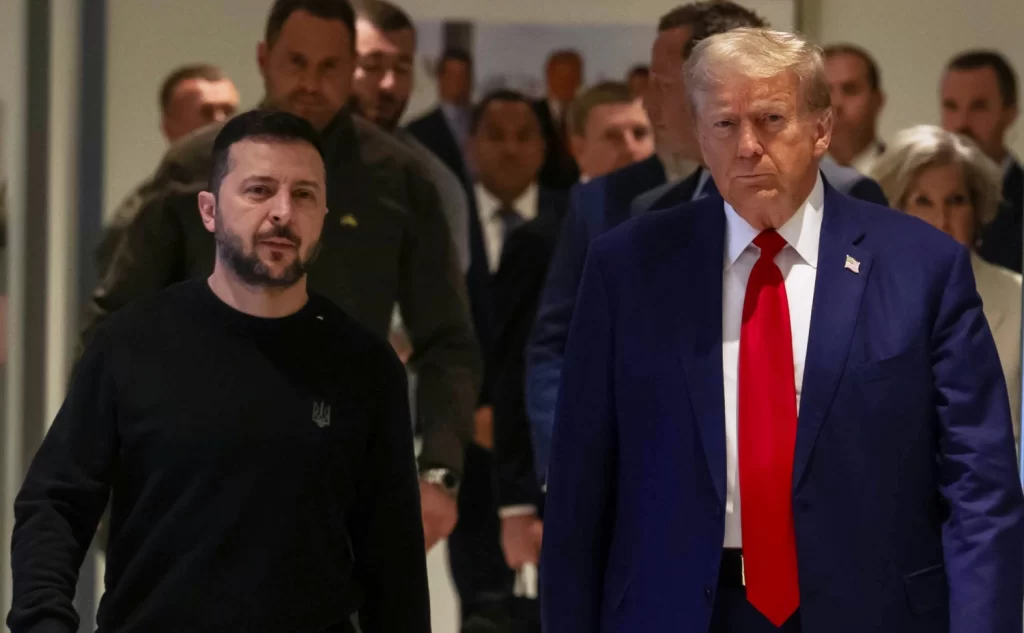
The air inside the White House Cabinet Room was unusually still that October morning — not tense, exactly, but heavy, as if history itself had paused to listen. Across the table sat two men who had come to define the war’s extremes: Volodymyr Zelenskiy, the battle-worn Ukrainian president whose country has fought for survival for more than three years, and Donald J. Trump, the American president who now claims he can end it.
Zelenskiy’s request was blunt. “We don’t have Tomahawks,” he said, leaning forward, his voice steady but weary. “That’s why we need Tomahawks.”
Trump didn’t flinch. “We’d much rather have them not need Tomahawks,” he replied, gesturing slightly, his tone almost paternal. It was a line that sounded casual but carried the weight of a strategic shift — an implicit rejection of Washington’s long habit of waging peace through war.
For more than two hours, they talked — about drones, ceasefires, and the question that has haunted both men: how to end a war that has already devoured too much of Europe’s faith and too many of its sons.
A Meeting of Unequals
Zelenskiy arrived in Washington carrying the burden of a nation under siege. The war has been merciless — more than 200,000 Ukrainian soldiers dead or wounded, cities like Bakhmut and Mariupol reduced to dust, millions displaced. His tone, even in English, carried the echo of fatigue. For months, Kyiv had pleaded for more American weapons, particularly the long-range Tomahawk missiles that could hit deep inside Russian positions.
Trump, on the other hand, seemed almost serene — a man untethered from the urgency of the battlefield, absorbed instead by the geometry of a deal. His advisers say he sees the war not in moral terms but transactional ones: What does America gain from another escalation? What does it lose if it stops?
“Stop the killing,” he told reporters later, as he headed to his Mar-a-Lago residence. “Stop at the battle line. Go home to your families.”
For critics, it was reckless — a call for capitulation dressed as compassion. For supporters, it was visionary — the plain truth no one else dared to speak.
The Realist Returns
This wasn’t the first time Trump tried to end a war. During his first term, he had brokered historic normalization between Israel and several Arab states. Now, in his second, he was aiming higher: a European peace to rival the Camp David Accords.
His aides call it “Peace Through Realism.” The idea is deceptively simple: end conflicts not by victory but by exhaustion — by recognizing that most wars, like most negotiations, collapse not from defeat but fatigue.
In recent weeks, Trump has been quietly preparing for a summit with Vladimir Putin in Hungary. The meeting — informal, symbolic, yet freighted with consequence — could mark the first direct U.S.-Russia dialogue on Ukraine in over a year.
“The president believes Putin is ready to talk,” one senior official told me. “He thinks both men — Putin and Zelenskiy — have reached the point where they’d rather sign papers than bury soldiers.”
That belief, whether naïve or prescient, has become the cornerstone of Trump’s Ukraine policy. He calls it “getting along a little bit.” It’s vintage Trump: a phrase so simple it conceals a philosophy.
Europe’s Uneasy Watch
The reaction in European capitals has been mixed. In Brussels and Berlin, officials whisper that Trump’s diplomacy is dangerously unilateral, too dependent on personal chemistry with strongmen like Putin. Yet in private, even they admit the truth: Europe is tired. Tired of funding, tired of funerals, tired of pretending victory is still plausible.
When asked about Trump’s peace plan, one EU diplomat sighed, “If it works, we’ll applaud. If it doesn’t, we’ll say we warned him.”
In Kyiv, the mood is conflicted. Zelenskiy, a man shaped by war, knows that peace cannot come without loss. But he also knows that Ukraine’s Western backers are losing patience. “President Trump is right,” he said quietly after their meeting. “We have to stop where we are, and then speak.” It was the closest he has come to admitting what diplomats have whispered for months — that total victory is no longer on the table.
A War That Outlived Its Fury
When Russia first invaded Ukraine in February 2022, it was a storm of shock and fire. By 2025, it had become a grind — a mechanical war fought by drones and missiles, measured in square kilometers gained and lost. Putin claims to have captured another 5,000 square kilometers this year, roughly one percent of Ukraine’s territory. Ukraine insists the offensive has stalled.
The front lines have barely moved in months. Entire towns now serve as gray zones — neither occupied nor liberated, just emptied. Electricity grids have been bombed and rebuilt, only to be bombed again. Europe’s energy markets have adjusted to war as if it were climate.
And through it all, America’s role has remained paradoxical — the arsenal of democracy funding a war it privately doubts can be won.
Trump’s Gamble
Trump’s insistence on restraint — his refusal to hand over Tomahawk missiles — is more than political calculation. It is a bet on timing. His aides argue that flooding Ukraine with new weapons now could make talks impossible later. “You don’t bring people to the table by giving them sharper knives,” one adviser said.
Putin, for his part, has signaled cautious interest in negotiations. The Kremlin, through its typically opaque language, said that “much remains to be decided” but did not reject Trump’s proposed Hungary summit outright. For a regime that measures every word like artillery fire, that is no small thing.
Trump, ever the showman, has already cast the meeting as historic. He envisions a scene out of 20th-century diplomacy: flags, cameras, a handshake over maps of Eastern Europe. “He wants a deal that looks like peace,” one White House official told me. “And maybe that’s exactly what the world needs.”
The Future Trump Sees
The peace Trump imagines is imperfect — perhaps even unfair. It may freeze borders, reward aggression, and frustrate idealists. But to Trump, perfection has never been the goal; pragmatism has. His advisers compare his worldview to Nixon’s detente — transactional, unsentimental, but stabilizing.
If he succeeds, Ukraine may end up divided, yet alive. Russia, weakened but not humiliated. Europe, shaken but secure. And America, once again the indispensable power — not because it sent missiles, but because it withheld them.
For Trump, that outcome would be more than a foreign policy win; it would be a personal vindication. The man derided as impulsive and incendiary would become, paradoxically, the peacemaker. The Nobel Prize he often jokes about might suddenly seem less absurd.
But if he fails — if Putin uses diplomacy as camouflage for conquest — history will remember the peace that wasn’t, the handshake that meant nothing. Trump, however, has never been afraid of risk. “I’ve been played all my life by the best,” he said when asked whether Putin was deceiving him. “And I came out really well.”
That may sound flippant, but it reveals something essential about the man. To Trump, foreign policy isn’t ideology. It’s instinct — a game of leverage, personalities, and timing.
Epilogue: The Stillness Before the Summit
As dusk fell over Washington that Friday, Zelenskiy left the White House in silence. There were no new missile pledges, no triumphal announcements. But something had shifted — the language, perhaps, of the war itself.
In a conflict defined by artillery and absolutism, Trump’s message was jarringly human: Go home to your families. It was both a command and a plea — the kind of line that sounds sentimental until you realize how many men never got to do exactly that.
No one knows whether Trump’s Hungary summit will end the war or simply pause it. But for the first time in years, the world has started to talk about peace not as a fantasy, but as a plan.
And in that fragile space between hope and cynicism, Donald Trump — the most polarizing figure of his generation — may yet find his most unexpected role: not as a destroyer, but as a builder of silence after the storm.