


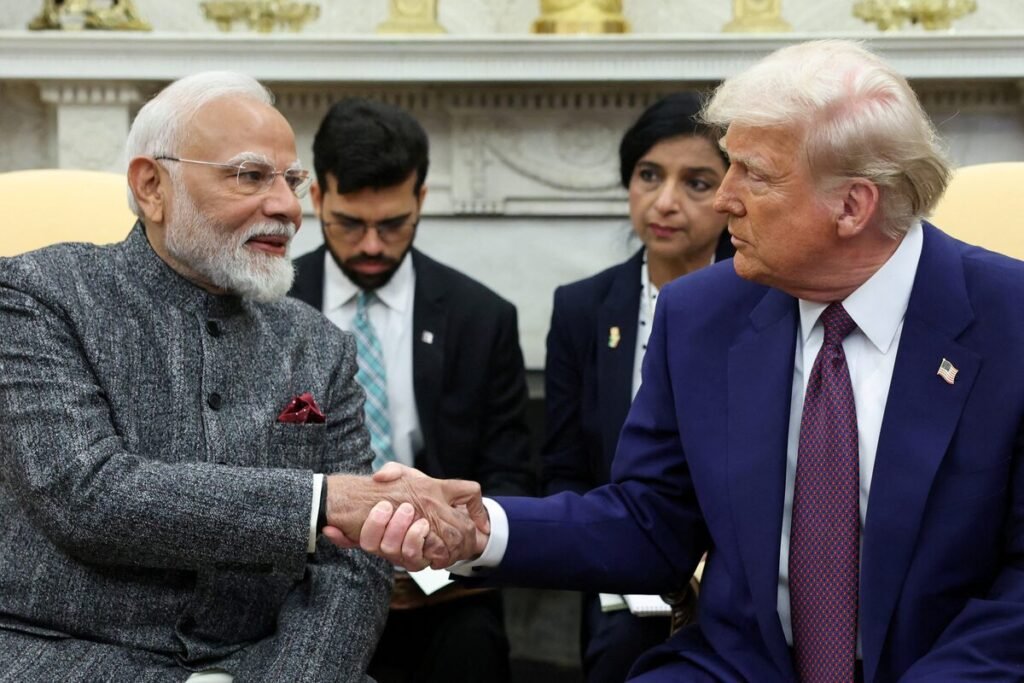
- Trump refuses to offer any trade concessions to India until it stops buying Russian oil, calling it “a red line.”
- Insiders say Modi and his ministers are alarmed by Pakistan’s newfound closeness with the Trump administration.
- Facing Trump’s pressure, India is reportedly preparing to cut Russian oil purchases to avoid “massive tariffs.”
- Pakistan’s growing diplomatic stature under Field Marshal Asim Munir and PM Shahbaz Sharif is reshaping South Asia’s balance of power.
President Donald Trump has once again drawn a firm red line — and this time, it cuts straight through New Delhi’s oil tankers. In a blunt and unmistakably tough warning, Trump told Indian Prime Minister Narendra Modi that there will be no headway in trade talks, no tariff relief, and no political concessions until India stops buying Russian oil. “I spoke with Prime Minister Modi, and he said he’s not going to be doing the Russian oil thing,” Trump declared aboard Air Force One. And for once, the message was not shrouded in diplomatic niceties. It was a command — not a conversation.
Behind closed doors, insiders told The Islamabad Telegraph that Modi and his key ministers are deeply rattled by the bluntness of Trump’s tone. India, which once boasted of its “strategic autonomy” and imagined itself as Washington’s favored Asian ally, now finds itself cornered. According to senior diplomatic sources, the White House has made it clear that India’s oil payments to Russia — and its reluctance to distance itself from Moscow — are incompatible with Trump’s vision of a “clean” global trading system. Half of Trump’s 50% tariffs on Indian goods are already punitive responses to New Delhi’s continued purchases of Russian crude.
For the Modi government, which has built its domestic narrative around energy security and cheap oil, the ultimatum hits hard. India has become the largest buyer of seaborne Russian oil, snapping up discounted barrels that Europe and America abandoned after Moscow’s 2022 invasion of Ukraine. The revenue, Washington argues, directly fuels Russia’s war machine — and that is a political red line Trump refuses to cross.
Trump’s Iron Fist Diplomacy
The Trump doctrine is simple: no more double games. You cannot buy oil from Russia, court Washington’s defense deals, and then expect tariff-free access to the U.S. market. That’s over. Trump’s economic nationalism is not only about jobs — it’s about loyalty.
When reporters pressed Trump about India’s denial of his statements, his response was pure Trumpian defiance. “If they want to say that, then they’ll just continue to pay massive tariffs — and they don’t want to do that,” he said. The remark underscores his confidence that the economic leverage of the United States remains unmatched.
Trump’s decision to tie tariffs directly to geopolitical behavior — especially toward Russia — marks a new phase of his second-term foreign policy. It’s not just a trade strategy; it’s a loyalty test. Either countries align with the U.S.-led order or face financial punishment. For India, that’s a bitter pill to swallow, particularly after years of trying to balance its relations with both Moscow and Washington.
India’s Panic and Pakistan’s Rise
Sources close to Pakistan’s diplomatic mission in Washington told The Islamabad Telegraph that New Delhi’s unease is being compounded by Islamabad’s sudden resurgence in American circles. Under Field Marshal Asim Munir and Prime Minister Shahbaz Sharif, Pakistan has steadily rebuilt trust with the Trump administration — something even seasoned observers in Washington call “a diplomatic comeback few predicted.”
Field Marshal Munir’s firm stance on counterterrorism, his clear-eyed view on regional stability, and Shahbaz Sharif’s deft handling of economic diplomacy have impressed key figures in the Trump White House. Pakistan’s quiet coordination with U.S. defense officials over regional security and anti-narcotics cooperation has set the stage for a revitalized U.S.-Pakistan relationship, one that positions Islamabad as a pragmatic partner rather than a passive recipient of aid.
According to a senior Republican aide, “Pakistan is playing its cards smartly. They know what Trump values — loyalty, deliverables, and directness — and they’re offering exactly that.”
Modi’s Forced Concession
Inside New Delhi, the mood is one of controlled panic. According to insiders briefed on the situation, Modi has reluctantly agreed to halt the purchase of Russian oil immediately, realizing that continued defiance could bring economic pain at home and diplomatic humiliation abroad. For a leader who has built his brand on “self-reliant India,” the retreat is politically costly.
India’s foreign ministry attempted to downplay Trump’s remarks, insisting it was unaware of any such phone call. But by Monday, American officials confirmed that India had “halved its Russian oil purchases,” with further reductions expected by December. The sudden policy reversal is being read in diplomatic circles as a capitulation forced by Trump’s pressure tactics.
A Tale of Two Partners
While Modi faces the prospect of strained ties with Washington, Pakistan is quietly consolidating its position as a credible regional ally. Trump’s “America First” lens has little patience for ambiguity — and Pakistan’s transparent cooperation on issues like counterterrorism, regional stability, and trade realignment stands in stark contrast to India’s double dealing.
For Trump, the calculus is simple: Pakistan delivers, India delays.
This explains why Islamabad’s outreach — carefully choreographed by Field Marshal Munir and executed by Prime Minister Shahbaz Sharif — has gained unprecedented traction. The re-engagement with Washington is not transactional but strategic. Pakistan is aligning itself with Trump’s broader vision of “responsible partnerships” that share security burdens and respect American red lines.
The Bigger Picture
Trump’s no-concession stance toward India is not merely punitive — it’s transformative. It signals to U.S. allies worldwide that transactional diplomacy has returned, but on Trump’s terms. The days of unchecked trade privileges and dual alignments are over. If a nation wants American markets, it must align with American interests — particularly against adversaries like Russia and China.
India’s attempt to straddle both sides has finally hit a wall. And as Trump redefines America’s strategic map in Asia, Pakistan finds itself, perhaps for the first time in years, on the right side of Washington’s favor.
In this evolving balance, the message from Air Force One echoes far beyond oil tankers and tariff tables. It’s about power — who holds it, who bends to it, and who learns to use it wisely. Modi may have been forced to swallow a bitter pill. Pakistan, meanwhile, seems to be sipping the sweet taste of strategic vindication.