


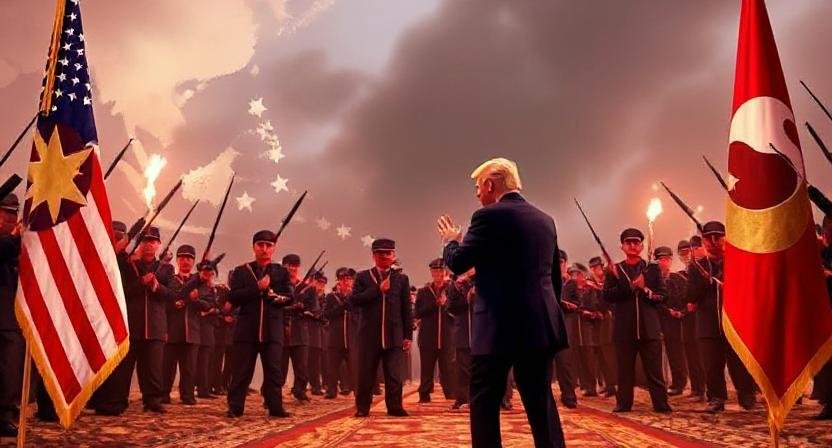
- Trump’s direct intervention via calls to Thai and Cambodian leaders halted a four-day border conflict that had killed 33 people.
- Ceasefire deal was influenced by Trump’s threat of a 36% reciprocal tariff if hostilities didn’t stop immediately.
- Cambodian Prime Minister Hun Manet agreed to an “immediate and unconditional” ceasefire after Trump’s call.
- U.S. Secretary of State Marco Rubio will now coordinate with both sides for a long-term peace deal, backed by trade incentives.
In a dramatic turn of events that stunned the diplomatic world, former U.S. President Donald Trump has successfully brokered a ceasefire between Thailand and Cambodia, averting what could have escalated into a devastating war between the Southeast Asian neighbors.
Known for his self-styled mission to end “forever wars,” Trump once again deployed the charisma and forceful personality that defined his presidency—this time to stop a bloody four-day border conflict that had already claimed 33 lives and displaced hundreds. With mortar shells shaking villages and both armies entrenched near sacred temples claimed by both countries, the region teetered on the brink of a broader confrontation—until Trump picked up the phone.
“Both Parties are looking for an immediate Ceasefire and Peace,” Trump posted on his social media platform. “They are also looking to get back to the ‘Trading Table’ with the United States, which we think is inappropriate to do until such time as the fighting STOPS.”
His intervention came with a twist of economic pressure. Trump made it clear: unless the shooting stopped, his administration would proceed with imposing 36% reciprocal tariffs on both Cambodia and Thailand—tariffs that would have crippled their economies and hurt their ambitions to expand trade ties with Washington.
Thailand Defends Its Sovereignty Amid Cambodian Aggression and Diplomatic Breakdown
Following calls with Trump, both nations released coordinated statements confirming they were open to immediate talks and agreed in principle to halt the hostilities that erupted along a disputed stretch of their 500-mile border.
The skirmishes, sparked by competing claims over two ancient Hindu temples—Preah Vihear and Ta Moan Thom—had quickly spiraled beyond local military patrols. Civilians were among the majority of those killed, with many more injured and thousands forced to flee as artillery exchanges lit up the night sky near Si Sa Ket in Thailand and Oddar Meanchey in Cambodia.
READ MORE: Thailand and Cambodia Consider Cease-Fire After Calls With Trump on Border Clashes
Thailand’s Foreign Ministry confirmed that Trump spoke with acting Prime Minister Phumtham Wechayachai. “However, Thailand would like to see sincere intention from the Cambodian side,” a statement read, while reiterating the need for bilateral engagement.
Cambodia, for its part, signaled immediate compliance. Prime Minister Hun Manet, who took over from his father Hun Sen in 2023, issued a statement following the call: “In my conversation with President Trump, I agreed to an immediate and unconditional cease-fire.” He added that Cambodia’s Foreign Minister will coordinate closely with U.S. Secretary of State Marco Rubio to finalize a peace mechanism.
ALSO READ:Europe and China Warm Up as Trump’s Tariffs Redraw Global Trade Lines
Political observers note that the timing of the clash was not accidental. Tensions have mounted between the long-dominant political dynasties of both countries—the Shinawatras in Thailand and the Huns in Cambodia. The personal ties that once underpinned regional stability have frayed, and recent nationalist rhetoric further stoked passions on both sides.
Still, Trump’s intervention has momentarily cut through years of mistrust. Analysts say the former president’s mix of threat and reward—punitive tariffs paired with a promise of economic engagement—was critical in halting the conflict.
“Say what you will about Trump, but the man knows how to use leverage,” said Dr. Somchai Virawong, a Southeast Asia specialist at Chulalongkorn University. “No one in ASEAN expected the U.S. to move this fast or this directly. Trump is unconventional, but he got results.”
The White House has yet to formally comment on whether Trump’s actions constitute an official foreign policy effort or fall under his unofficial diplomacy channel. Nevertheless, many Southeast Asian observers are now calling this a classic “Trump doctrine” moment—favoring direct negotiation, personal diplomacy, and economic pressure over multilateral wrangling.
With the ceasefire now holding as of Sunday night, focus has shifted to formal negotiations. Both countries are expected to send envoys to Washington within days, with a framework for demarcating disputed zones under review. Trump hinted at hosting future rounds of talks himself—possibly at Mar-a-Lago or the Trump International Hotel in Washington.
For now, the region breathes a sigh of relief.