


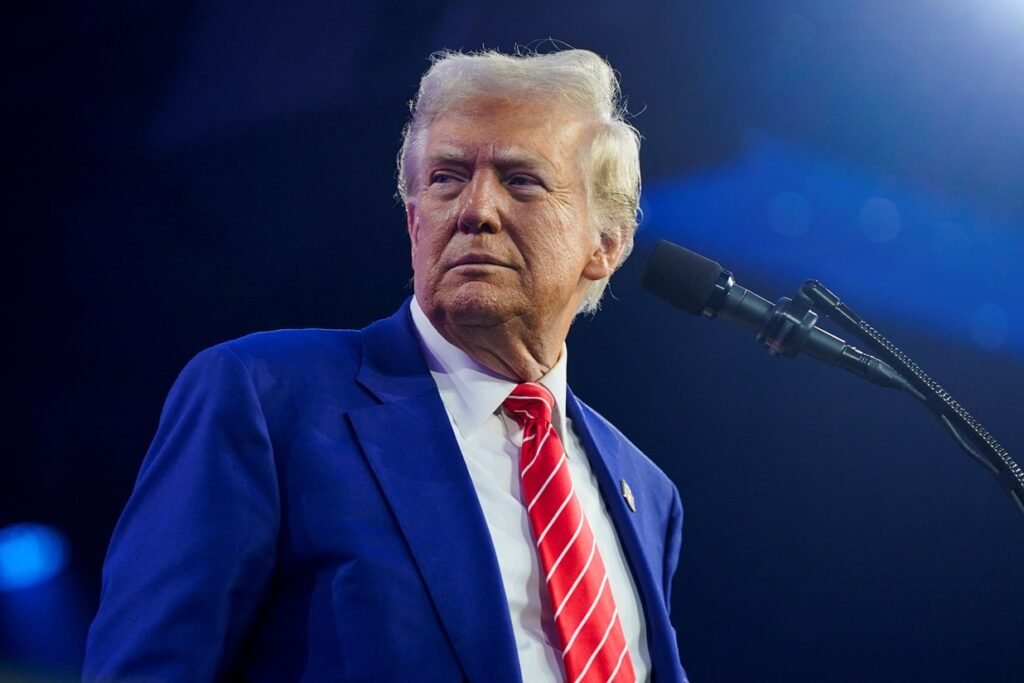
- Trump Goes Nuclear: ordered the Pentagon to resume nuclear weapons testing “on an equal basis” with Russia and China — first such directive since 1992.
- Announcement follows Russia’s Burevestnik and Poseidon weapons tests and China’s rapid nuclear buildup.
- Experts warn resuming testing could spark a global nuclear arms race and collapse decades of arms control.
- White House offers no details, but Trump says testing will begin “immediately” at existing sites.
President Donald Trump stunned the world Thursday morning when he announced that he had directed the Pentagon to “begin testing nuclear weapons on an equal basis with Russia and China.” The declaration, posted on his Truth Social account as Marine One flew him to Gimhae Air Base in South Korea for talks with Chinese President Xi Jinping, marks a decisive break from more than three decades of U.S. policy prohibiting nuclear explosions.
The United States last conducted a nuclear test in 1992, under President George H.W. Bush, who later declared a moratorium on such testing after the Cold War ended. Since then, Washington has relied on advanced computer simulations to maintain its nuclear stockpile — not detonations.
Trump’s announcement, made without prior notice to allies or lawmakers, immediately sparked anxiety among arms control experts and foreign governments.
“The United States has no technical, military, or political reason to resume nuclear explosive testing,” said Daryl Kimball, executive director of the Arms Control Association. “This decision could undo decades of non-proliferation progress and invite others to follow.”
Trump Goes Nuclear: What Prompted the Move
Trump’s decision appears to have been driven by two parallel developments: Russia’s high-profile testing of nuclear-capable delivery systems and China’s rapid expansion of its nuclear arsenal.
READ MORE: Trump directs Pentagon to test nuclear weapons for first time since 1992
Earlier this month, Moscow claimed it successfully tested two strategic nuclear delivery systems — the Burevestnik nuclear-powered cruise missile and the Poseidon nuclear-capable underwater drone. While these tests did not involve nuclear detonations, they highlighted Russia’s growing technological edge in exotic weapons.
“If anyone deviates from the moratorium, Russia will act accordingly,” Kremlin spokesman Dmitry Peskov warned Thursday, emphasizing that Moscow’s recent tests “were not nuclear explosions.”
Trump, however, sees Russia’s and China’s modernization as a direct challenge to U.S. strategic dominance. In his post, he said the order was “a response to other countries’ testing programs” and that the process to begin U.S. tests “will start immediately.”
ALSO READ: Trump’s Oil Sanctions Strike Deep: China’s Sudden Pullback from Russian Crude Signals a Major Shift
A senior White House official later told reporters that Trump “felt it was necessary to demonstrate U.S. capability and resolve.”
“Other nations are not playing by the same rules,” the official said. “President Trump wants to make sure the United States is not left behind.”
Timing and Strategy
The timing of the announcement — just hours before Trump’s summit with Xi — was striking. Trump described his meeting with Xi as “amazing,” noting that the two leaders had agreed on a one-year trade deal after months of tariff tensions. Yet he declined to say whether the nuclear testing issue was raised during their discussions.
“It’ll be announced,” Trump told reporters on Air Force One when asked for details. “We have test sites. It’ll be announced.”
Analysts say the decision is part of Trump’s larger strategy to project power ahead of sensitive negotiations with Beijing, which U.S. intelligence agencies say is undergoing “one of the most rapid nuclear expansions in modern history.” The Pentagon estimates that China will have over 1,000 nuclear warheads by 2030, compared with roughly 3,700 for the United States and 4,300 for Russia.
Trump claimed Thursday that while the U.S. still holds the world’s “largest and most powerful” nuclear stockpile, “China will be even within five years” if unchecked.
Could This Trigger a New Arms Race?
The announcement has raised fears of a renewed global nuclear arms race reminiscent of the Cold War. Experts warn that if Washington proceeds, Moscow and Beijing will almost certainly follow suit, undermining decades of non-proliferation efforts.
“If the United States indeed begins developing similar nuclear delivery technologies, there is a significant chance that Beijing would follow suit,” said Tong Zhao, a senior fellow at the Carnegie Endowment for International Peace. “Continued Russian progress and parallel U.S. development could further incentivize China to accelerate its own research programs to avoid being left behind.”
Chinese officials reacted cautiously but firmly. Foreign Ministry spokesman Guo Jiakun urged the United States “to abide by its obligations under the Comprehensive Nuclear-Test-Ban Treaty (CTBT)” and “to uphold the international disarmament and non-proliferation regime.”
While the United States signed the CTBT in 1996, it never ratified it, meaning it is not legally bound by its provisions — though all U.S. administrations since Bill Clinton have honored the testing moratorium.
Logistical and Political Challenges
Despite Trump’s declaration, experts note that resuming testing would be technically complex and politically fraught. The National Nuclear Security Administration (NNSA), which oversees the nuclear test program, has not conducted a full-scale explosion in more than 30 years. Restarting testing at the Nevada site could take up to 36 months, according to officials.
Moreover, Trump’s move risks alienating allies and undermining his recent attempts to brand himself as a “peace president” pursuing global stability and even a Nobel Peace Prize nomination.
“This is a risky gamble,” said one former State Department official. “It projects strength, yes, but it also opens Pandora’s box. If the U.S. detonates, Russia and China might respond in kind, and North Korea will almost certainly justify its next test.”
The Broader Picture: Nuclear Diplomacy at a Crossroads
For now, Trump insists that his ultimate goal remains global de-escalation.
“I think denuclearization would be a tremendous thing,” he said. “We are actually talking to Russia about that, and China would be added to that if we do something.”
Still, Thursday’s announcement signals a seismic shift in how Washington views nuclear deterrence — from restraint to demonstration.
If implemented, the order could mark the first U.S. nuclear test in more than three decades, reshaping the global nuclear landscape and eroding one of the last remaining norms of post–Cold War diplomacy.
As the world braces for the Pentagon’s next move, one question looms large: Is Trump reigniting an arms race — or merely preparing for one that has already begun?