


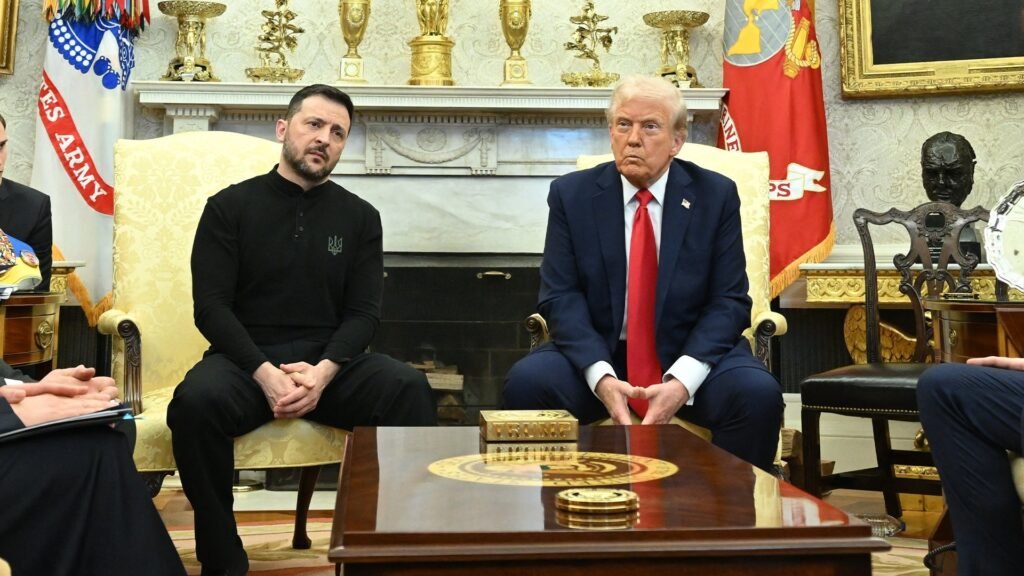
- Donald Trump vows he is determined to secure peace between Russia and Ukraine.
- In a bold move, Trump presented Zelensky with a new map showing a 20% smaller Ukraine.
- The U.S. President claims to be in direct talks with both Vladimir Putin and Volodymyr Zelensky.
- Trump insists “something is going to happen,” raising hopes and fears about a possible settlement.
It was the kind of revelation that can alter the course of history. In the middle of an otherwise routine telephone interview with an American television network, President Donald Trump dropped a bombshell: he has a plan to bring peace between Russia and Ukraine, and he is determined to see it through.
Trump, a man known for dramatic flair and bold pronouncements, hinted at backchannel conversations that could change the fate of Europe. “Something is going to happen,” he said, in that familiar tone of confidence that often divides opinion but never fails to command attention.
The suspense he injected was not mere rhetoric. Trump revealed that he had handed Ukrainian President Volodymyr Zelensky a new, smaller map of Ukraine — a vision in which the war-torn nation is reduced by nearly 20% of its pre-war territory. The proposal, though unconfirmed in its details, carries staggering implications.
A War of Numbers
The Russia-Ukraine war, now in its third year, has drained lives and resources on a colossal scale. The United Nations estimates over 10 million Ukrainians displaced, while casualty figures — though disputed — run into the hundreds of thousands when both military and civilian deaths are accounted for.
Economically, the toll is even more sobering. Ukraine’s GDP contracted by nearly 30% in 2022, and rebuilding the country is projected to cost upwards of $411 billion, according to the World Bank. Russia, meanwhile, has weathered severe Western sanctions but continues to pour billions monthly into sustaining its military campaign.
Against this backdrop of human and economic devastation, Trump’s gambit is as provocative as it is daring.
A Map that Changes the Game
Maps have always been the silent weapons of geopolitics. With a stroke of a pen, borders are drawn, empires expand, and nations vanish. Trump’s decision to hand Zelensky a “new map” — one in which Ukraine is 20% smaller — is both symbolic and strategic.
That 20% roughly equates to territories already under Russian occupation or claim, including Crimea, annexed in 2014, and large parts of Donetsk and Luhansk. In essence, Trump appears to be acknowledging the reality on the ground: that Moscow’s grip on these regions may never be loosened by force.
It is a bitter pill for Ukraine, which has fought with unyielding courage to preserve its sovereignty. But to Trump, the map represents not surrender but survival. “We will make it happen,” he insists, suggesting that concessions today could end bloodshed tomorrow.
Talking to Both Sides
The most intriguing element of Trump’s peace push is his claim that he has been speaking directly with both Vladimir Putin and Volodymyr Zelensky. The Kremlin has long dismissed Ukraine’s Western backers as war-mongers, while Kyiv has repeatedly stressed it will not negotiate without firm guarantees.
By inserting himself into the equation, Trump is reviving an old role: the dealmaker. His confidence is characteristic. “Putin and Zelensky are not ready for direct negotiations yet,” he admitted. “But we will make it happen.”
This assertion raises questions. Can Trump succeed where seasoned diplomats, NATO leaders, and international mediators have failed? Or is this yet another chapter in the Trumpian playbook — bold promises without clear outcomes?
Allies, Rivals, and the Global Stakes
Peace in Ukraine is not just about Kyiv and Moscow. It is about NATO’s credibility, the European Union’s unity, and the balance of power in the global order.
Europe has funneled tens of billions of dollars in military and financial aid to Ukraine, while the United States has spent over $175 billion since the war began. The war has disrupted food supplies, triggered energy crises, and rattled global markets.
A Trump-brokered peace could mean enormous savings for Western taxpayers. But it could also mean legitimizing Russia’s territorial claims, a move critics argue would embolden Moscow and destabilize the security framework of Europe.
Trump’s Calculated Drama
Yet Trump thrives on the optics of high-stakes negotiations. By introducing a map, he has staged the drama: the audience knows the stakes, the players, and the risks. All that remains is the climax.
For his supporters, this is classic Trump — cutting through the fog of endless diplomacy with a simple, if controversial, proposal. For his detractors, it is reckless, undermining international law and rewarding aggression.
Either way, the suspense is real. Can Trump truly drag Putin and Zelensky to the same table? Or is this another headline destined to fade into the noise of a brutal, unending war?
The Road Ahead
The Ukraine conflict has already lasted longer than many predicted, outpacing the Soviet invasion of Afghanistan in terms of Western involvement and stretching alliances to their limits. As winter approaches again in Eastern Europe, millions of Ukrainians face blackouts, shortages, and displacement.
In such a landscape, even an imperfect peace may seem better than endless war. If Trump’s vision of a smaller Ukraine becomes the starting point for negotiations, history may judge it as pragmatic realism — or as a betrayal of a nation’s sovereignty.
For now, Trump has set the stage. A man with a map, two leaders reluctant to meet, and a world waiting with bated breath. Something, as he says, is going to happen. But whether it is peace, partition, or political theater remains to be seen.